Pilates balls are a small tool that can have a large impact.
They tend to be around nine inches in diameter—the size of a soccer ball—and are soft and malleable.
They also happen to be the favourite piece of equipment of veteran Pilates instructor and Balanced Body educator, Portia Page.
“This deceptively simple piece of equipment is versatile as a modifier, prop or to add challenge,” she tells Fit&Well.
Page, whose Pilates ball of choice is the nine-inch TOGU ball from Balanced Body, explains why Pilates balls work differently to the large inflatable exercise balls often found in gyms.
“Unlike the traditional exercise ball, the TOGU ball is small, lightweight and unstable—yet able to provide some support.
“That instability is exactly what makes it so effective. It helps awaken deep stabilizing muscles while providing support where many people need it most.”
She adds that she favours the TOGU ball specifically because “while standard generic Pilates balls are made of soft, moldable PVC, TOGU balls use a proprietary, latex-free Ruton material, which gives them a softer, tackier and more durable feel.”
Page likes to use the ball to help clients improve their proprioception (your awareness of your body’s position), support their spine and torso during challenging exercises, and to encourage better posture and alignment.
“It is also great to reduce unnecessary tension in the neck, shoulders and hip flexors during certain exercises, plus challenge balance and stability in a safe, progressive way,” she explains.
“In Pilates, we’re always looking for ways to improve awareness and create balanced muscle development, and the TOGU ball provides immediate feedback, helping you find better alignment and connect to the deep stabilizing muscles that support efficient movement.”
The following three exercises are Page’s top choices for how to use your nine-inch Pilates ball. She recommends inflating it to three-quarters full for these movements.
1. Double leg stretch with extension
Why Page recommends it: “This is one of my favorite ways to teach any abdominal exercise because the ball supports thoracic alignment,” says Page.
“You can add thoracic extension while reducing the tendency to grip through the neck and shoulders.
“Many people overuse their hip flexors instead of their abdominal muscles,” adds Page.
“Using the TOGU Ball to support the torso brings the chest up to recruit your abdominal muscles.
“The ball creates feedback for thoracic mobility while helping clients discover true abdominal support. Many notice less neck tension and better core engagement.”
How to do it:
Sets: 4-6 Reps: 4-6 each side Rest: 20-30sec
- Place the TOGU Ball beneath your upper back, toward the base of your shoulder blades.
- Lie back over the ball and bring your knees and elbows to meet over your torso, with your knees bent and your hands either side of your head—this is your starting position.
- Extend your legs so they are at a 45° angle to the floor as you lean back and extend your arms behind you.
- Reverse the movements to return to the starting position.
Targets: Rectus abdominis, transverse abdominis, internal and external obliques and deep spinal stabilizers.
2. Swan with rotation in extension and flexion
Why Page recommends it: “Swan develops the often-neglected posterior chain and promotes healthy spinal extension, which balances all the flexion-heavy activities we do throughout the day and helps with posture and alignment,” says Page.
“The TOGU ball provides excellent feedback for challenging and assisting spinal extension. The instability of the ball helps you to find rotation and spinal mobility.”
How to do it:
Sets: 2 Reps: 5-8 Rest: 20-30sec
- Place the TOGU ball beneath your breastbone and lie on your front with your legs extended.
- Bend your elbows and place your fingertips on your forehead or behind your head.
- Gently engage your abdominal muscles to support your spine and lower back. Flex your upper body over the ball. Your chin may touch or rest on the ball if needed.
- Press lightly into the ball as you lengthen your spine from the crown of your head. Lift your head, chest and upper spine into extension, but focus on length before height.
- Rotate to the right, back to the center, then rotate to the left, then back to the center again.
- Lower with control back to the starting position.
Targets: erector spinae, multifidus, gluteals, mid and lower trapezius and posterior shoulder stabilizers
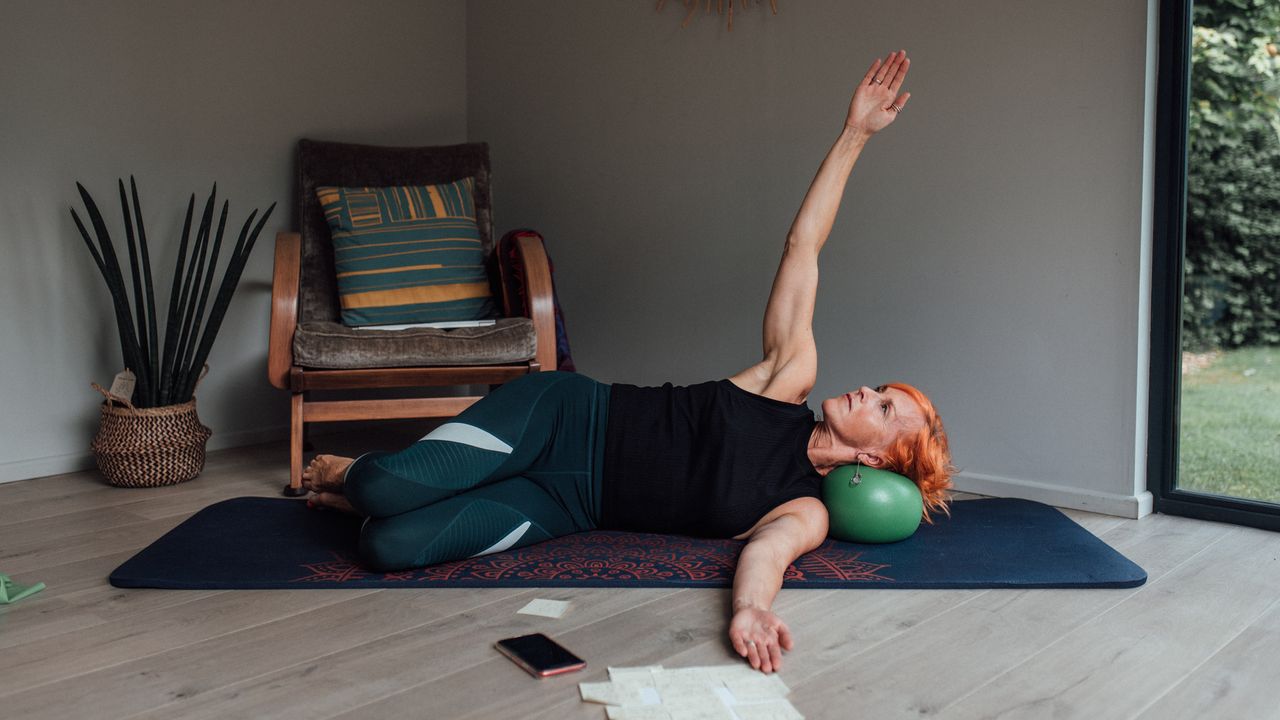
3. Side-lying lateral flexion to side hip lift
Why Page recommends it: “Most people spend very little time training lateral stability and side-body strength,” says Page.
“This series improves balance, pelvic control and movement efficiency while helping clients feel muscles they often don't realize they have.
“The TOGU ball offers support beneath the side body, making lateral flexion more accessible in a larger range of motion and challenges balance by providing an unstable surface.”
How to do it:
Sets: 2 Reps: 6-8 each side Rest: 20-30sec
- Lie on your left side with the TOGU ball under your ribcage, with your arms extended past your head.
- Bend your left knee to 90° and bring your left knee forward so there is a 90° bend at your hip.
- Bend your right knee to 90°, moving your lower leg behind you—this is your starting position.
- Raise your right arm, right leg and head, moving your right arm to towards your right leg, lightly tapping your right knee with the back of your right hand.
- Reverse the movement to return to the starting position.
Targets: obliques, quadratus lumborum, gluteals, hip abductors and deep core stabilizers.