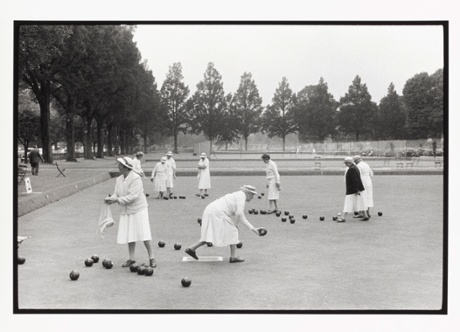
When Queen magazine invited American photographer Bruce Davidson to visit the UK in 1960, it was for a series called Seeing Ourselves as an American Sees Us: A Picture Essay on Britain. Though Davidson had lived in the UK during the second world war, the magazine were hoping for an outsider’s view of a culture on the cusp of social revolution.
Known for his gritty reportage in Life magazine, Davidson was living in New York and had just finished one of his most memorable shoots, Brooklyn Gang, a series based around the Jokers, greasers with DA’s, tattoos and dangling cigarettes. Esquire wanted to publish some of them with Norman Mailer writing the text, but that required signed model release forms – so Davidson gave $200 to a gang leader named Bobby Powers. “I doubt anybody ever saw that money,” he says, “or he was really good at forging names cause obviously parents wouldn’t want you to have your picture taken in the context of a gangster.” Either way, Davidson started getting threatening phone calls and, at the advice of Magnum’s Cornell Capa, took the Queen assignment.
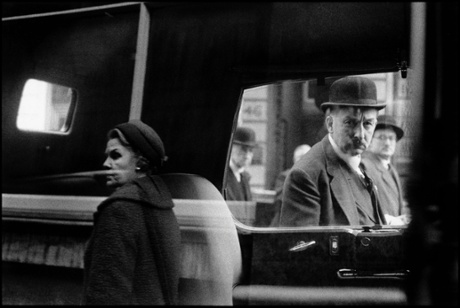
Early in the trip, he was introduced to a gamekeeper who allowed him to photograph the hounds and the caretakers at country estates. “It all had a kind of mood, I think … the fact that this was a last remnant of an England that was vanishing into other things like the Beatles or modernisation of some kind,” Davidson says. “I captured a moment that was authentic and true to my observation.”
Six years later, his fellow American photographer Paul Caponigro found himself headed across the Atlantic on a Guggenheim fellowship. Anxious to get out of New York City, where he was teaching and studying Gurdjieffian dance on a path to spiritual awakening, he relocated to Dublin with his wife and small child. “I had a full year working in Ireland, and it was wonderful just being there, learning, feeling and trying to find enough images that might reflect what I was feeling,” says Caponigro, whose pictures have the natural splendour associated with artists like Ansel Adams and Minor White.
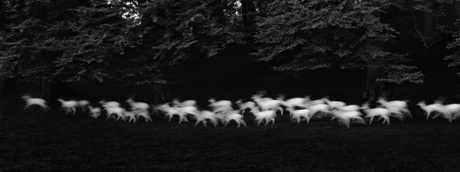
His most famous photo, Running White Deer, was taken in County Wicklow, where a herd of the ghostly creatures ran free. He asked the keeper to loose his dog to try to stir them up, and the herd took off like a bolt across the bottom of his frame, their spectral white bodies blurred by motion, starkly contrasting with the shady forest behind them.
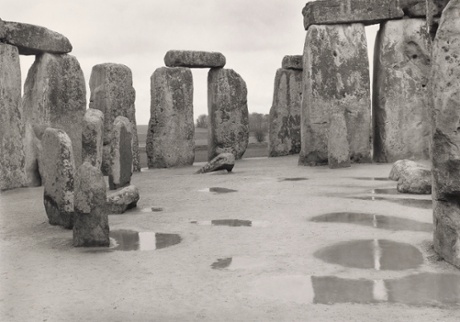
A landscape photographer rooted in the West Coast school, Caponigro made Stonehenge his muse, shooting there as well as locations in Scotland and Ireland. “I like people just fine, I just don’t like them standing in front of my camera,” curator Jennifer Watt overheard him tell an admirer at the opening of her new show, which brings together the two photographers.
Though they never met at the time, both shot extensively in Wales. Where Caponigro’s pictures feature misty gray hills and textured dolmens, Davidson focused on the miners and their families. Davidson, who had photographed the Freedom Riders for the New York Times, said the grit and resiliency of those civil rights activists, who rode into the south to challenge the states still illegally running segregated bus services, had reminded him of Britons during the war. That grit characterises his photos of the miners. By now Davidson was stage-directing his subjects, and the candid fun of London and Brighton Beach in 1960 gives way to drudgery, poverty and children playing among gravestones.
On assignment two years later, Davidson went briefly to Ireland to photograph Duffy’s circus. If the early shots of London are reminiscent of his mentor, Cartier-Bresson, and Robert Frank (whose book, The Americans, was widely influential), this last trip with its dwarf clowns and acrobats is inspired by the outsiders of the works of Davidson’s friend, Diane Arbus. Caponigro continued to photograph the Britain and Ireland for decades to come, shooting countless rolls of black and white at Stonehenge alone. “There’s a force in the land, and it’s intelligent,” he’s been known to say. “You don’t recognize it immediately. You go in and you feel around and you try to experience what’s going on. It’s not an overnight thing.”
“Paul photographed over a period of years the poetry and meaning of those rocks and stones. And my rocks and stones are the streets, sidewalks of New York,” says Davidson. “His entity was stone, and my entity was sidewalk.”
- Bruce Davidson/Paul Caponigro: Two American Photographers in Britain and Ireland, at the Huntington in San Marino, near Los Angeles, which runs until 9 March.