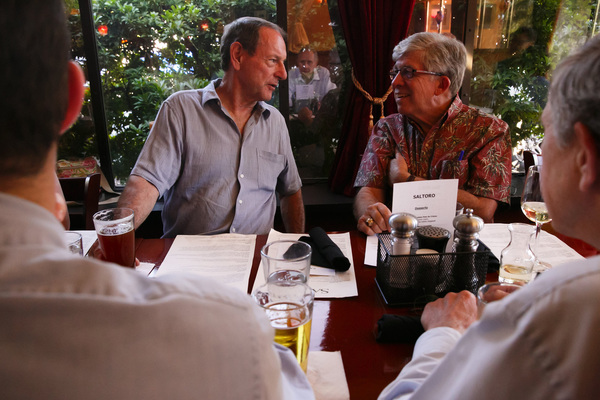
SEATTLE _ Ray Cassingham didn't know a single person at the table when he first sat down. Not a one.
But before the server at Saltoro in North Seattle had even brought water, Cassingham was talking about a medical procedure that involved his being naked from the waist down _ and a balloon.
Welcome to The Prostate Club, a monthly gathering of prostate-cancer patients from the Seattle Cancer Care Alliance's (SCCA) Proton Therapy Center.
The center opened in North Seattle three years ago and is one of only two such treatment facilities on the West Coast. (The other is in Loma Linda, Calif., more than 1,000 miles away, where the proton therapy was pioneered.)
With proton therapy, radiation goes in at a low dose. Once it hits the tumor, the energy spikes and immediately drops off. Patients undergo 44 daily procedures, which means many move to the area for nine weeks of treatment without knowing anyone.
"When you first talk to them, they're at wits end and dying to get some answers," said Brian Kuest, the prostate intake coordinator who guides patients through the treatment process. "They don't know who else to talk to.
"So this group is a relief."
Prostate cancer is the most common cancer in American men, with more than 180,000 new cases and 26,000 deaths per year, according to the American Cancer Society. Six in 10 cases are diagnosed in men aged 65 and over.
SCCA's Proton Treatment Center also cares for people with brain tumors and ocular melanoma, but the prostate patients go through certain uncomfortable preparations. They have to have full bladders, and balloons are inserted and inflated in their rectums _ all to isolate the prostate and prevent radiation damage to surrounding organs.
That's why they refer to themselves as "The Brotherhood of the Balloon," or "BoB."
It's also why, when a waiter preparing their checks asked, "Does anyone have to go?" the table burst into laughter.
"We always have to go," said David Marquardt, 69, a retired Army Corps of Engineers architect who was celebrating the completion of treatment.
He and his wife, Mary, came to Seattle from their home in Gig Harbor every week for nine weeks, returning home on the weekends.
Marquardt would have his one daily round of proton treatments each morning, then the couple would explore the area's museums and restaurants. They put together a tour guide for other patients to refer to while they're undergoing treatment.
"It's nice to be in a situation where you can talk to someone going through the same thing," he said. "Sometimes we commiserate, sometimes we laugh. But we always drink a lot of water."
Just a few weeks into his treatment, Cassingham, 69, of Sumner, had already picked up some of the proton-treatment lingo.
"We call it going to the barbecue," he said, then paused with comedic relish. "We get roasted every day. But they never had a beer garden after."
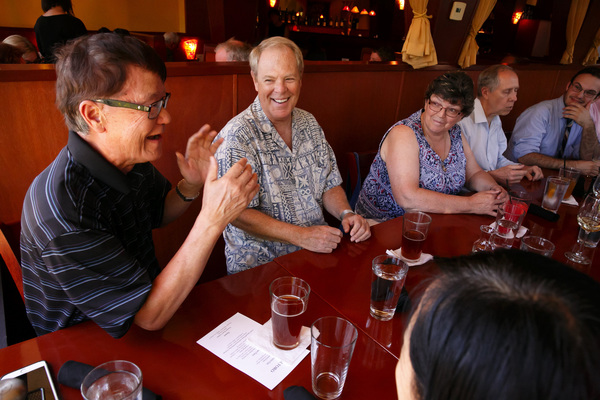
"Oh, they did when Rob and I were there," Marquardt cracked.
And so it went.
Valerie Cassingham, 65, turned to me and shrugged: "You might as well have fun."
It's striking how candid everyone is. Aren't men typically quiet about medical procedures, their vulnerabilities and fears about illness, especially when it strikes this particular part of their bodies?
Not here.
"Guys don't know how to talk about this stuff," Kuest said. "Once the ball started rolling and people realized there were people they could talk to, it just grew and grew."
The dinners started as a "dine around" program; the center sent patients to different restaurants in the area.
"Patients get bored when they're here that long," Kuest said. "They're looking for connections with other people."
Soon, though, the restaurant didn't really matter. The patients just wanted to be together to share what they've been through. Now, they need a bigger room every month.
The group is so connected that many who have completed treatment return every month to celebrate what they call the "extra time" they might have lost to cancer.
Some of them go on vacation together.
"Men have trouble making friends, especially ones they can relate to," Kuest said. "And this is a huge common denominator.
"In the beginning, they don't want their friends to know," Kuest said. "Once you get them to talk, they're more open with everyone.
"And by the end, they're with this group saying, 'I'm a survivor. I'm proud.'"
Robert Bangs, 65, of Lake Forest Park, started coming to the dinners in April, when he first started treatment. He finished July 7 and has been to two dinners since.
"I'm celebrating my graduation," he said. "The diagnosis of cancer is rather emotional. It's a big deal.
"This is a unique way of dealing with it," he said. "We're kindred spirits."