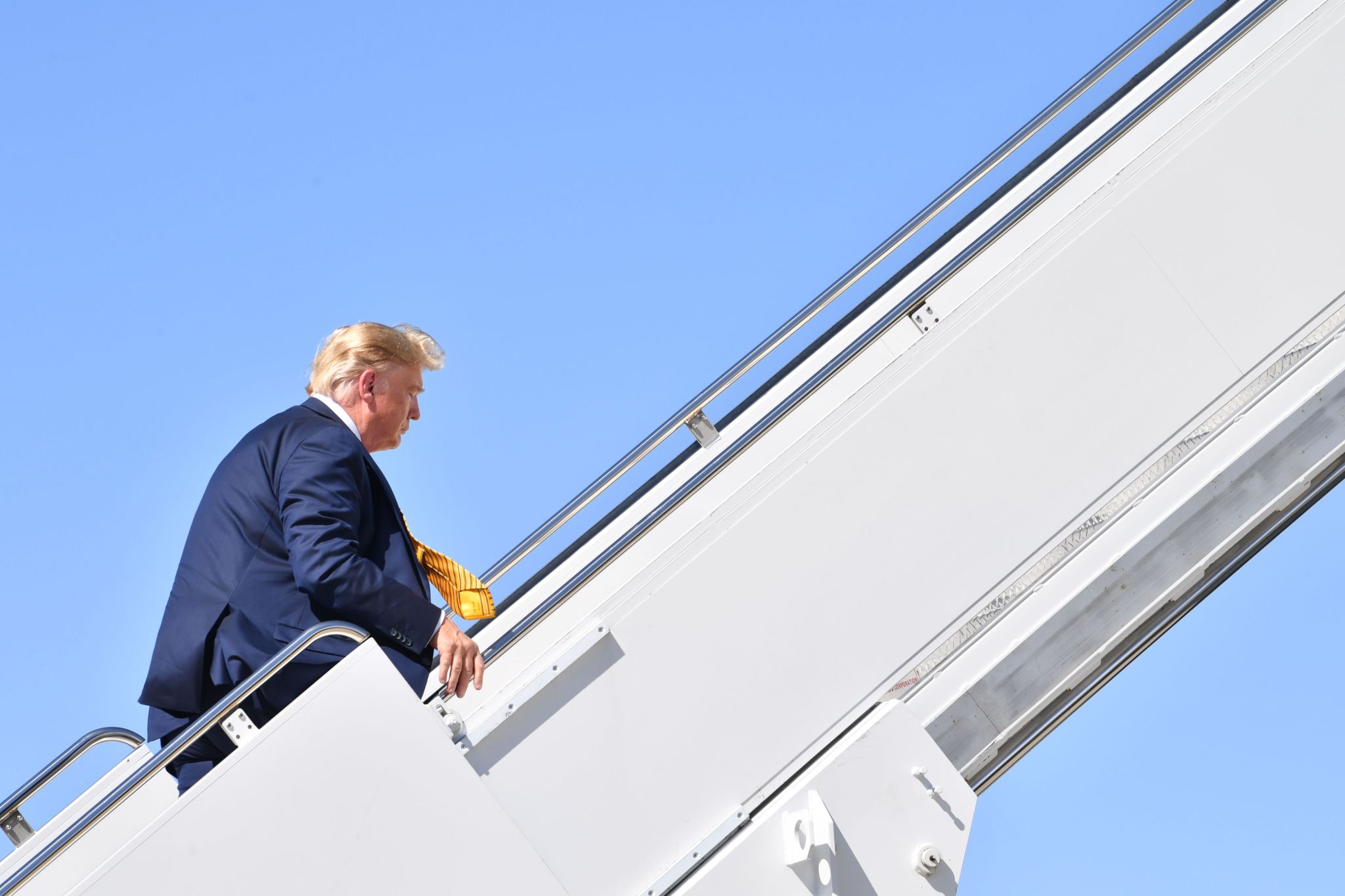
US President Donald Trump boards Air Force one as he departs from Mountain View, California on September 17, 2019. (Credit: NICHOLAS KAMM/AFP/Getty Images)Good morning from Hong Kong.
When it comes to Donald Trump’s China policy, there is, as journalist Thomas Friedman puts it, a “method to his madness” but also “madness to his method.” Trump was right to single out China a challenge facing the U.S., and he showed more courage than his predecessors in confronting China on policies that violate global norms. But his tariffs and tariff threats have, in many cases, been counterproductive, inflicting as much pain on the U.S. as on China.
So what would a more sane U.S. policy look like? Well, first of all, it would include offense, as well as defense. That’s the message of a new report out this morning from a group assembled by the Council on Foreign Relations, entitled Innovation and National Security. The group was chaired by retired Admiral William McRaven and McKinsey’s James Manyika, and included ex-Google
Restore federal R&D to its historical average—$80 billion more than it is today.
Take a “moon shot” approach to key challenges: AI and data science, battery storage, 5G, synthetic biology, etc.
Target debt forgiveness for students in key technology disciplines.
“Staple a green card” to the degrees of overseas students in key technology disciplines.
The report also suggests some selective defense measures, including a targeted effort to stop the theft of scientific knowledge from U.S. universities. And it calls for new international alliances to set global standards for the monitor and control of emerging technologies.