
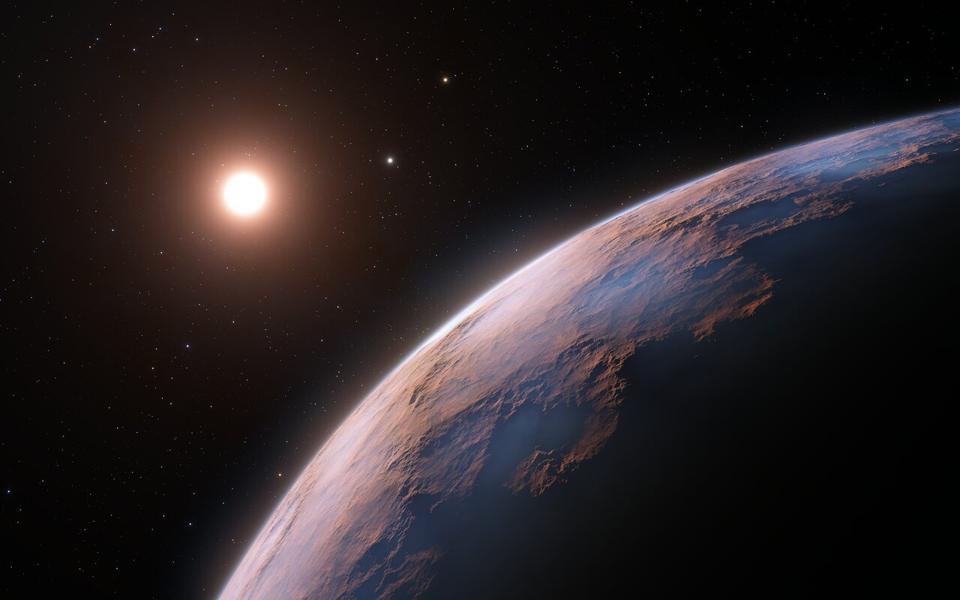
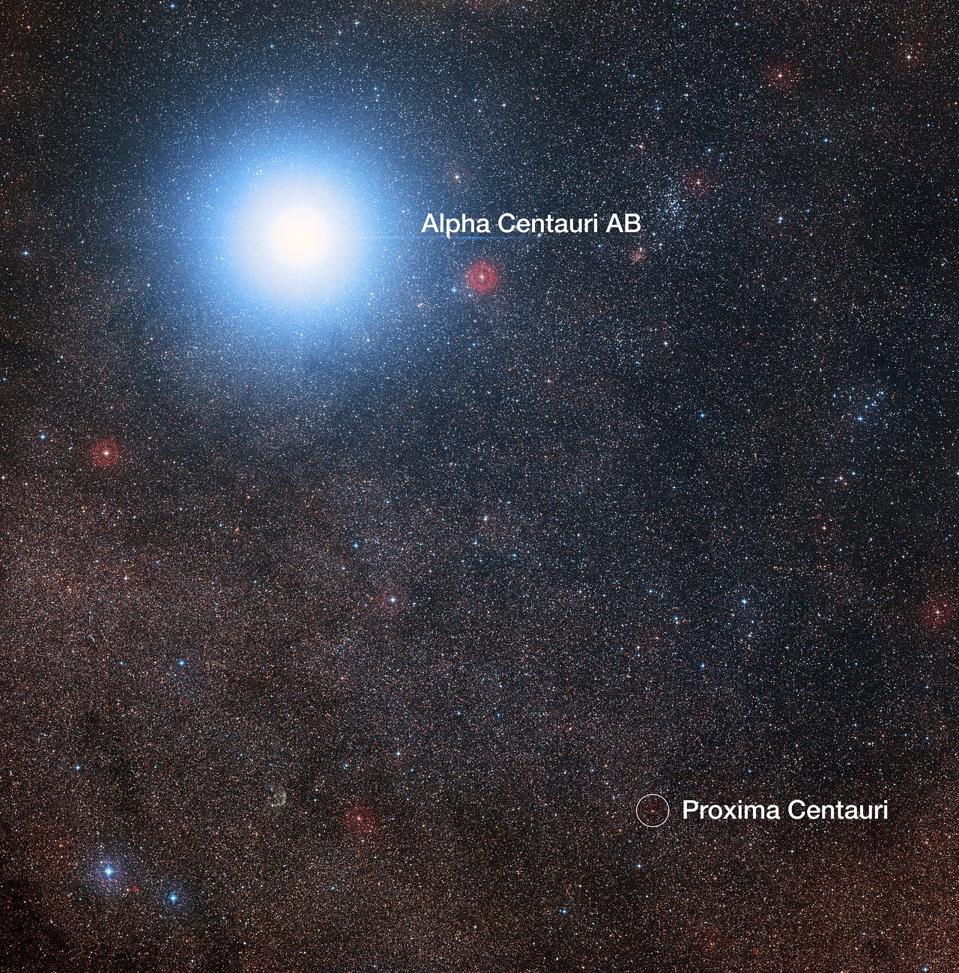
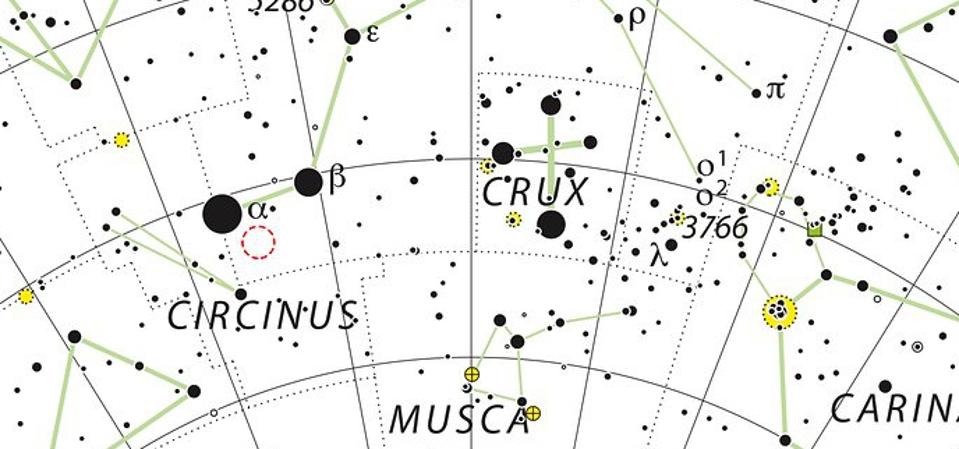
Astronomers have found another planet is the next star system along. Called “Proxima d,” it’s the third planet found orbiting Proxima Centauri, a red dwarf star just 4.24 light-years from the Sun.
Although Proxima d is closer to its star than Mercury is to the Sun—so unlikely to host liquid water—its status as the lightest exoplanet ever discovered gives astronomers hope of more easily find Earth-like planets.
Low mass planets such as Proxima d are expected to be the most abundant in our galaxy and could potentially host life as we know it.
Just a quarter of the mass of Earth, Proxima d orbits Proxima Centauri from 2.4 million miles/four million kilometres and completes an orbit in just five days.
It was found by a team of astronomers using the Echelle SPectrograph for Rocky Exoplanets and Stable Spectroscopic Observations (ESPRESSO) instrument on the European Southern Observatory’s Very Large Telescope (ESO’s VLT) in the Atacama Desert, Chile.
It took over two years of observations to find Proxima d.
“Our closest stellar neighbour seems to be packed with interesting new worlds, within reach of further study and future exploration,” said João Faria, a researcher at the Instituto de Astrofísica e Ciências do Espaço, Portugal and lead author of the study published in Astronomy & Astrophysics.
Proxima d was found using the radial velocity of the host star. A star wobbles if there are planets in orbit because they all orbit a common center of mass away from the star’s center of mass.
“This achievement is extremely important,” said Pedro Figueira, ESPRESSO instrument scientist at ESO in Chile. “It shows that the radial velocity technique has the potential to unveil a population of light planets.”
The vast majority of exoplanets found so far are “super-Earths,” “mini-Neptunes” and “hot Jupiters,” none of which are Earth-like or likely to host life.
“This result clearly shows what ESPRESSO is capable of and makes me wonder about what it will be able to find in the future,” said Faria.
Astronomers already know about two other planets around Proxima Centauri:
- Proxima b, an Earth-mass planet that orbits the star every 11 days and is within the habitable zone.
- Proxima c, a yet-to-be-confirmed planet that takes over five years to orbit the star. A “super-Earth” or “mini-Neptune,” it lies outside the habitable zone.
“After obtaining new observations, we were able to confirm this signal as a new planet candidate,” said Faria. “I was excited by the challenge of detecting such a small signal and, by doing so, discovering an exoplanet so close to Earth.”
Wishing you clear skies and wide eyes.