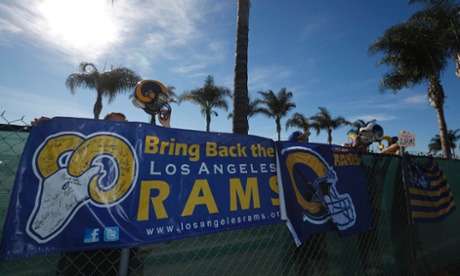
When news broke on Monday that the St Louis Rams owner, Stan Kroenke, is planning to build a football stadium in Inglewood, greasing the skids for the NFL’s return to Los Angeles as early as 2016, you could forgive longtime observers for reacting with all the surprise of a pass play on third and long.
The threat of relocation to coerce a city into a new stadium or other financial favors is one of the most timeworn tactics in the NFL owners’ playbook. And in the two decades since the Rams and Raiders left Los Angeles inexplicably without a pro football team, a parade of owners have floated the prospect of a move to the greener financial pastures of America’s second-largest market as a means of leveraging sparkling new venues (or upgrades) from their current home cities.
Yet there’s reason to believe Kroenke’s gambit is more than just a ploy to spur St Louis into putting its best offer forward, beginning with improvements to the 19-year-old Edward Jones Dome as mandated by the breathtakingly short-sighted “state of the art” clause the city agreed to years ago.
None of the previous owners who floated an LA move went as far as to purchase enough land for both a stadium and parking. None moved forward with plans as ambitious as the vast sports-entertainment complex unveiled Monday outside Inglewood City Hall, let alone demonstrated interest in constructing the stadium without their own money and not public tax dollars. And certainly none were owners of a team that called LA home for nearly a half-century as the Rams did from 1948 through 1994.
If approved by an Inglewood municipal ballot later this year, ground will be broken on the 80,000-seat stadium, pending an environmental impact study, with or without a commitment for an NFL team – yet another difference from the “shovel-ready” proposals of the past.
The outcome won’t be certain until the team applies to relocate ahead of the 2016 season, a proposal that will require approval from 24 of the league’s 32 owners. NFL bylaws also say teams cannot move unless they have “exhausted good-faith efforts to negotiate with their host city.” While the Hollywood Park stadium would not be ready until 2018, the Rams could play at a temporary venue like the LA Coliseum or the Rose Bowl for the 2016 and 2017 seasons.
In simpler times, before head-injury crises and domestic-violence epidemics commanded the headlines, the greatest problem facing the NFL was the rampant trend of franchise free agency that reached a crisis point during the 1990s – threatening the league’s hard-won stability and counting fans, cities, taxpayers and the sport itself among its victims.
When Art Modell revealed plans to move the Cleveland Browns to Baltimore ahead of the 1996 season, the move prompted a groundswell of backlash and litigation. The motive, of course, was money: Baltimore assured a package that included a $200m stadium (rent-free, natch) at Camden Yards. Lest we forget: The vacancy by the Chesapeake was made possible only by Robert Irsay’s notorious relocation of the Colts to Indianapolis under cover of darkness in 1984.
Ultimately, the parties reached a settlement that allowed Modell to move the team (where it was renamed the Ravens), while the name, colors and logo of the Browns remained in Cleveland. Furthermore, the NFL promised to provide Cleveland with between $28m and $48m to help build a new stadium for a replacement team, which league commissioner Paul Tagliabue guaranteed by 1999.
No fewer than 12 teams – including well-established NFL strongholds like Philadelphia, Pittsburgh, New England and Detroit – used the threat of relocation as leverage for new stadiums. “This may be the biggest problem the league has ever faced,” former NFL commissioner Pete Rozelle told the New York Times of the alarming trend. “It’s very serious. The integrity of the league and its stability is hinged on local support.”
In fact, with the NFL facing antitrust liability if it tries to block a team move, the system seems to give owners a direct incentive to maximize stadium revenues by holding cities hostage – or at the very least the implicit encouragement to test the waters.
Since stadium incomes, naming rights, suite and club seating, concessions, advertising and parking receipts are not included in the league’s revenue sharing model, NFL owners are seemingly given an incentive to seek out the best deal regardless of market size. That is to say, a license to seek out the best deal. That leaves cities desperate to keep their teams willing to resort to anything – take on any financial burden – to maintain an investment they may have already poured hundreds of millions into.
Would a return to LA be a smart decision for the Rams and the city? Some have argued yes, others have demurred. Whatever you think, just don’t pretend it’s a sure thing.