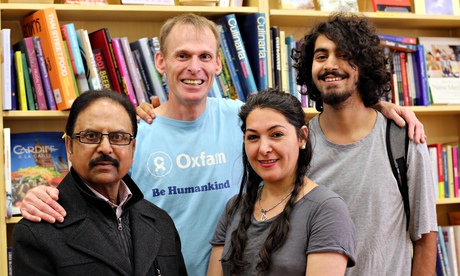
Squashed between Riley’s bingo bar and a salon selling extravagant hair extensions, the Oxfam book and music shop in Swansea bulges with stories of journeys. The display is full of travel books – Italy for the gourmand, Wainwright walking guides – but the travel theme runs much deeper than the window. Refugees and asylum seekers make up about a third of the shop’s workforce; there are volunteers here from Eritrea, Ethiopia, Syria, Pakistan, Ukraine and more.
Sharmin Fattahi, who is 18, works the Tuesday afternoon shift, filling bags with the ragtag books that no one wants. He is one of eight members of the shop’s volunteer staff to have sought asylum in Britain and been “dispersed”, as the terminology has it, to Swansea. He made the journey here from Tehran with his mother Farzaneh, an artist, who also volunteers here. It sounds like a long story, but Sharmin says only “lorry”. He thinks the journey began last November, and probably took around two weeks. He can’t be sure, because there wasn’t time to think about it. “Left everything,” he says, plucking a film book from a crate. His sentences break into small pieces, mostly two words each, as if he is still putting everything, language included, back together after the trip.
“Most there was darkness. Just I want time to pass,” he says. There were murmurings from passengers he could not see in languages he did not understand. Sharmin and his mother “talked little bits. Not too noisy.” He sat beside her, giving her hugs when she felt cold. “The lorry was almost a freezer. Not a freezer, a fridge.”
Sitting in the back room amid the teetering towers of books, with the kettle happily bubbling and the chocolates being passed around, it is easy to see why this shop is so important to those who work here. It casts them immediately in a different relationship with the outside world. Instead of needing help, they are giving help – to customers – and all for a good cause. In the shop, they are knowledgeable insiders.
The benefits can be practical as well as emotional. When, for instance, George William, a volunteer from Pakistan, was removed to a detention centre in 2007, 3,000 customers signed the petition for his family’s release. It soon followed. William’s son went on to marry a local woman; William is now a grandfather.
Nadia Ahmed, another volunteer, travelled from Sudan to Swansea three years ago to join her husband, who was already a refugee here. “Fighting,” she explains grimly. In Nyala, in South Darfur, she had been doing human rights work. But when she arrived in Wales, three years ago, the only English she knew was “Hello” and the correct reply to “What is your name?”, which she wrote down as prompts in a notebook.
After a fortnight in the shop, her English is advancing. She sees this as a first step into the world of work. “Give me experience,” she says. Perhaps she, like so many volunteers here, will travel the three miles east to Amazon’s giant fulfilment centre and the world of paid employment.
Oxfam Castle Street is the sorting office for book banks across south Wales, which is why several slatted structures, like giant compost bins, rise behind Nadia, almost to the ceiling. They are full of bags for bulk sale, many of which have been thrown up there by the strong arms of fellow volunteer Alexi, a Russian agronomist, who came to Swansea seeking asylum after working as a builder in London. “I was really excited,” he says. “City very nice. Sea views. Lighthouse. I never had a chance to live in a quiet and peaceful place.”
Others are more ambivalent. When the doors of Sharmin’s lorry opened and daylight poured in, Sharmin’s mother Farzaneh was ecstatic to see they had reached England. “But for me not,” he says. Despite all the danger, and the fact he and his mother have been granted refugee status – they share three rooms and £70 a week of living costs – he hesitates to say that leaving Tehran “was a good choice”.
“I still not sure,” he says. “’Cause, you know, I’ve lost too many things. Money. Good life. Friends. Studying. Everything. My film and music studio.” In Tehran, he planned to start a degree in industrial design. In Britain, he will have to take A-levels. In Tehran, he “had found my cast – my friends who match with me”. In Swansea, even with his work at Oxfam Castle Street, he is “younger than anyone else, my interests are different. Honestly. No friends yet,” he says.
What Sharmin does get from the shop is a sort of cultural embrace. He is really here for the books and the music. And the conversations about music with the shop’s manager, Phil Broadhurst, 49, who, in his youth, put together a gig guide in Reading and hung out in the town’s Caribbean Club. Broadhurst likes “obscure reggae” to Sharmin’s prog rock (he hopes one day to flip through all the Perry Como records and find Camel’s 1974 album Mirage).
Broadhurst’s policy of inclusivity is about being “open to everybody, because the more people you’re open to, the more good people you’ll meet”. In recognition of his commitment to inclusivity, last year the shop became the first retailer in Britain to receive a national City of Sanctuary award.
Clearly, providing a warm welcome to refugees and asylum seekers fits with Oxfam’s mission, but, more than anything, it is Broadhurst’s creed that is played out in this shop. He says this openness began for him aged 11 when he came across his first non-white fellow pupil, and went home after school laughing at his name. “You’ll find out he’s just the same as everyone else,” his older brother sagely counselled. Sure enough, the two became best friends, and, in some ways, Broadhurst, nearly 40 years on, is still applying the lesson he learned that day. It enriched his life, and the lives of countless others.
Beyond the benefits of working with Broadhurst, there is one more perk to working in this particular Oxfam shop. “I take plenty of books about fishing,” Alexi says. Broadhurst looks troubled by this revelation. Loaning stock to staff is not official Oxfam policy. But Broadhurst is kind. And the books come back.
Sharmin borrows anything on film. Nadia, who hopes for a council house because her rooms are damp, has borrowed a book on home improvement. Bogdan, from Ukraine, takes all the half-finished Sudoku books the shop cannot sell, while Farzaneh takes broken books and loose leaves and uses them in her art. For months after she arrived, she could not paint. But these snippets and scraps have given her ideas, and this week the shop is holding an exhibition of her work: Farzaneh Yousefi, the Swansea era.