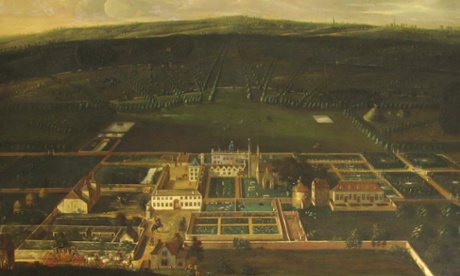
Lumping this heavy book around – I needed a small suitcase to transport it – I have repeatedly been interrupted in my reading repeatedly by people saying: “That looks a beautiful book.” Not only is it visually gorgeous – a rich and diverse cabinet of curiosities with watercolours of magnolias in voluptuous flower, intricate engravings of butterflies, the imperious head of an American flamingo – but it also meticulously illustrates Mark Laird’s scholarship. He is a British-born historic landscape consultant and conservator who teaches at Harvard, but it would be wrong to think that this is a book for garden historians only. His text is as grandly miscellaneous as nature itself and, at every turn, he lightens erudition with wit. His implication is that gardens, in every century – though his focus is on the 17th and 18th – are complicated and suggestible and influenced by more than the people who make them.
As the title asserts, natural history and the history of landscape dovetail. Gilbert White is the genius of this book in which weather, birds and butterflies all signify. Laird’s gardener’s eye serves him well as a writer: he homes in on detail, attends to every stitch in his embroidery (the word for 18th-century lawns threaded with flowers). And if there were occasional moments when I could not see the stems for the petals, there was a multitude of other moments to educate, entertain and charm.
For all gardeners, this book offers a fascinating insight into the meteorological extremes of England’s past. It is a Book of Showers – and worse. In 1703, a great storm destroyed deer parks. In 1750, there was an earthquake. There were ferocious winters (17th-century snow settled for between 20 and 30 days each year). In the Little Ice Age winter of 1683, the Thames froze. Parched and lawn-scorching summers seemed as if they would never end. In Mill Hill, London, the botanist Peter Collinson was mortified, in 1765, by the state of his grass (“looks like the Sunburnt Countrys of Spain and Africa”).
Laird writes, too, about the way wildlife impinged. Whales were washed up on the banks of the Thames and, in his entry for 3 June 1658, John Evelyn, diarist and gardener extraordinaire describes a whale’s skin as like “coach leather” and offers us a toothy sketch. In 1748, a plague of “Great Brownish spotted locusts” invaded the City of London. There was intense pollution (Evelyn’s suburban garden suffered. He produced the first book about pollution: Fumifugium.)
Laird’s is a unifying view. He leads the way through the gates that link different fields, as well as exposing contradictions (he considers the English double standard about birds that made them admired – and shot). But the most perversely cheering realisation is that most of the problems of being a gardener – and of being alive – have not changed. Even the chores are familiar. Evelyn advises: “Whatever work you neglect, ply weeding at the first peeping of y’Spring.” It is interesting, too, to learn, in the marvellous chapter devoted to the Duchess of Beaufort, that her herbarium was a solace for depression (or, as it was charmingly called in her day, “mopishness”). She said: “When I get into storys of plants I know not how to get out.”
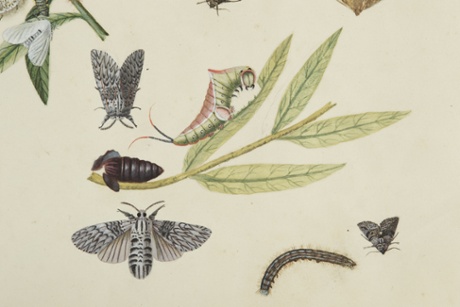
This book is at its best in celebrating women who contributed to gardening and natural history. I wish Mary Delany (1700-1788), about whom Laird has written before, could be spirited back to life. What a friend she must have been: her voice remains as playful as her paper collages against black backgrounds are beautiful. She has a teasing enthusiasm for life and plants. In June 1776, she writes: “I have made an appointment for tomorrow with a very fair lady called ‘lychnidea’. If I neglect her, she will shut herself up, and I shall see her no more.” Delany was one of several women who were liberated by widowhood to thrive as artists, gardeners and naturalists. Many such women have tended to be almost erased from historical record. And there was something triumphant about Eleanor Glanville, who became obsessive about collecting insects after separating from her husband (any connection, one wonders?), wearing a pincushion around her neck for the purpose of impaling them. And who would dare challenge forthright Margaret Cavendish who likened the plight of birds to that of captive women: “We are kept like Birds in Cages, to Hop up and down in our Houses, not Suffer’d to Fly abroad.” It is thrilling to learn that Mary Delany’s remarkable collages were created between the ages of 73 and 82. She said: “Idleness never grew in my soil.” How these women would have rejoiced at Laird’s industrious, uplifting and accomplished book.
A Natural History of English Gardening is published by Yale University Press (£45). Click here to order it for £36