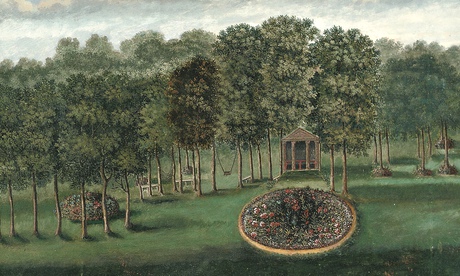
For more than 200 years the 18th-century English garden has been associated with meandering paths and rolling lawns dotted with clumps of trees and green groves – landscapes with little scent or colour and devoid of birdsong, butterflies or caterpillars. I blamed Capability Brown and his bland, repetitive designs for these seemingly sterile landscapes, until I read Mark Laird’s magisterial The Flowering of the Landscape Garden. Published in 1999, this book put perfumed blossoms and brightly coloured blooms back into the Georgian garden. Rather than being green and monotonous, Laird argued, the 18th-century garden featured shrubberies populated with flowering shrubs and trees from North America – elegant Magnolia grandiflora, the spidery yellow winter blooms of witch hazel and the bloodied autumn foliage of maple trees. They became, one contemporary gardener said, the “living pencils” that coloured these landscapes.
In his new book, Laird presents gardens alive with sounds and animals, once again challenging our misguided ideas of the 18th-century garden, which he blames on Horace Walpole. A man of letters and the owner of Strawberry Hill in Twickenham, Walpole became England’s first garden historian when he wrote The History of the Modern Taste in Gardening in 1780. This popular book celebrated the “natural” English style of garden designers William Kent and Capability Brown, a contrast to the formal geometric baroque garden. Interestingly, though, Walpole firmly excluded nature and natural history from his account. Ever since then, Laird explains, the history of English gardens “has been prone to a Walpolean bias”. This book sets out to correct that imbalance.
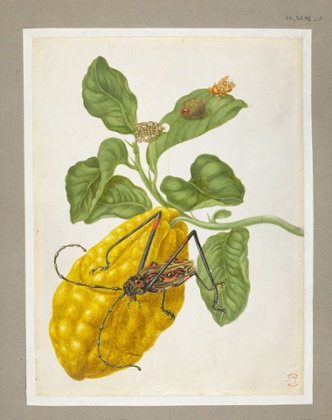
with bodycolour and with pen and grey ink on vellum. Courtesy of the Trustees of the British Museum
Guided by Gilbert White’s detailed records of weather, pests and plants in the Natural History of Selborne (1789), Laird recaptures nature: the “shrilling noise” of crickets, the havoc caused by snails and the song of goldfinches. White, who was one of the first to understand nature as an ecological system when he wrote of worms as “great promoters of vegetation … by boring, perforating, and loosening the soil”; Laird now provides what he calls an “environmental view” of the garden.
The main protagonist of this book is not a gardener but the weather, “the unsung artist, as well as the despoiler of gardens”. In 1739/40, a devestating winter destroyed almost all Magnolia grandiflora in England. In contrast, 1748 was a cornucopia year, and the dry summers of 1762 parched lawns across the south. The milder climate of the 1760s favoured North American flowering shrubs – so much so that London merchant and plant collector Peter Collinson declared: “I am Charm’d, nay in Extasie”. A Natural History of English Gardening is filled with accounts of droughts, great storms, blizzards and the 1783 volcanic eruption of Laki in Iceland which veiled large parts of Europe in ash clouds and turned honeysuckles into loathsome objects, covered with aphides.
Laird has painstakingly researched the subject over many years and gathers his information from hundreds of letters, journals and newspapers. Where better to start than with a famous gardener who was also a diarist: John Evelyn, who gardened at Sayes Court in Deptford at the Thames between 1653 and 1694. His diary and manuscripts not only detail the effect of weather on his plants but also describe caterpillars as “cursed Devourers” and butterflies as “flying flowers”.
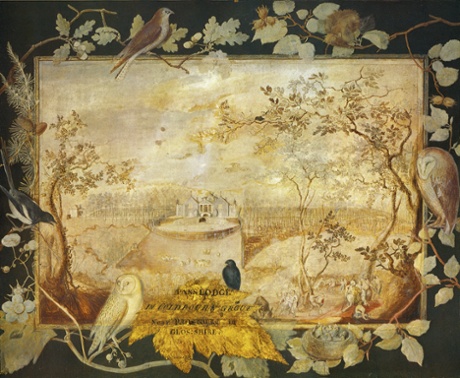
Laird explores how plants and animals were brought together in the garden. He writes about the menagerie of the Duke of Richmond at Goodwood and Princess Augusta’s aviary at Kew Gardens but also reveals how animals could determine the design of a garden. Lady Luxborough, for example, explained in 1748 that her flower beds only included “such Flowers as the Hares will not eat”.
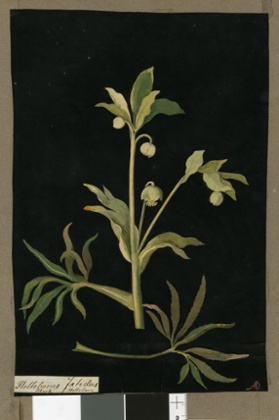
collage of coloured papers, with
bodycolour and watercolour. Courtesy of the
Trustees of the British Museum
Another important aspect is Laird’s focus on the contribution of women in the realm of gardening and natural history. There is the Duchess of Beaufort and her early 18th-century collection of exotics, which rivalled those at the royal palace of Hampton Court. Prone to depression – or “mopishness” as it was called – the duchess coped with her melancholy by gardening and she was fanatical about flowers: “When I get into storys of plants,” she said, “I know not how to get out.” She was self-taught, but her knowledge was far greater than that of many professional men. The marvellous Mary Delany was another prolific gardener, who produced nearly 1,000 flower collages that are breathtakingly beautiful and scientifically accurate. Delany, who must have had infinite patience, cut countless pieces of coloured paper and stuck them with flour glue on black backgrounds. Many of these were rare flowers which reveal Delany’s close connections with botanists, explorers and plant collectors. She received specimens from Kew and Chelsea Physic Garden and was one of the first to see the floral spoils that came back on Captain Cook’s Endeavour.
A Natural History of English Gardening truly looks magnificent – packed with hundreds of stunning engravings and paintings and coloured botanical drawings, as well as many reproductions of 18th-century letters, sketches and estate maps. The lavish production of the book, however, belies its scholarly content. This is not a coffee-table book but a deeply researched work. Facts, anecdotes and quotes from original manuscripts abound so that even seasoned garden historians will find new information.
It’s a dense account that, as Laird himself admits, “inclines to the fragmentary”. There are sections in which the narrative disappears in the details but it doesn’t pretend to be a rollicking read. But Laird’s new book, just like The Flowering of the Landscape Garden, pushes garden history into new territory – one in which the garden is seen as an ecological and cultural system rather than a stage for fashionable designs or horticultural achievements.
• Andrea Wulf’s forthcoming book, The Invention of Nature: The Adventures of Alexander von Humboldt, the Lost Hero of Science will be published by John Murray in September.






.png?w=600)