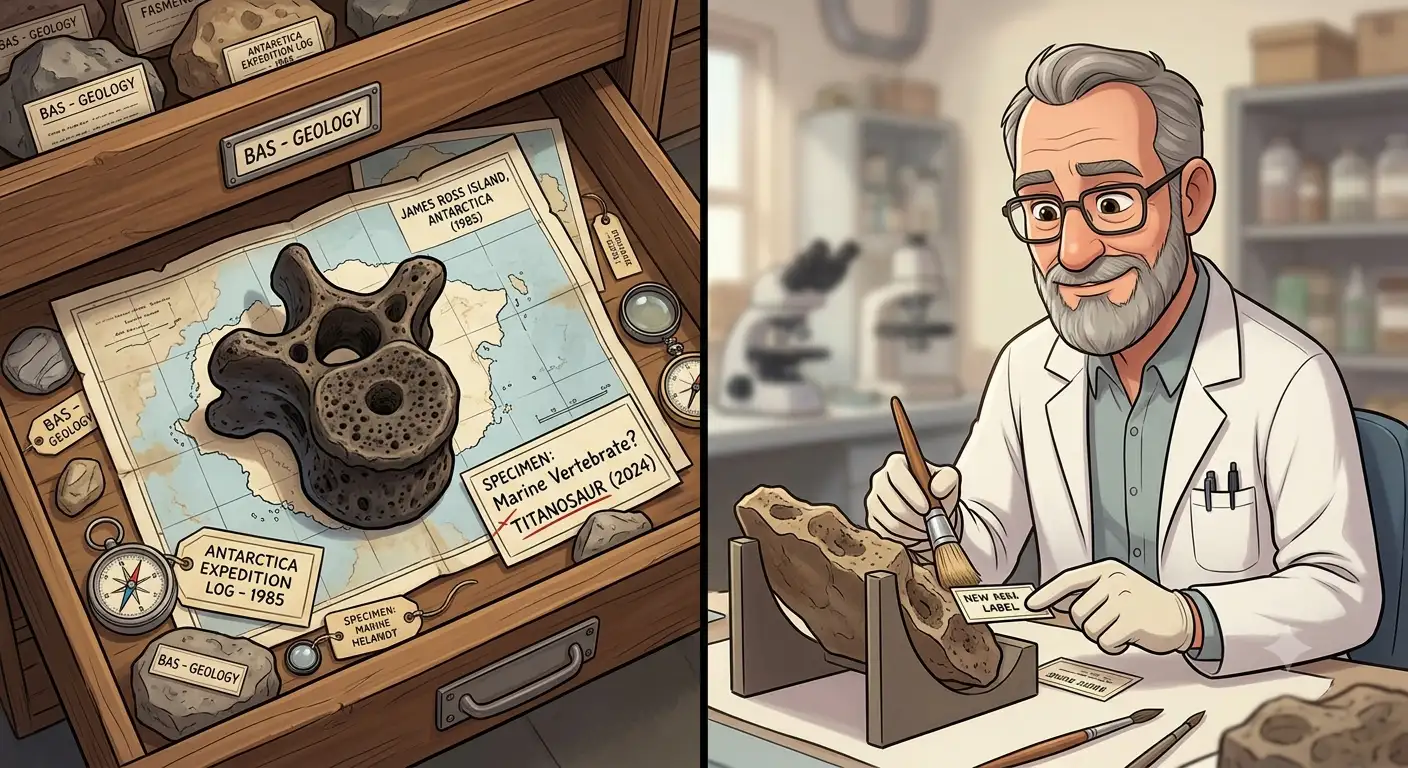
Antarctica dinosaur fossil discovery : A forgotten fossil that sat in a museum drawer for around 40 years has finally revealed a major dinosaur discovery from Antarctica, reshaping what scientists know about the southern continent’s ancient past.
The specimen, an 82-million-year-old fossilized tail vertebra, is now recognized as the first dinosaur fossil ever recovered from Antarctica, according to a study published on June 29 in Acta Palaeontologica Polonica, as per a report. It belonged to a titanosaur, part of a group of massive, long-necked, four-legged plant-eating dinosaurs.
A fossil that waited decades to be understood
The bone was originally collected in December 1985 by geologist Mike Thomson during a British Antarctic Survey expedition on James Ross Island, as per a Smithsonian Magazine report. At the time, it was believed to be from a marine creature and was stored away in a collection drawer in the United Kingdom, where it remained unstudied for decades.
Its true identity only emerged years later when Mark Evans, a paleontologist and collections manager at the British Antarctic Survey, re-examined archived specimens and suspected the bone could belong to a dinosaur. He then contacted Paul Barrett at the Natural History Museum in London.
Barrett said, “As soon as I saw it, I knew what we were dealing with… It was a dead cert we were dealing with a titanosaur,” as quoted by Smithsonian Magazine.
A rare Antarctic dinosaur find
Titanosaurs include some of the largest dinosaurs ever known, with species like Patagotitan mayorum reaching up to 122 feet in length. However, the Antarctic fossil is far more incomplete, making it impossible to identify the exact species.
Researchers estimate the animal was about 23 feet long, suggesting it may have been a juvenile or a smaller adult.
The vertebra’s shape, featuring a hollow on one end and a rounded bump on the other, confirmed its place in a line of ball-and-socket tail bones typical of titanosaurs.
How the fossil ended up preserved in Antarctica
Scientists believe the dinosaur likely died near a coastal environment. The fossil was found in a marine rock formation, suggesting the body may have floated out to sea before sinking and becoming preserved alongside marine life such as ammonites, as per the Smithsonian Magazine report.
The surrounding rocks also helped researchers determine the fossil’s age at around 82 million years.
A missing piece of Gondwana’s ancient map
The discovery helps fill gaps in the dinosaur record of the southern continents. While titanosaur fossils are common in South America and present in New Zealand, none have been identified in Australia.
During the late Cretaceous period, Antarctica, South America, Australia, and New Zealand were part of the supercontinent Gondwana. Scientists suggest the Antarctic Peninsula may have acted as a land bridge, allowing dinosaurs to move between regions that are now separated.
Barrett explained, “At the time, New Zealand was, weirdly, quite a long way away from Australia,” adding, “It was closer to southern South America and the Antarctic Peninsula than it was to Australia, just because of the way the continents have moved around,” as quoted by Smithsonian Magazine.
Despite Antarctica’s current icy conditions, the continent was much warmer during that era due to high levels of volcanic activity and atmospheric carbon dioxide.
READ ALSO: A ghost particle hit Antarctica, and led scientists to a hidden galaxy 11 billion light-years away
Why museum collections matter
Researchers say the discovery highlights the importance of preserving and revisiting old museum specimens.
The study's co-author Matt Lamanna said, “This bone sat in a collection drawer for decades until new research revealed it for what it was,” adding, “It’s a powerful reminder of exactly why museums collect, care for and steward objects like these—new methods and expertise continue to emerge, enabling scientists to unlock discoveries from specimens that have been waiting in plain sight,” as quoted by Smithsonian Magazine.
FAQs
What was discovered in Antarctica?A fossilized tail vertebra belonging to a titanosaur dinosaur.
Why is this fossil important?
It is the first dinosaur fossil ever found from Antarctica.
READ ALSO: This hellish planet is so hot it has clouds of glass and an atmosphere of vaporized metal