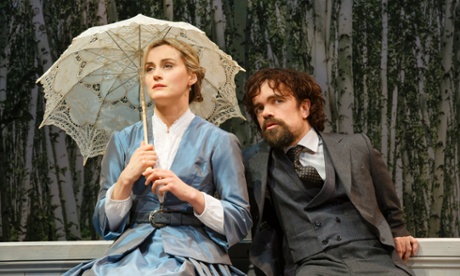
In Ivan Turgenev’s A Month in the Country, Taylor Schilling, star of Orange Is the New Black, wears a yellow gown, a blue gown and one made of flowing ivory satin. There’s not a carrot-colored jumpsuit in the mix.
But Classic Stage Company, strangely adept at attracting name actors, is surely counting on Netflix fans to swell audience ranks for this anodyne comedy, which also stars the delightful Peter Dinklage, who cuts an impish swathe through Game of Thrones.
A Month in the Country, published in 1855, though not performed uncensored until well after that, is a sort of pastoral romance. Chekhov fans will be shocked – pleasantly and then less so – at how much it resembles his plays, without ever really equaling them. Chekhov wrote to his wife that this play was “not at all to my taste.” His tastes must have changed.
On a rural estate, Natalya (Schilling) enjoys a platonic flirtation with her husband’s friend Rakitin (Dinklage). But her lovely head is turned by the arrival of a young tutor, Aleksey (Mike Faist), who also catches the notice of her young ward, Vera (Megan West), who’s being pursued by the doltish landowner Bolshintsov (Peter Appel), who has conscripted the mocking doctor Shpigelsky (Thomas Jay Ryan), who has an ironical yen for the governess Lizaveta (Annabella Sciorra). Perhaps a Gogol could have pushed this amorous roundelay toward farce; maybe Gorky would have urged it toward tragedy. Chekhov might have attempted both. Turgenev does neither.
In Erica Schmidt’s anemic if perfectly pleasant revival, the costumes are smashing and the sets are elegant. John Christopher Jones’s new translation is only occasionally infelicitous (Vera on her suitor: “He’s so weird”). Schilling is – somewhat surprisingly – a real theatre actor and Dinklage, a reliably exciting and sardonic presence Off-Broadway before Hollywood had at him, is terrific, though a little less so when the script strands him with unplayable soliloquies: “What is this? Is this the beginning of the end? Or the end? Or the beginning?” Ryan is hammy and delectable.
Though finely acted, it’s strangely tepid. The play has sometimes been hailed as a social allegory, pitting a desiccated older generation against a vital younger one, but that’s little in evidence here. Konstantin Stanislavsky, who staged a celebrated production in 1909, described the play as “lacework of the psychology of love”. This makes it sound a lot more fragile and indirect than it actually is. Natalya and her circle make their feelings known bluntly. The songs and jokes and anecdotes bear on the main themes squarely. If you love Chekhov, you’ll find yourself missing the allusive, the elliptical, the subtextual – with all the terrible, wonderful yearning that entails. Turgenev’s characters talk an awful lot, often to the point. But they might mean more if they said less.