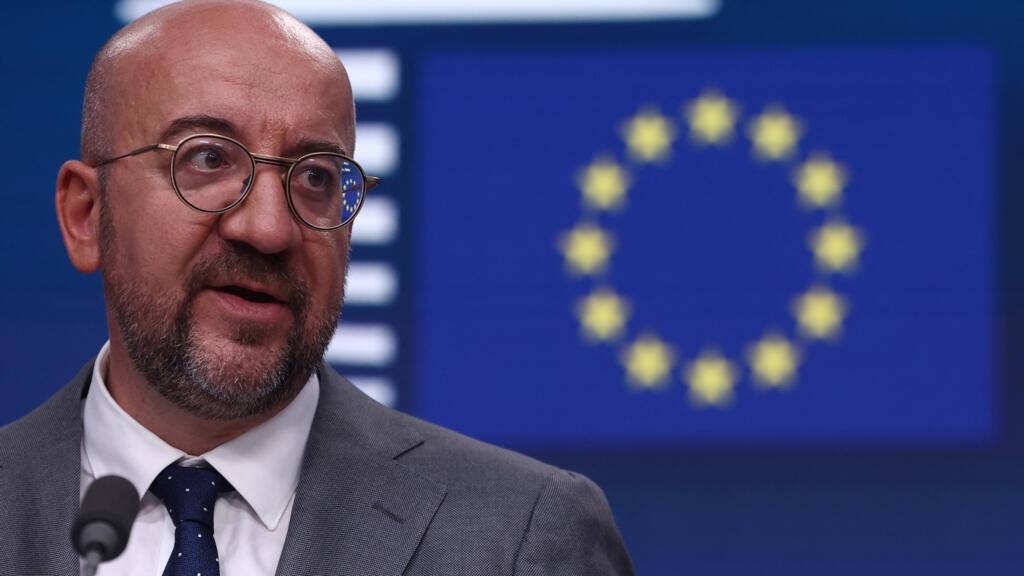
US President Donald Trump has threatened to annex Greenland and impose hefty tariffs on a number of EU countries, including France, if they continue to oppose the move. In an interview with RFI one year after Trump's return to the White House, Charles Michel, former president of the European Council and former prime minister of Belgium, calls on Europeans to say "enough is enough".
RFI: Since Donald Trump returned to power, he has repeatedly attacked Europe, going so far as to threaten the annexation of Greenland. Do Europeans today have an enemy in the White House?
I wouldn't speak of an enemy. I think we simply need to be lucid. The transatlantic relationship as we have known it for decades is rooted in the blood of the Second World War. That relationship is over, and we'll have to build a new one. That will probably involve a moment of confrontation, which may be difficult politically and diplomatically. But this is the time for the European Union to stand tall and say: 'enough is enough, we must now be respected'.
The issue of the moment is, of course, the United States’ desire to annex Greenland. And Donald Trump has added fuel to the fire saying: 'I don’t think European leaders will put up much resistance to my project.' Is he wrong?
I hope with all my heart that he's wrong. And I believe this is a moment of truth for the European Union and for European leadership. [On Tuesday] the European Council is meeting in Brussels, convened by my successor, António Costa. It's the moment for clarity and for unity within the European Union. Why? Because in reality, for several years now – and this has intensified since Donald Trump’s return to the White House – all the pillars on which the European project is founded have been under attack.
On the one hand, a war has been unleashed that threatens peace on the European continent – a war launched by Russia. In terms of competitiveness, the trade war launched against the rest of the world, including against the European Union, is clearly a threat to our future prosperity. And we can also see, even at the democratic level, attempts to interfere in a number of European democratic debates that are unacceptable.
So I believe this is a moment for lucidity and for strength. That means we must be extremely clear and use the means at our disposal. We are not without leverage. We hear far too often that the EU cannot resist, has no strength, no capacity. Take the European market – 450 million consumers – that's vital to major American companies.
European allies hit back at US threat to start trade war over Greenland
You said, 'I hope he is wrong' referring to Trump's claim that European leaders will not put up much resistance. Does that mean you nevertheless have doubts – not about Europe’s capacity to resist, but about the willingness of European leaders to do so today?
If I have mixed feelings, and if I hope the right decisions will be taken, it is because over recent months I have observed far too little resistance. On the contrary, I have seen what I call the development of a diplomacy of flattery – a diplomacy of complacency and appeasement. I believe this is a major mistake made by some of my former colleagues. And it doesn't work. It is even counter-productive.
We can clearly see that the more there have been these sometimes cowardly compliments – it has to be said – and this sometimes cowardly flattery, the more it has fuelled the White House’s appetite and the more it has worsened and unbalanced the relationship between the United States and the European Union.
Our wish, of course – and mine as well – is to have a respectful, balanced and effective relationship between the US and the EU. And that's not the case.
You're describing a Europe that has been immensely soft, weary, when facing the United States.
I think that over recent months and the past year, Donald Trump’s arrival in the White House has unfortunately not been an opportunity for the European Union to reveal its power, its strength, or its capacity to defend our vision of Europe in the world – including economically.
When we were threatened in the context of this trade war, and when in the end 15 per cent tariffs were imposed on us, and the response was a thumbs-up and a smile, that shows, in my view, very serious naivety – if not a culpable error. Because that attitude triggered an escalation and indeed encouraged a temptation to go ever further in threatening, intimidating and ultimately harming the European project.
Trump says not thinking 'purely of peace' in Greenland push
On Monday the Commission's deputy spokesperson [Olof Gill] call for restraint in the face of Trump's threats saying 'Our priority is to engage, not escalate'. Does that mean the Commission has decided we'll do nothing?
There's a saying in Latin: 'to err is human, but to persist is diabolical'. And I hope European leaders will draw the lessons of recent months. What more is needed when we are faced with serious ambiguity from the United States – if not complacency – towards Russia? What more is needed when we are hit hard by a trade war? And what more is needed when we are now confronted with direct threats to the sovereignty of one of our Member States? [Greenland is an autonomous territory within the Kingdom of Denmark – a member of the EU]
Who is to blame for this weakness? European leaders as a whole? The Commission? Ursula von der Leyen? Is there anyone in particular who should be held responsible?
I don't want to personalise the debate at this stage. I simply observe that over recent months a number of extremely important opportunities have been missed. That was certainly the case over the summer, when negotiations between the White House and the European Commission on tariffs were finalised.
I believe this was a very sad moment for the European Union – that is the first point. But there is more than that. A few years ago, before the war against Ukraine, only a handful of us were arguing for what we called the European Union’s strategic autonomy, its sovereignty. The French President was very clear-sighted on this issue. I was clearly – and I still am – on his side in this ambition for independence and sovereignty for the European Union. But at the time, Emmanuel Macron, myself and others were facing strong headwinds within the European Union, including from the European Commission.
Even under the previous Joe Biden administration, when decisions were taken that harmed European competitiveness – each time there was an attempt at appeasement.
A collective drifting off to sleep...
A form of lethargy.
In other words the Europe we have known for years?
No, not for years. During the Covid crisis, we reacted within a few months. We succeeded in countering the pandemic and in launching joint borrowing that demonstrated European solidarity at the economic level.
EU to tighten Covid-19 vaccine export approval to ensure doses for own citizens
You are saying it can be done?
Of course. The history of Europe has shown that in difficult moments, European leaders have been capable of vision and courage. What we have seen in recent months is sad, but I don't think it's too late. And I believe that in the coming days we'll see whether there is the indispensable wake-up call.
What should Europe do in the face of this threat of annexation combined with threats of punitive tariffs? What levers does the European Union have to say to Trump: 'no, this will not pass'?
We have a range of economic levers, in particular anti-coercion measures. This is the moment to activate them, and we must be clear. Of course, we all hope there can be dialogue that might suddenly lead to de-escalation, but I do not see that happening. On the contrary, if no concrete action is taken – not just agreeable language and calls for restraint – that will indeed provoke smiles in the White House.
What is needed is to show that we have instruments and that we are ready to use them. If, for example, tomorrow we say that American companies no longer have access to European public procurement markets, that strategic American investments are halted or frozen on European soil... we have a whole range of measures that can be deployed, with an intensity that can go quite far.
We have to act and stop talking...
I think so. I will be a bit blunt. In diplomacy, if someone slaps you, you slap back and then you talk. But you cannot simply take one blow, then a second, then a third. For now, I have the feeling that the White House is slapping the European Union, and the response is a thumbs-up, a smile – or even, within NATO, a certain general [Secretary-General Mark Rutte] calling the President “Daddy”. That is complacency. That is flattery. It does not work.
This interview, adapted from the original in French, has been lightly edited for clarity.