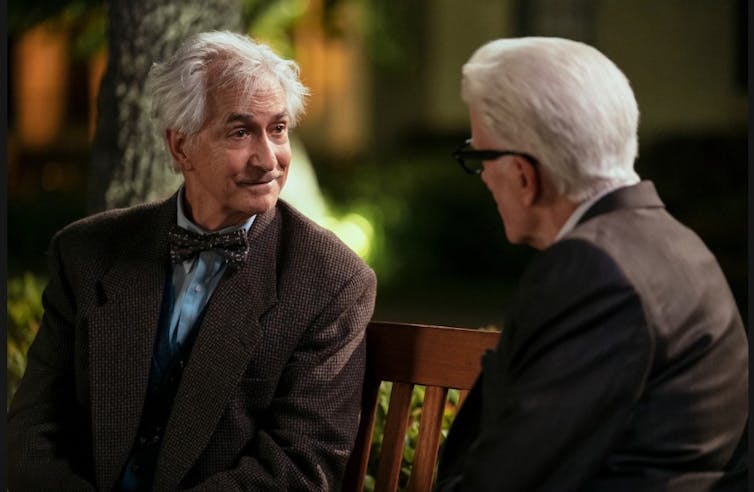
Season 2 of Netflix’s A Man on the Inside finds Charles Nieuwendyk, private investigator and retired engineering professor (played by Ted Danson), undercover at Wheeler College.
The mission: recover the college president’s laptop. This might not seem juicy, but said laptop contains sensitive information about a $400 million donation by a tech multibillionaire, Brad Vinick.
As someone who has lived and studied academic life, I find the series created by Michael Schur (also behind The Good Place starring Ted Danson, among other hit series) is both funny and uncomfortable because it hits close to home.
Budgets trimmed to the bone
The P.I. is thrilled by his university case, calling it something “I can really sink my teeth into.”
Wheeler College, founded in 1883, has seen better days. It is struggling financially and its leadership is unpopular. The board of trustees hired a president who trims department budgets to the bone, cuts student aid and embraces corporate sponsorship — as well as the bonus he receives with every major donation.
These measures are not enough. Enter Vinick.
Vinick’s secret plan — “Project Aurora” — is to fire half the professors, exclude faculty from decision-making and close what he considers “non-essential departments,” leaving “three tracks of study — biotechnology, economics and computer science to prepare young adults for life in the modern world.”
President Jack Beringer knows Vinick’s intentions but does not want anyone to know he knows. Faculty uprisings would not help his bid for a higher-paying university job in Dallas, where he ate the best steak ever.
Language of efficiency, innovation
Any campus stroll reveals that Wheeler’s “Pepsi T-Mobile Covered Garage brought to you by Sephora” (Episode 4) is only a slight exaggeration.
Vinick’s language of efficiency and innovation dominates in real life. Universities are run increasingly on a corporate model, as numerous studies have demonstrated, including my collaboration with Maggie Berg in our book The Slow Professor: Challenging the Culture of Speed in the Academy.
Budgets and programs are being slashed, and in the guise of economic necessity, principles of higher education are undermined.
Professors also satirized
While Beringer and Vinick are the villains of the piece, there are, of course, some digs at the professors. (I admit we are an easy target).
The musicologist, for example, will abandon any conversation mid-sentence when inspiration hits.
In Episode 4, we see the chair of the English department is a snob about books you can buy at airports.
However, the show resists indulging in nutty, overpaid professor stereotypes because it recognizes, in the words of Dr. Benjamin Cole, head of the English department, “these are not the best of times.” The show focuses on staff and faculty efforts in an era of budget cuts and attacks on what the billionaire investor calls “pointless subjects” like art history and philosophy.
Holly Bodgemark, the provost, is so overworked she swallows nicotine gum (“It works faster if it goes right to the stomach”) and mixes her own “Peptocoffee.”
The musicologist may be flaky, but she buys used instruments out of her own pocket for students who can’t afford them. Money is tight for students. Student Claire Chung works a dozen jobs to pay tuition and housing. “When do you sleep?” Nieuwendyk asks. “In class,” she replies.
Defending higher education
To defend higher education, the show calls in the big guns: Ozymandias, a sonnet by 19th- century Romantic writer Percy Bysshe Shelley. It’s mentioned in one of Cole’s lectures, where he recites some of its lines and comments on its continued relevance: “Money, fame, power do not last. But ideas … can endure.”
Published in 1818, Ozymandias speaks of a “traveller from an antique land.” The traveller comes across the remains of a sculpture with an inscription that reads:
“‘My name is Ozymandias, King of Kings,
Look on my Works ye Mighty, and despair!’”
The rest of the sculpture is a “colossal Wreck,” and the king’s boast has dwindled into unintentional irony.
Given that the show is American, the literary allusion might be a veiled reference to the No Kings protests.
Making sense of the present
The series seems to side with philosophers like Martha Nussbaum, who argues that a liberal arts education can help us make sense of the present and read it critically.
Vinick is a modern Ozymandias. He wants to be immortal, literally (he undergoes longevity treatments) and figuratively (he commissions oil portraits of himself). As the professor of fine arts notes in the first episode of Season 2: “Newsflash: the billionaire is a narcissist.”
Not to give away the mystery, but a crisis is averted. Wheeler is safe … for now. It might go under, but, as the provost says, “better to end on our own terms.”
And those terms are: education is not a business; it cannot be reduced to the delivery of quantifiable outcomes. The book What Are Universities For?, by Stefan Collini, professor emeritus of intellectual history and English literature, makes this case in a particularly compelling (and at times laugh-out-loud) way.
Higher education is a public good because it teaches critical thinking and civil debate and prepares engaged citizens.
Community
Good satire like A Man on the Inside points out the problems as well as possible remedies. Vinick mocks the notion of community, but the show values it above all because, without it, resistance is impossible. Wheeler College’s faculty and staff celebrate each other and band together across disciplinary divides.
In the words of the provost in the last episode of the season, they are committed to protecting “community and knowledge for the sake of knowledge.”
Schur’s comedy offers a timely defence of higher education and is notable for bridging the gap between academics and the general public.

Barbara K Seeber received a Social Sciences and Humanities Research Council Institutional Grant at Brock University.
This article was originally published on The Conversation. Read the original article.