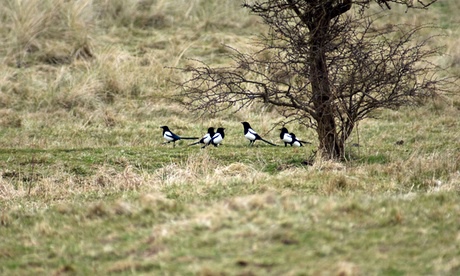
The other day I was down by the river and ran out of rhyme. Magpies were spilling out of a copse and gliding across the open meadow to a pair of waterside alders. Five for silver, six for gold. Still they kept coming.
They made me think of parachutists streaming out of a plane. Fifteen, 16. As one bird flew, an invisible chain pulled the beak of the next out of cover.
Nineteen, 20. At 23, the party was complete, landed in the bare branches, hopping animatedly in a “now where shall I put my very big tail?” way.
They chattered with chacking calls and, to a casual observer, this might have looked a straightforward black and white case of a sociable flock, or a gang, a mob intent on mischief.
The reality was neither: these were landless drifters, condemned to spend their lives wandering in search of a territory, gathering in mutual animosity, conditioned to follow subtle rules of social hierarchy. A 24th bird, perhaps the territory holder, had stayed apart.
Perched in a willow over my shoulder, it called continuously, watching and waiting until the invisible thread tugged the intruders one by one out of the trees and away over the common.
One of these territorial tussles came to the birch outside my window early this morning, at the moment when low sun gave the trunk an ethereal glow.
Three magpies dropped in at different branch levels. They swung their shiny-beaked heads to and fro in unison, wiping their half-open bills on the branches.
This was a fearful act with menace, a coded way of saying they would really like to attack their perchmates. There was a fourth bird sitting impassively at the top of the tree. It saw the lowest bird fly off, and then the next lowest, and then the next.
All four magpies made for a nearby roof and the jostling for dominance continued. One bird strutted along the apex; the others shuffled up and down tiles on the slope. Here were the early skirmishes of spring, played out in the depths of winter.