Wrapping up A-level results day
With college leaves across the UK getting ready to party late into the night, it’s time for me to sign off this live blog. Here are some of the key points of today.
- The proportion of A-level candidates gaining the highest grades of A* and A fell for the fourth year in a row, figures showed.
- At the same time, the numbers entered for “traditional” subjects such as geography, history and maths all rose.
- A record number of students accepted in higher education, according to Ucas figures - in the year that caps on university student numbers were lifted.
- NUS research showed, however, that many of the first tranche of students to graduate after fees were tripled to £9,000 were unhappy with their courses.
- And there were increasing worries over the gender gap, both among students accepted to university and in the pictures of celebrating college leavers.
- However, there were plenty of success stories, and a couple of sad tales as well.
And to all those celebrating tonight: have fun!
A final contribution from GuardianWitness. Congratulations to all the students that passed at Leyton sixth form college! And to those who didn’t, you can always re-sit - it happens to the best of us...

Leyton Sixth Form College celebrates record 99.7% A Level Pass Rate
The results day mood at Leyton Sixth Form College was buoyant with staff and students celebrating a record 99.7 per cent A level pass rate. Of a massive 1257 subject entries, 1253 produced successful outcomes. As a delighted Principal, Kevin Watson, pointed out, “Given the huge numbers involved these results represent success on a grand scale and take still further the advances of previous years.”
Students at Southfields Academy, London, find out whether they have achieved the grades they need to go to the university of their choice on Thursday morning.
The Institute of Engineering is warning that today’s results have revealed a low proportion of students studying physics, which it calls “a crucial gateway engineering subject”.
Figures released today by the Joint Council for Qualifications show no increase in entries to physics, design and technology and ICT A-levels. The figures also show a decline in performance in some science A-levels, including physics, which is down 0.1 percentage points. Paul Davies, IET Head of Policy, said:
This year’s results show no increases in students studying the crucial engineering gateway subjects of Physics, Design & Technology and ICT. If we don’t reverse this trend thousands of young people are effectively closing the door on an exciting, creative career as engineers.
There continues to be huge demand for engineers so it is important that young people continue their studies into higher education. The country needs more people studying science and engineering subjects at university taking up apprenticeships.
We are at risk of stifling economic growth if we do not encourage more students to study STEM subjects which are crucial to ensuring a healthy and balanced economy.
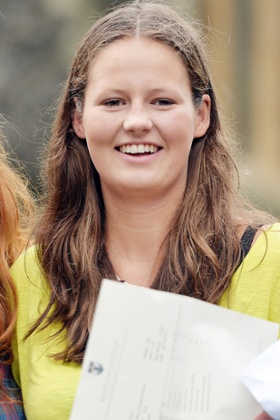
Sir Winston Churchill’s great-granddaughter Isabella Soames is celebrating three A* grades in her A-levels.
The 18-year-old deputy-head girl at independent Brighton College will now study History at Oxford University’s Keble College after top grades in Latin, English and History.
Headmaster Richard Cairns said: “She feels inspired by her teachers like so many of our pupils. She has a particular love of history and a great warmth towards her history teachers who she credits with a lot of her success.”
Soames is the daughter of Nicholas Soames, the Conservative MP for Mid Sussex and grandson of the wartime prime minister.
Brighton College achieved the best A-level results ever achieved by a co-educational school in England.
Updated
Although most of Britain’s college-leavers are probably off getting drunk or at least preparing for a night of partying right now, Schools Minister Nick Gibb has published an audio message congratulating them. He also took a minute to hail the government’s attempt to refocus education on “core academic subjects”:
What we have seen today is a significant increase in the numbers being entered for those core academic subjects - maths, English, science, modern languages. Those are the subjects that the top universities say give students the greatest opportunities, the greatest choice of degree course and therefore the best chance of securing a university place.
Results day at Abbeywood Community School, Bristol
Freya, 18, tears open the crisp white envelope in her hands, writes Aisha Gani. She pauses. Then beams as she realises she has got the grades from her local Bristol sixth form to study English literature at Cardiff university.
Like many other teenagers around the country, the 42 A-level students at Abbeywood Community School in Bristol, Gloucestershire, have been waiting anxiously over the summer to learn their grades after two years of intense studying.
“I did really well,” said Freya, “I did better than I expected. I got ABB in geography, biology and English.”
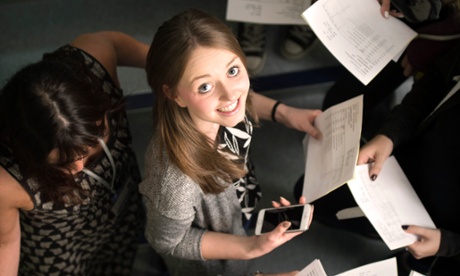
In a small huddle of friends, Emily Morris, the outgoing headgirl of the school, scanned the slips of paper with her grades printed on. “I got straight Cs,” she said. “I knew I had got into university last night, but just found out my results.”
Morris will be going to Portsmouth to study human geography. “I’m looking forward to leaving home and starting something new. But it’s weird, it doesn’t feel like I’ve left school yet”, she said.
Ethan Dyke, 18, said he was very pleased and looking forward to “moving onto the next chapter” and is going on to study physical and sports education at nearby Hartpury College.
George Stephens, 18, got a distinction in business and is already working in retail but is now looking forward to getting an apprenticeship. “When I got the envelope in my hand I just wanted to get it open. I can relax now,” he said.
After the heartwarming tales of students moving on to new stages of their lives, here’s one that might leave a bitter taste in the mouth.
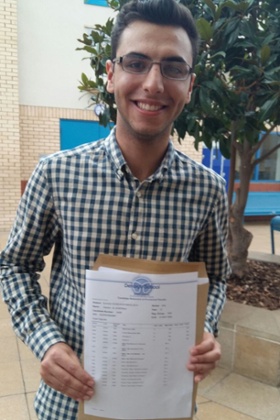
A student celebrating 4A*s at A Level faces not being able to take up his offer to study chemical engineering at Imperial College, after disputes over his immigration status.
Hassan Al-Sherbaz, 18, was refused student finance even though the Iraqi-born has lived in Milton Keynes for 9 years with definite leave to remain. “I have to wait 2 years until my Visa is considered acceptable so that I can have the Home fee Status,” he said.
Despite knowing at the start of year he would not get funding he is happy to get his results: “ I was very motivated to prove myself that I can get through this and show that I can achieve my results with all the unique challenges that I faced which thankfully lead to a successful outcome.”
Updated
Of course, even if you do get the grades you’re looking for, university is not for everyone. Apprenticeships offer an alternative route into work and are increasingly attracting strong candidates. Here are two:

Emma Gray, 22, is a higher apprentice in the Mayor of London’s environment team. She left school with three great A-Levels in Politics, Philosophy and Art, all at B grade. Emma decided against going to university, and after a stint of part-time work in a pub and working with a solicitor, decided that an apprenticeship was for her. She says:
At school, it was expected that everyone went to university and there was no guidance on other options. I was interested in politics and luckily saw Boris Johnson calling for apprentices on his Twitter feed, so I applied to the City Hall scheme. I thought it looked great and it sounded like my dream job.
I wanted to gain some practical life experience and earn money, so an apprenticeship was perfect for me. Since I’ve been at City Hall I’ve met and worked with MPs and ambassadors, which has been great for improving my people skills and a fantastic experience.

Chloe Jervis, aged 21, joined Frank PR as an apprentice in September 2012 and is now the youngest Senior Account Executive at the firm. She left school with three A-grade and one B-grade A-Levels. She said:
In August 2012, I finished Sixth Form with a strong set of A-Level results and a place at The University of Sheffield – but I knew that I didn’t want to pay £9,000 a year for a degree I wasn’t sure I wanted to do.
Instead of taking the place, I decided to pursue an apprenticeship and looked for PR opportunities online after my mum said I’d be good at it. Turns out she was right; PR seems to come naturally to me. I’m now nearly three years in, working on award winning campaigns at an award winning agency and even heading to Rio soon after winning 2014’s employee of the year.
Updated
And here are some more A-level results contributions from GuardianWitness. Thank you to everyone who’s shared your thoughts, feelings and pictures with us so far!

Alfie Denness from Hastings celebrates getting a place at Cambridge
Alfie Denness who is a student at Ark Sixth Form East Sussex got Alfie Denness got three A*s in Geography, English Literature and Sociology and an A in History and is off to study history at Cambridge University.
Alfie said: “It was a relief because it was quite stressful. I knew that I would get some of the grades, but some of the subjects could be subjectively marked, so I was a bit nervous that I had let myself down on at least one of them on the day. My Mum said she was very proud because of all the work that I put in and she thought I deserved it. All the teachers I had were really good, I couldn’t have done it without them.”

City of London Academy Islington pupils score big in the sciences
Charles Anuyagu (18) and Shakiru Adefuwa (18) from City of London Academy Islington achieved great results in the sciences. Charles secured ‘A’ in Maths ‘B’ in Chemistry and ‘B’ in Physics. He will study mechanical engineering at University of Surrey in Guildford. He said, “I’m really happy with my A in maths. When I graduate I would love to design F1 racing cars at McLaren.” Shakiru Adefuwa is off to Reading University to study chemistry, after achieving ‘B’ in chemistry, ‘C’ in Biology and a ‘D’ in Physics.
Tom
Just got A*AA in Biology, Chemistry and Maths with Statistics respectively, and I've got a place to study an MEng in Chemical Engineering at the University of Leeds in 2016 (deferred entry). Over my gap year I'm going to retake two of my Maths A2 units to bring my grade up to an A* so that I can get an engineering scholarship and some grant money. Really happy with these results.
Attention students! You can still send in your thoughts (or pictures) with the Guardian via WhatsApp by adding the contact +44 (0) 7867 825056
Here’s Tino Gwashavanhu, of Woodbridge High School in London.
I applied for Animation Production in Arts University Bournemouth. I got accepted into the university as I got the grades I needed! I got BCD and I couldn’t be happier, which is Ironic as last year I got BCDE (I was doing four A Levels, I dropped one) and I was quite disappointed! All’s well that ends well, having a positive mindset lead to a positive outcome and now I’m excited for university!
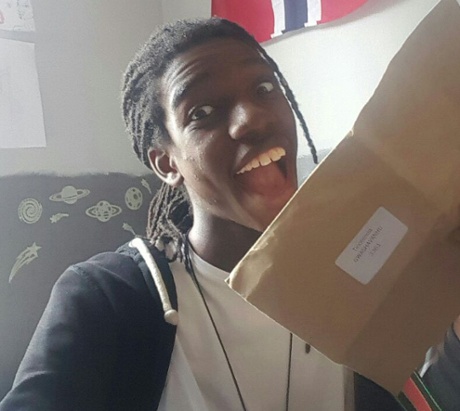
And here’s Izinegbe Akhabau, who is celebrating with her friends Eva Wainaina and Misan Aviomoh. Izinegbe said:
Me, and my two best friends got into Russell Group Universities. Two of us are from a council estate.
We’re at St. Dominics Sixth Form College in Harrow, London. It’s actually down the road from Harrow boys. We all prayed this morning on the hills near us before we went in!
Eva has been accepted at Birmingham University to study International Law, Misan will be studying History at UCL, and Izinegbe is weighing up whether to do Politics, International Studies and French at Warwick or to pursue a digital journalism apprenticeship at the BBC.

Here are some more contributions from GuardianWitness. The first, a very happy mum!

The reaction says it all – Eesha Savani reveals results to mum – 3A*!
Eesha Savani from Loughborough High School achieved 3 A*in Mathematics, Further Mathematics and Chemistry, guaranteeing her place at the University of Warwick to study Mathematics.
A nice sentiment from someone who didn’t grades they what they wanted in 2013
Don't give up quite yet
I received disappointing results in 2013 and wasn't accepted a position to study Biomedical Science by any University. However, I was offered a place on the Chemistry course at one University and although I was worried about my ability (I got a C in Chem), I hastily accepted. I've now moved to the University of Liverpool studying an MSc Chemistry and loving it! Remember, be open to alternatives. You may just enjoy them much more than you expect.
And a slightly confusing table listing the re-mark and script fees for various exam boards

Remark choices
I want to get one of my further maths papers looked at and it feels like working out how to do it is a maths problem itself!
Remember, you can share your A-level results photos and stories by clicking on the “contribute” button at the top of this live blog. You can also share your stories, photos and videos with the Guardian via WhatsApp by adding the contact +44 (0) 7867 825056 - please include ‘A levels’ in the caption.
A particularly moving story has come out of the north west, where 18-year-old student Georgina Morris discovered she had the grades to go on to study medicine, inspired by her father, who died of cancer while she was studying.
Morris, who studied at Winstanley College, near Wigan, said the death of her father Stephen had made her decide she wanted to give something back to those who had helped him.
“It is what I have been working so hard for and I feel elated that I have managed what my dad always told me I could do,” she said. “I feel like I would be making him proud. I’m ecstatic, I still don’t think it has sunk in.”
We had a picture of Georgina holding up her results sheet earlier, but here’s another with her mum, Leslie, as they celebrated her grades earlier today.

Congratulations to Greg Henderson, who has actually managed to get three A* grades in Maths, Further Maths and Physics - achieving a phenomenal 100% in two of those. He’ll be off to Oxford in a month’s time. Well done!

Triple A* Success for Greg!
Eighteen year old Central Sussex College student, Greg Henderson, has been awarded three A*s in Maths, Further Maths and Physics, achieving an astounding 100% in two out of the three subjects. Greg has been accepted to study Physics at the University of Oxford.
The British Council has said that A-level entry figures for language courses have remained “disappointingly low for yet another year”.
Figures show a 1% drop in the number of French exams taken and a 4.25% drop in German. Spanish is the exception with a 14% rise in entries.
Vicky Gough, schools adviser at the British Council, said:
Despite languages being crucial for life and work in an increasingly connected world, A-Level entry figures remain disappointingly low for yet another year.
While it is good news to see Spanish – one of the languages the UK needs the most – buck the trend with a rise in entries at both A and AS level, this isn’t enough to compensate for the long-term decline in other key languages. In particular, entries for French and German, which are still valued very highly by employers, have more than halved since 1999 with language entries as a whole falling by almost a third in the past two decades.
The reality is that as this decline continues, the UK risks falling behind on the international stage - we need far more of our young people to develop their language skills in order to effectively connect, work and trade with their counterparts around the globe as well as to become the language teachers of the future.
Just a quick note to say that the Clearing live Q&A has now begun. Hop over to put your questions about where to turn next to a panel of experts.
We know that parents’ social status significantly affects a young person’s likelihood of going to university. But now a fascinating map shows how the city you grow up in also has a significant influence on your educational attainment.
Research by the Centre for Cities found that just on five young people from Hastings go to university compared to nearly 1 in 2 young people from Cambridge. Indeed, it shows that with a few notable exceptions, such as Preston, the further you live from London, the less likely you are to get a degree.
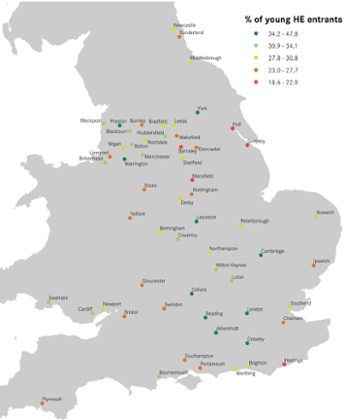
“These trends reinforce economic and social divides across the country. On the whole, cities with fewer young people going to university have higher youth unemployment rates,” the centre says in a statement.
It is calling for the government to break down barriers to higher education for young people living in cities like Hastings and, with six in 10 young people not going to uni, for a greater focus on alternative routes into work.
Disquiet among first graduates to face £9,000 fees
More than half of the full-time students graduating under the post-2012 fees and loans system believe their degree was not worth the cost of tuition fees, according to research from the National Union of Students.
Research published to coincide with A-level results day found one in 20 graduates saying that if they could turn back the clock they wouldn’t have bothered going to university. The cost of study and level of debt were cited as the main reasons.
Meanwhile, a separate poll carried out by NUS found 91% of 16-18 year olds were concerned about the financial implications of going to university.
The report, Debt in the first degree (pdf), also found:
- 77% of graduates were worried or very worried about their student debt
- 43% of graduates believe their standard of living would be affected by the cost of repaying their student loan
- Only 45% of graduates expect to fully repay their student loan debt
- Of the 56% of graduates who believed that their degree was not worth the cost of their tuition fees, 17% believed their degree was worth considerably less than they paid
- A third of black and minority ethnic (BME) graduates were more concerned about the interest of student loans and much more likely to want to repay them as soon as possible, believing the student loan debt to be as bad as other forms of debt such as bank loans or credit cards
Commenting on the findings, Sorana Vieru, NUS vice president for higher education, said:
Graduates are rightfully worried about their future, not only in terms of finding a graduate job, but also in how their finances will be affected by larger debts that the majority will be repaying until they are in their 50s.
These results show how the myth of consumer empowerment is being questioned by graduates who, on reflection, are able to see that the quality of the student experience is not linked to an increase in tuition fees.
We urge government to take note of the views of students and the real concerns they have about student debt, particularly those from widening participation backgrounds. Cuts to maintenance grants in particular could seriously harm access, as our evidence suggests that students from poorer backgrounds may think again about university if they have to incur higher debts.
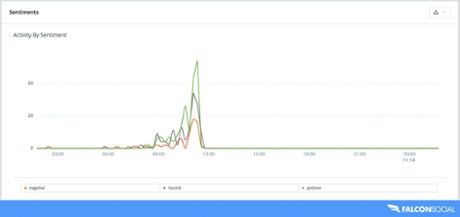
So the very first thing a lot of students will be doing on receiving their A-level results today will be to tell their friends all about them on social media. Social media management platform Falcon Social have sent through these infographics showing the kinds of sentiments they are expressing:
Positive tweets have been dominating the social stratosphere so far
Looking at the top 10 trending keywords, we can see that positive affirmations like ‘congratulations’, ‘good’, ‘luck’ and ‘remember’ are popular

#Alevelresults has been the most used hashtag so far
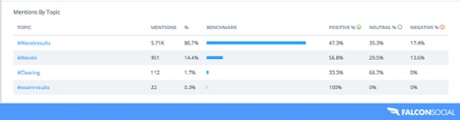
The majority of conversations are playing out on twitter, with Instagram the next most popular platform

And the prize for the success jump of the day, comes from this guy, pictured third from the right in this tweet from the Manchester Evening News.
A Level results 2015: Live - results and pictures as students find out their grades http://t.co/YGzeOARZnJ pic.twitter.com/1poAPLUuCy
— Manchester News MEN (@MENnewsdesk) August 13, 2015
Thank you to my colleague Alexandra Topping for spotting this one. “Looks like he’s been practising for that leap all his life,” she says.
Rebecca Ratcliffe has just sent another dispatch from Sussex University’s Clearing nerve-centre.
She spoke to Molly Raymer, a third year English and art history student at Sussex University, who is one of the many undergrads running the clearing phone lines today.

Molly used clearing herself, so she knows how stressful it can be. She said:
It’s that sinking feeling, your stomach dropping because you haven’t got what you were hoping for. It’s not just the disappointment, but also the worry because you don’t know where you can go to university.
Young people are under a huge amount of pressure - especially, I found, with Facebook and Twitter - it’s a day of constant updates from people, which is the last thing you want.
The best thing to do is just to stay calm, you probably haven’t done as terrible as you think. I thought my grades were terrible but they weren’t. Do your research, look at websites, universities will list what they’re looking for - got to college and talk to an adviser. Get your mum and dad to help you research.”
It’s a really emotional day - not just because people are scared or sad, but also because you can see how happy people are when we can offer them a place. I went through clearing and for me, things couldn’t have worked out better.
Here are a couple of pictures coming in from Westminster Kingsway College in King’s Cross, London. `


With all this celebration of young people, let’s not forget about who got them there. The National Union of Teachers, the UK’s largest teaching union, has hailed the success of pupils, but sounded the alarm over cuts to funding and proposals to reform qualifications.
Kevin Courtney, deputy general secretary of the NUT, said:
The results for A and AS-Levels reflect the hard work of students and their teachers. Many young people will rightly be celebrating their achievements and considering their options for the future, and nothing should detract from that.
In celebrating success, however, we should also note that debate about the appropriateness of A-Levels as a high-level qualification is by no means closed. Proposals for an inclusive national baccalaureate are once again under discussion, through the work of the National Baccalaureate Trust. Those are important discussions for the future, in which the teaching profession, further and higher education, and employers are all involved.
There will be considerable upheaval to qualifications in coming years, and it is vital that schools, colleges and learners are properly supported as changes are introduced from September this year and in subsequent years. Schools and colleges are facing substantial real terms funding cuts for post-16 education, and it is vital that those cuts are reversed to ensure that future cohorts of learners are not disadvantaged and are able to achieve their potential and realise their aspirations.
Updated
Amid the excited teenagers sharing their A-Level stories and pictures on WhatsApp, we’ve been getting stories from people wishing to reassure those who may not have got the results they’d been hoping for that it isn’t the end of the world.
This is from Dr Elizabeth Butler-Meadows, who is in Portsmouth, Hampshire:
A level results: for those who didn’t get what they needed, 10 years ago today I missed my offer to study medicine at Liverpool, by quite a long way. I chose not to do a course I didn’t really want to do via clearing and instead to a year out to resist my A-levels.
I used the extra year to work as a nursing assistant and taking blood - those skills helped enormously later on and allowed me to save for uni. Many people advised it wasn’t an option but I succeeded the following year.
I have been a doctor for three years now and am married with a young baby - I wouldn’t have met my husband if things went my way in 2005.
Failure isn’t what you think it is
Want to share your own story of life after disappointing results? We have an assignment for that:
Updated
Northern Ireland students still outperforming England and Wales
Northern Ireland A Level students achieved slightly less A and A* grades compared to last year while still outperforming their counterparts in England and Wales, writes Henry McDonald in Belfast.
The Joint Council for Qualifications said that 29.3% of students in the region achieved A or A* grades, a drop on last year’s 29.9%.
But the overall pass rate this year for more than 12,000 students who took the exams is up by 0.1%, with 98.2% achieving grades A* to E.
There has also been a significant shift in the number of students taking A levels in Mathematics. There has been a 10.6% rise in the number of girls taking Maths at A levels in Northern Ireland.
Northern Ireland’s Education Minister John O’Dowd congratulated the peformance of the region’s A level students:
After their years of hard work, I am delighted to congratulate the thousands of young people on their achievements today, and of course their parents and teachers...
Our young people have performed well and I wish them well in their next step.
For other young people, today’s results will not be what they had hoped and I would encourage them not to be disheartened.
The pathways through study and training to employment are not the same for everyone, and help and advice is available. Teachers, careers advisers and parents can offer good advice and support on the options available to you.
So record numbers are set to start university next month, Ucas has revealed today. But what if you’re not ready? Or maybe you didn’t get the grades you wanted? After 13 years of education, maybe you just need to take some time out.
If that sounds like you then read up on your gap year volunteering options. Experts told the Guardian some of the things to look out for when choosing a placement, answering crucial questions such as:
- How old do I need to be?
- Where should I volunteer?
- How long should I volunteer for?
- How do I find a trustworthy organisation?
- How much should I pay?
Tristram Hunt, Labour’s shadow education secretary, has issued a statement congratulating students on their results, but warning that the country continues to waste far too much potential. He says:
Congratulations to all the young people receiving their results today – the culmination of years of hard work, perseverance and curiosity. I hope their grades allow them to pursue whatever new chapter of their life they decide is right for them, whether that be work, training, entrepreneurship or further study. And congratulations too to all the teachers and leaders who have inspired them on their journey.
Sadly, as a country we still waste far too much potential. These results remind us that progress on increasing the number of young women taking subjects like physics, maths and computing is still too slow. The need to increase options for university-level vocational and technical study is still being ignored. And we saw earlier this week that the ability of many sixth form institutions to offer the broad and stretching curriculum our young people need to thrive in a modern economy could be under threat.
This country’s future success depends upon making sure every young person has the opportunity to fulfil their potential. At the moment, the Government’s narrow and backward-looking education policies are simply not up to that task.
Words of advice for young people from John Cridland, the CBI director-general. “There’s more than one way to be successful in the labour market,” he says.
Pupils switch to more rigorous courses
A-level students have dropped so-called “soft” subjects such as general studies overwhelminglyin favour of more rigorous traditional courses, with geography, history and maths all showing a marked increase in A-level entries, writes Sally Weale.
National results published today showed there were 15,000 more entries in the core facilitating subjects generally required to get a place at a top university - a 13.3% increase since 2010 - a trend which will be seen by the government as vindication of their drive to encourage the study of more academic subjects.
The biggest single increase in the number of A-level entries this year however is in computing, with a 29.1% spike in the number of A-level candidates, up from 4171 in 2014 to 5383 this year. Take-up among female students is still low with only 456 women candidates.
Modern languages, which have long been in decline, also received a boost with a 14.4% increase in the numbers studying Spanish, regarded as a vital language in the global business market. Numbers are still small but the increase is significant, up from 7601 last year to 8694, though the number of students taking German A-level continued to fall with a 4.3% drop from last year.
The gender gap is so far affecting today’s A-level results, Ucas admissions and now the pictures in this liveblog.
The picture editor working on the liveblog, Matt Fidler, writes:
It’s 11.30 on the Guardian picture desk and so far we have only one photograph on our agency feeds of a male student receiving his results, from Wigan in Lancashire, v 40+ photographs of female students getting theirs.
Luckily the Guardian has its own photographer out in Bristol to correct the balance later. In the meantime, here’s a group picture of taking in both sexes.

Updated
There are a soaring number of budding theologians, it seems, with the number of students taking A-level religious studies more than doubling in the past 12 years.
According to research by the National Association of Teachers of RE (NATRE) and the Religious Education Council of England and Wales, 23,372 RS A level entries were recorded, an increase of 6.5% on 2014 and 110% on the number in 2003.
Nearly a quarter (23.9%) of students taking the course got an A or A* grade, which is lauded by Russell Group universities as providing “suitable preparation for university generally”. Both Oxford and Cambridge also include Religious Studies in the top level list of “generally suitable Arts A levels”.
Daniel Hugill, chair of (NATRE), said:
Congratulations to the many students receiving their Religious Studies results today. The grades they have achieved are the product of their hard work grappling with some of the most difficult questions to ever puzzle humankind. Thanks are due to their teachers, too, who have worked tirelessly to ensure that their students can reach their full potential.
I think it’s now time for the classic exam results day gallery. Here are some pupils at Winstanley College in Wigan, Lancashire, picking up their grades.


Worries over widening gender gap
As I mentioned earlier, Ucas data reveals that the gender-education gap has widened once again, with 27,000 more young women set to start university than young men.
While this might be a boon for those young men who have made it to university, Mary Curnock Cook, Ucas’s chief executive, has sounded the alarm over its long-term implications. She said:
I do feel worried about the fact that so many more young women than young men are going to university which I feel in the long term is not going to be a good thing at all.
I always think that a degree is for life and not just for graduation. It is going to support your career progression over many years of working life.
The Department for Education is pointing out increases in the number of academic subjects, such as geography, taken this year. It attributes their rise to the government’s drive to ensure more pupils studied core academic courses at both GCSE and A level
Schools minister Nick Gibb said in a statement:
This year’s A level students are among the best qualified in a generation and I want to congratulate them on today’s results which reflect the dedication of teachers and young people across the country.
These results provide the clearest proof that the introduction of the EBaccand our drive to persuade more pupils to study core academic subjects has been a success.
As a result, thousands more pupils from all backgrounds are studying subjects that will secure them a place at a top university or an apprenticeship and that will help to secure well paid employment.
Controlled chaos at Sussex University's Clearing nerve centre
There are around 50 people here busy answering the phones, which have been ringing since 7.55, writes Rebecca Ratcliffe. Rob Evans, head of admissions, describes the scene as “manic” - but then adds “it’s controlled chaos”.
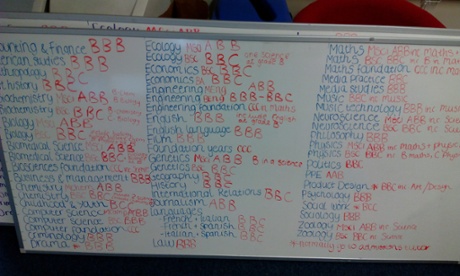
Just outside the room is a collection of stacked whiteboards listing all of the required grades for different courses - a contingency measure, says Rob. “We put it together yesterday. Should the computer system go down but the phones are still ringing, we’ll still be taking calls.”This is the busiest admissions day for universities, he says.
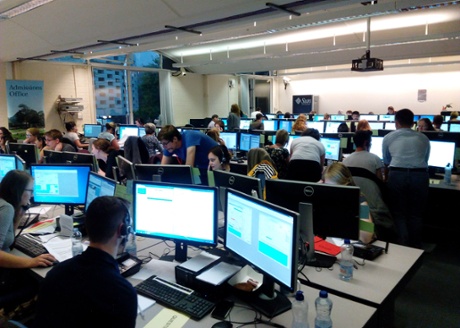
“Clearing officially started in July but probably the biggest share of most English universities’ students will come through A-levels. It’s very very quick. Students will be able to ring up and get offers straight away - though they can’t do anything until 5pm, when Ucas open their referral process to enable students to start formally sending through their application to an individual institution.”
Clearing used to have a bit of a stigma attached to it, says Rob, but the gradual easing of student number controls means more universities are offering places through this route.
“Five years ago, we didn’t have clearing at all, there were years where we might dip in for the odd course, but we didn’t really use it.” Now it’s a very busy time for the university, he says, before running off to answer the phone.
Updated
Here are our first contributions through GuardianWitness this morning. This dad below appears to be even happier than his son about results day.

Matt Ashcroft has written in to tell us how, in light of his results today, he is considering a jarring career change from acid house producer to historian.
A Level Results - Mixed Bag
I received mine online at 6:30am, meaning a weary trek to college was thankfully avoided. From the first sight of things it went well, with a surprise A in history, a B in English and a C in ICT. Unfortunately, my beloved music technology course was my worst result, with a D, which, although still a pass, now leaves me with the awkward (and pretty depressing) knowledge I'll be told to drop it.
Looks like the acid house is a hobby again and I'll have to become a historian. Which will probably be the most jarring career change in history.
And this student, who prefers to remain anonymous, is looking for a remark on his/her AS results, which are bizarrely inconsistent. It happens aslevelstudent, read our revelatory article by an anonymous senior examiner for an insight into how exam marking can go badly wrong.
AS level Art and Design Technology results!
I am a student who has just received my Art and DT results at AS level. There seems to be something wrong with the marking! I have an A in unit 2 of DT and a U in Unit 2!! Then I have a C in unit 1 of Art and a U in unit 2!!
In my 3rd subject media, I have an A and a B. Only mentioning this last set of grades to prove that I am a good student and do not understand how I have received the U grades!!!
Will definitely be requesting remarking the Art and DT units!!!
Updated
I’m loving this Vine posted by @ResultsDayFears. How did your parents respond when you told them your results this morning? You can share your stories, photos and videos with the Guardian via WhatsApp by adding the contact +44 (0) 7867 825056 - please include ‘A levels’ in the caption.
My parents looking at my exam results https://t.co/9vBho2x2zI #resultsday #results #resultsdayexcuses
— Results Day Fears (@ResultsDayFears) August 12, 2015
Numbers of students getting top grades slips
The proportion of A-level candidates gaining the highest grades of A* and A fell for the fourth year in a row, while the overall pass rate reversed last year’s trend with a slight rise, Richard Adams reports.
A or A* grades were awarded to 25.9% of A-level papers, compared with 26% the year before, while the total number of A*-E grades reversed 2014’s fall with a 0.1 percentage point uptick, to 98.1%.
The share of entrants awarded A and A* grades has now declined by more than a full percentage point since 2011, when 27% were awarded the top grades, showing the impact of the government’s policy of fixing A-level outcomes to the cohort’s GCSE results two years previously.
The fall in papers awarded the top A* and A grades was particularly marked in science subjects, including biology, as well as in English and mathematics.
Are you getting ready to call a university Clearing hotline? Nervous? Calm yourself, the Guardian has got your back. Liz Lightfoot has put together some advice on how to approach the ordeal
Get two phones ready, make notes and try to strike a balance between moving fast and giving yourself time to consider your options, she advises. And remember, it’s the student seeking a place that has to call, your mum, dad or teachers can’t do it for you.
Colleges body warns over funding cuts
Amid all the joy, we must remember these are serious times for sixth-form colleges, which are facing serious funding cuts, according to a recent report.
Almost four in 10 sixth-form principals say it’s likely their college will fold within five years, according to the report published on Tuesday. Seven in 10 say they can’t offer a quality education on the money they’ve been allocated next year.
Commenting on the A-level results, James Kewin, deputy chief executive of the Sixth Form Colleges’ Association, which conducted the research, said today:
Many congratulations to all students who received their A level results today. The early signs are that sixth form colleges will celebrate another year of outstanding success. Sixth form college staff and leaders should also be congratulated for helping their students to achieve such remarkable results against a backdrop of curriculum change and funding cuts.
As our funding impact survey indicated this week, ongoing cuts to 16-19 funding are threatening the life chances of students and the ability of sixth form colleges to deliver the sort of high quality education young people need. To ensure the sector can continue to act as engines of social mobility and deliver outstanding exam results, the government should maintain sixth form funding at current levels while an urgent review of education funding is undertaken.
More exam results joy is coming in from WhatsApp.
My name is Henry, I’m 21 and I’ve just found out I will study Journalism at Sheffield Hallam university. I am happy to say that I am proud of myself, completing an intensive one year A-level course three years after leaving education and while battling all encompassing depression right around exam time will always be something that nobody can take away from me.
Congratulations to everyone that got what they needed!
This is my face upon finding out!

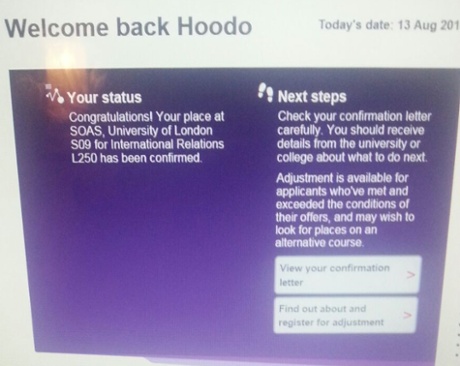
And for those of you who want to feel old, here’s how Hoodo Richter, of Ellen Wilkinson School for Girls, found out she’d been accepted by SOAS to study International Relations.
Whatever happened to envelopes, eh? It’s the envelope industry I feel sorry for.
You can also share your stories, photos and videos with the Guardian via WhatsApp by adding the contact +44 (0) 7867 825056 - please include ‘A levels’ in the caption.
Updated
With the results coming in, it’s now likely that together with the record number of young people celebrating their grades there are more than a few who have not got what they were hoping for.
If you’re one of those who are feeling disappointed this morning then it is worth reading this contribution by an anonymous senior examiner who says your A-level results could easily be wrong.
From “aberrant” markers to “guesstimating” chief examiners, there are lots of points along the way where a paper’s true worth can have been distorted. Our anonymous contributor writes:
If in doubt about a result, always go for a re-mark – the numbers of requests are booming. It’s hardly a surprise; some examiners are not even standardised. In standardisation, they are given a sample of pre-marked papers and tested on how well they can match the agreed marks. If they cannot, they are not allowed to continue marking. But there are thousands of orphan scripts left unmarked every summer and my board was so desperate that it summoned the zombies, the lingering doubters and other barrel scrapings to a special centre to mark against the clock. Several of these worthy souls had failed standardisation but were allowed to carry on (paid at several times the normal rate).
Of course, the cliche is that A-level examinations get easier every year. Twitter is already chock full of smug oldies proclaiming that in our day we had to complete three-hour exams with no toilet breaks while enduring whips from a rattan cane any time we stopped writing.
Well, if you think you can pass an A-level so easily, why not have a go with our interactive science quiz? I wanted to let you all know my score, but unfortunately a sore head forced me to give up after question two.
As befits my position, I did, however, do rather better in the interactive vocabulary quiz, scoring a grade A and beating 98% of others. That said, I’m not sure how many people have tried their luck with it in the half-an-hour since it was published.
Updated
Record number of students accepted in higher education
More than 409,000 students know they are accepted to UK universities and colleges as of today - a 3% rise on results day last year, Ucas has revealed.
“This is the highest number of acceptances recorded on A level results day, and includes 362,000 students accepted to their first choice, up 3%, UCAS figures show,” the higher education admissions service says in a statement.
The record comes in the first year that the government has allowed universities to recruit as many students as they like. Now students pay their way through fees, the old constraints of government funding no longer apply.
Mary Curnock Cook, UCAS Chief Executive, said:
More UK 18 year olds will benefit from higher education in 2015 than in any year previously. More students in total have been placed at their first choice, an increase of 3% on 2014.
This is an impressive outcome, given the slightly slower growth in the UK application rate.
The Ucas data also reveals that the gender-education gap has widened once again, with 27,000 more young women set to start degree courses than young men.
Clearing live Q&A from 1pm
If you have found yourself in need of new options after opening your results envelope this morning, relax. We will later be hosting a live Q&A with experts to give Clearing advice to students who didn’t get the grades they needed for their university offers. It starts a 1pm, so set a reminder, but questions can be posted now.
The Panel
- Helen Bower, assistant director for student journey, Northumbria University
- Nichola Malton, assessment services manager, Student Finance England
- Vicki Sellens, transition and progression manager, Berkshire College of Agriculture
- Kelly Fenn, editor of Which? University
- Liam Owens, director of student recruitment and administration, Edge Hill University
- Bev Woodhams, head of central recruitment, University of Greenwich
Click here and post your questions in the comments section below the line.
Are you a nervous student waiting to get your results? Unsure of what the future might bring? Do you feel like you have an abyss opening up in the pit of your stomach? Scared this morning will be the pivotal moment in your entire life? Don’t be: Sarah Marsh has collated the best advice for beating results day nerves.
My favourite is from Bethany Kelly, a PGCE tutor at the University of Buckinghamshire, who says go in on the day with a flexible outlook. She writes:
Be flexible in your thinking. You might have got your heart set on one course at a specific university, but there are lots and lots of variants of courses that would offer very similar subject content. Look for courses with different, but similar titles. Don’t dismiss alternatives too quickly and think only one course is your destiny. The same goes for university. Of course it does depend on individual circumstances, but I would often think wherever you go is usually just a train ride from home.
For the first time, we’re asking students to get in touch with us via WhatsApp, the mobile messaging service beloved by young people.
Our historic first ever person to contact us in this manner is Eli Richards, an 18 years old, who has been studying at Hasmonean High School in London.
“I’m at a camp in America so the time difference is killing me,” he writes. “And the stress throughout the summer leading up to finding out results has been so tough.”
In the past few minutes he’s found out his results: A* A B in english literature, politics and economics, and applied for political economy at King’s College. In the last few minutes he found out they accepted him.
“It’s very dark and I’m sitting alone at a camp in America, upstate in the mountains. I am obviously delighted.”
You can also share your stories, photos and videos with the Guardian via WhatsApp by adding the contact +44 (0) 7867 825056 - please include ‘A levels’ in the caption.
Updated
Already anticipating disappointment? Don’t know how to explain yourself to your parents? Here’s a selection of the best #ResultsDayExcuses that have been shared on Twitter so far this morning.
#ResultsDayExcuses I flopped on purpose to lower grade boundaries for mandem
— Tarzan (@Erlandas23) August 12, 2015
The prophet PBUH said when a thing disturbs the peace of your heart you should leave it, so I left the exams early.😊😊 #ResultsDayExcuses
— Simba Alexis Sanchez (@DeRozenDontCare) August 10, 2015
#ResultsDayExcuses I deliberately didn't want to get into uni because apparently all you get out of it is being constantly drunk and in debt
— Student Problems (@ProblemsAtUni) August 12, 2015
#ResultsDayExcuses Exams were 3 months ago!! Don't judge me by my past, I'm not that person anymore
— marie. (@MarieBates3) August 12, 2015
#ResultsDayExcuses no mom, e is for excellent
— becks (@rebeccadaish) August 13, 2015
Today is A-level results day. Students (and their teachers) in England, Wales and Northern Ireland will be anxiously waiting to see what they’ve got to show for their past two years’ study.
Expectations are that the results will show a slight drop in top grades as students turn to more competitive subjects. As Richard Adams, the Guardian Education editor, wrote on Wednesday:
Students in England who studied physics, biology and chemistry are likely to be particularly disappointed, with core science subjects seeing a fall in the proportion of entrants awarded A* and A grades this year compared with previous years.
There is likely to be better news for students who took English and mathematics, the two most popular A-level subjects, with English seeing a modest recovery after weaker results last year and mathematics little changed but with a higher proportion of entrants achieving B and C grades.
Overall, the proportion of top grades awarded may fall slightly, based on statistical analysis of the results achieved by the same group of students at GCSE level, which are used by the exam regulator Ofqual to fix the proportion of grades awarded.
We will be liveblogging throughout the morning as students receive their results, the overall pass rates are released, higher education places are confirmed and the university clearing process gets under way.
Are you picking up your results today, or have you nurtured a class through their studies and waiting to see their results? Remember, you can share your A-level results photos and stories by clicking on the “contribute” button at the top of this live blog or contact us via WhatsApp on 07867 825056.