The weekend is a funny thing. As anyone who is a chef, who is married to a chef or is descended from a progeny of chefs will know, Saturday is the busiest day of the week. It is everyone else’s Monday – a struggle, and a cacophonous one at that.
In my household, it is on a Sunday when the cooking takes an about-turn; breakfast can turn into brunch and lunch can become an early supper. In fact, Sunday is the only day of the week when I don’t feel as if I have to operate with a timeframe in mind; on weeknights, I am 5 O’Clock Apron by name, 5 O’Clock apron by nature.
And so, with that, Sunday sees the start of our weekend. Having three children aged eight and under, lie ins have become a distant memory but, all the same, Sunday mornings can be a wonderfully sluggish affair in comparison with the week. My eyes don’t snap open with thoughts of spelling books and packed lunches. For breakfast I might make pancakes, yoghurt muffins or French toast, with or without bacon. The coffee pot bubbles away and I like to make plenty of warm frothy milk. Some for the coffees, and some for the kids. (I can’t bring myself to use that coffee shop expression beginning with “baby” and ending in “cino “– let’s call a spade a spade and say “warm frothy milk with chocolate powder sprinkled on top”, which we make by plunging warm milk in a cafetiere up and down, to produce perfect thick aerated milk).
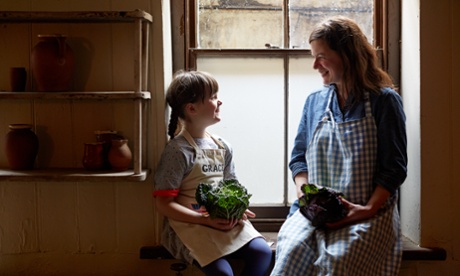
Cooking never really stops on Sundays in our house. After breakfast, I might make a cake or some bread with the children. Dorothy, my two year old, gets her fair share of kneading and spoon-licking with me at home in the week, but for the other two there’s a novelty to weekend baking. At five, Ivy is keen on helping me out with recipes – most of all, she likes chopping things. I am fine with this. She has a serrated rounded tipped little knife. She knows it is sharp, and she uses it with care. Meanwhile, my eight year old, Grace, likes nothing better than being left to her own devices to make a dish from scratch. We’ve had fattoush salads from her, a considerable amount of smoothie concoctions (some wackier than others) and a wicked raspberry, oat and almond crumble to name a few. Ovens are hot, knives are sharp, and kitchens can get very messy very quickly when kids are at the helm. That said, I think it is incredibly important to give children access to ingredients and a level of autonomy when using them. In my experience, if the kids have helped me make a dish or, in my eldest’s case, made a dish themselves, there’s a heartening pride and excitement when whatever they’ve contributed to is presented on the table.
For this main course recipe, there are plenty of opportunities for children to help out if you’re that way inclined. It’s a dish of which I am very fond.
Way back when, long before I had children, we went on holiday to northern Cyprus and met a lovely Turkish Cypriot woman through a friend of my mother’s, Leoni, who was living there and knew that both my husband and I were chefs. She arranged for us to spend the day with this family at their home in the dusty town of Dipkarpaz. We arrived at the house to witness a cow being led away by a boy who couldn’t have been older than 10. The animal had been sold to another family in order to secure some extra money for their daughter, who was soon off to study at university.
The daughter spoke good English, and to her we explained our goal. Could we take her and her mother shopping at the local market and buy the ingredients for them to cook their favourite family dish, and could they also make enough for us? She was delighted, and into the car we all piled, waving goodbye to the cow again as we passed it on the road.
It was a speedy shop: she knew exactly what she needed. We bought lamb to mince, rice, onions, herbs, spices and cabbages. Back at home, the daughter stoked the earth oven (an underground fire pit secured with a heavy metal lid) and the mother got busy with the simple ingredients.
The results were nothing short of brilliant. This is my interpretation of that dish. Served with seasoned yoghurt and Turkish chilli flakes, this is up there with the best meals I have ever eaten. While I am sure the family will never see this piece, that day was a privilege, for us and our kids, who have grown up with the recipe. As for the cake that follows ... this is a recipe that is, quite literally, child’s play, and a welcome addition to any day, Sunday or otherwise.
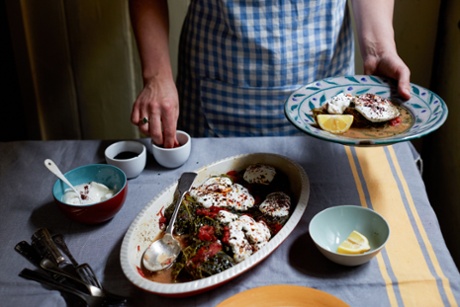
Spiced lamb and rice-stuffed cabbage leaves
Serves 4-6
Olive oil, for frying both onions and the mince (4 tbsp approx.)
2 medium onions, very finely chopped
3 garlic cloves
400g minced lamb
300ml boiling water
150g rice
A small bunch of chopped parsley
Zest and juice of 1 large lemon
½-1 tsp cinnamon
½-1 tsp allspice, freshly ground is best
Salt and black pepper, to taste
Leaves of 1 large savoy cabbage
1 x 400g tin plum tomatoes, drained of their juice
250ml chicken stock or boiling water
2 tbsp butter
To serve
250g Greek yoghurt, seasoned with salt and half the lemon juice
Dried mint
Chilli flakes (I like the Aleppo variety)
1 Warm 1 tsp oil in a good heavy-bottomed saucepan with a tight-fitting lid. Add the onions and sweat for a good 8-10 minutes until soft and translucent. Add the garlic and continue to cook for 5 minutes or so. Remove this mix when ready and set aside for the meantime in a large mixing bowl.
2 Put the pan back on the heat and get it hot. Add 1 tbsp olive oil. In small batches, fry the lamb mince until nicely browned, but not cooked through. Add the mince to the reserved onion mix. Repeat until all the mince is browned.
3 Meanwhile, boil the kettle. Add 1 tbsp oil to another saucepan with a tight-fitting lid. When the oil is shimmering hot, add the rice and give it a brisk stir for 30 or so seconds to coat all the grains in the hot oil. Add the boiling water – let the rice bubble up and then put the lid on the pan. Turn down the heat to a simmer and cook until the water has completely evaporated and holes/craters have appeared in the surface of the rice. Remove from the heat and place a clean tea towel over the rice and under the lid for a few minutes.
4 To the mince and onion mix, add the cooked rice, chopped parsley, the lemon zest, ground cinnamon and allspice, and give the ingredients a thorough mix – with your hands is best. Season with salt and pepper to taste. Preheat the oven to 180C/350F/gas mark 4.
5 Boil the cabbage leaves 3 or 4 at a time until softened: 2–3 minutes for the outer greener leaves and 1 minute or so for the smaller central leaves. Remove with a slotted spoon and leave to cool on the side. When cool, remove the vein of the tougher outer leaves as this will hinder rolling and make for a less flexible leaf.
6 Add about 1 tbsp of mince mix to the centre of each leaf, then roll it up.You’ll get the hang of it. In a large baking dish, place the cabbage rolls seam-side down and side by side in one layer. Using your hands, tear the drained tomatoes into pieces and pop these in among the cabbage rolls.
7 Heat the stock or boiling water and pour the liquid evenly over the cabbage rolls. Cover with foil or a lid and put in the oven for 45-60 minutes.
8 Meanwhile, melt the butter over a moderate heat in a saucepan until nut-brown sediments begin to fall away to the bottom of the pan. Add the remaining juice of half a lemon and stir.
9 Remove the cabbage leaves from the oven and let them rest for around 15 minutes. This dish is best eaten piping hot. When ready to serve, blob the seasoned yoghurt over the top, then the browned butter, and scatter with chopped dill, dried mint and chilli flakes, to taste.
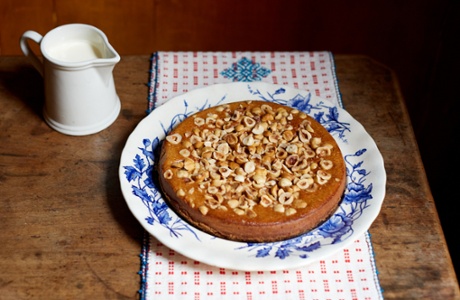
Hazelnut, cinnamon and sour cream cake
Serves 8-10
150g light brown sugar
120g plain flour
½ tsp cinnamon powder
65g cold butter, diced
120ml sour cream, plus extra to serve
½ tsp baking powder
1 egg
120g hazelnuts, skinned and chopped
1 Preheat the oven to 180C/350F/gas mark 4. Line a 25cm cake tin with greaseproof paper. Mix the sugar, flour and cinnamon together and rub in butter until you have a sandy texture (best done in food processor). Spread ½ this mix into the cake tin and press down slightly forming an even base.
2 Whisk together the sour cream, baking powder and egg. Add the remaining ½ of the flour mix to the sour cream, then pour it all over the base of the tart. Sprinkle the mix with the chopped hazelnuts.
3 Bake for 40 minutes. Serve with extra sour cream or creme fraiche.
- Claire Thomson runs Flinty Red restaurant in Bristol and is the author of the Five O’Clock Apron (Ebury)