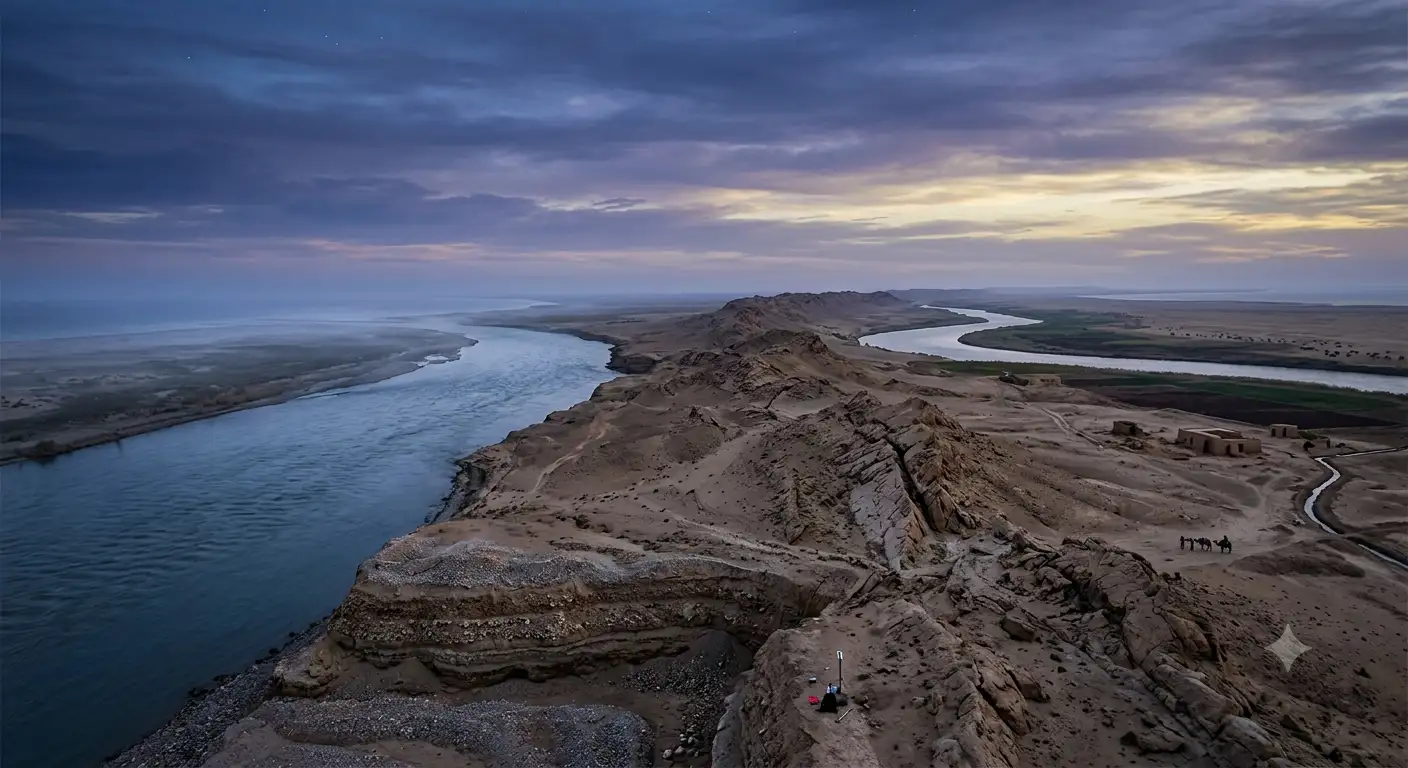
Euphrates River origin : For thousands of years, the Euphrates River has been closely linked to the rise of some of humanity's earliest civilizations. Flowing through western Asia, the river helped shape Mesopotamia, often called the world's first cradle of civilization.
But new research suggests that the famous river's story began very differently than previously thought.
Scientists now believe that around 5.5 million years ago, the Euphrates River as we know it did not yet exist. Instead, two enormous ancient rivers once flowed separately into the Mediterranean Sea before eventually joining together and changing course, according to a study published in 'Nature Geoscience' as reported by Smithsonian Magazine.
Ancient Euphrates River May Have Begun as Two Massive Waterways
Today, the Euphrates stretches roughly 1,700 miles from Turkey through Iraq before emptying into the Persian Gulf.
However, researchers discovered evidence that two ancient river systems once occupied the region. Using seismic imaging, surface maps and satellite data, scientists reconstructed how these waterways evolved over millions of years, as per the Smithsonian Magazine report.
The team identified a northern river, named Paleo-Karasu, and a southern river, called Paleo-Murat. Both were named after modern tributaries of the Euphrates.
Scientists Use Seismic Imaging to Reconstruct the River's Past
Researchers relied on seismic imaging techniques to examine buried layers of gravel, sand, mud, limestone and salt that had been compressed into rock over millions of years.
Their analysis revealed that the two ancient rivers existed around 5.5 million years ago and likely flowed into the Mediterranean Sea.
Computer simulations suggested these rivers were enormous. According to the researchers, Paleo-Karasu was larger than the Nile River, while Paleo-Murat was larger than the modern Tigris and Euphrates rivers combined, as per the Smithsonian Magazine report.
Ancient Rivers May Help Solve Mediterranean Mystery
The findings may also help explain a long-standing geological puzzle known as the Messinian salinity crisis.
Between approximately 5.33 million and 5.97 million years ago, large quantities of salt accumulated on the floor of the Mediterranean Sea as much of its seawater evaporated.
Scientists had previously discovered sediment deposits dating back five to six million years in offshore areas near Turkey, Syria, Lebanon, Israel, Cyprus and Egypt, as per the Smithsonian Magazine report. However, no large rivers exist near those deposits today, leaving researchers uncertain about their origin.
The new study suggests that Paleo-Karasu and Paleo-Murat transported water and sediment from Anatolia into the eastern Mediterranean, creating those deposits.
Tectonic Shifts Eventually Created Today's Euphrates River
Researchers found that around five million years ago, shifting tectonic plates altered the downstream paths of the ancient rivers, redirecting them away from the Mediterranean Sea.
By roughly 1.6 million years ago, the two waterways had merged to form the Euphrates River known today.
The study also estimates that Mediterranean sea levels dropped by around 0.6 miles during the Messinian salinity crisis and suggests the ancient rivers may have helped refill the basin, as per the Smithsonian Magazine report.
How Ancient River Changes May Have Helped Civilization Flourish
Scientists believe the redirection of these rivers may have played a major role in shaping the Fertile Crescent, the crescent-shaped region spanning western Asia and northern Africa.
The area became known for nutrient-rich silt that supported agriculture and allowed early civilizations, including the Sumerians, to thrive.
The Sumerians, named after the ancient city of Sumer in modern-day Iraq, are considered the world's earliest known civilization. They developed cities, systems of writing and irrigation methods, as per the Smithsonian Magazine report.
FAQs
How old is the Euphrates River?Researchers say the modern Euphrates formed roughly 1.6 million years ago.
What were the ancient rivers called?
Researchers named them Paleo-Karasu and Paleo-Murat.