In a league with 10 teams and a salary cap, you can’t afford to have three whipping boys. With the Newcastle Jets a roiling saga and Tony Popovic’s Wanderers succumbing to fatigue, post-Asia blues and the loss of Shinji Ono, Youssouf Hersi and Jerome Polenz, the competition needs the Mariners to not flounder.
Away to aspiring premiers Melbourne Victory though, Central Coast played like a side in finals contention and were hugely unfortunate not to garner a result.
On his appointment as technical director in February, now interim head coach Tony Walmsley identified a “vibrant and proactive playing style” as key to the Mariners transformation, a point he reiterated in his post-game comments. “The club has had to decide how it plays football, it’s been a challenging season on and off the pitch – the crowd numbers are not what we want them to be, and that starts with the playing style,” he said.
Away to the Victory, it was an aggressive high press that almost delivered the Mariners the win and yet there was one key weakness in their system.
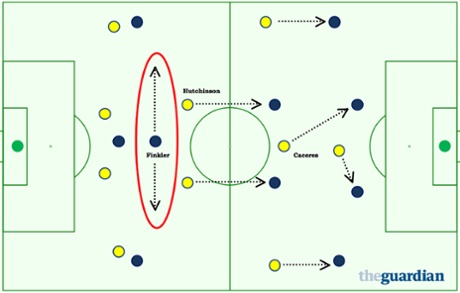
With both sides lining up in matching 4-2-3-1 systems, it was the work of the Mariners’ front six without the ball that gave them a noticeable edge, especially in the first half. Key here was the work of Anthony Caceres, racing up to join Fabio Ferreira (or for parts of the second half Nick Fitzgerald) in pressuring Victory’s centre-backs, and also John Hutchinson and Nick Montgomery in looking to prevent Melbourne’s dual midfield holders Rashid Mahazi and Carl Valeri from turning or playing forward.
In transition, such a press required at times a 20-40m shuttle, placing massive demands on Hutchinson in particular, if Mahazi or Valeri were to drop to receive the ball from Victory’s keeper Nathan Coe.
Critically, with both of the Mariners’ deeper-lying midfielders pushing on, it afforded Victory’s No10 Gui Finkler tremendous space in front of their back four. The theory being that if neither of Melbourne’s centre-backs or central midfielders were allowed to face forward and to play Finkler to feet, and any lofted attempts to find the wily Brazilian would bring Central Coast’s no-nonsense centre-backs into play, then supply to Victory’s playmaker would effectively be strangled.
No stranger to attempts at shackling him, Finkler from about the 12th minute started drifting wide right or left, creating overloads with the ever-dangerous Fahid Ben Khalfallah or Archie Thompson, knowing that should either of the Mariners’ centre-halves follow him, they would expose space behind for Besart Berisha. And whilst for the better part of 90 minutes the Mariners’ game-plan worked, on two glaring occasions, it was exposed.
Indeed, all three goals in this game came as an immediate result of Walmsley’s high pressing strategy. In the 31st minute, it was Montgomery pressing hard onto Valeri that enabled a turnover, Isaka Cernak’s drift in-field then enabled space for Hutchinson to wrap round, putting in an excellent cross for Fitzgerald at the far post, before Cernak was able to head home Coe’s parried effort.
The price for taking the game to the Victory in their own half and committing your entire front six to pressing is that should an error occur at the back, you’re left 4v4 – and with Thompson, Berisha, Ben Khafallah and Finkler – it’s some four.
Just eight minutes later, a mistake from Fitzgerald in his defensive third, saw an understandably fatigued Hutchinson let Finkler drift from left to right unmarked – for just a few seconds, but it was all he needed.
Having dominated possession and field position (55% spent in Victory’s half), and having reduced the Victory to one meaningful half-chance for an entire half, it was desperately hard on the Mariners to go in even at half-time. No other No10 in the league (with the possible exception of Marcelo Carrusca) could punish a side the way Finkler can, so it was a tremendously brave gambit by Walmsley.
As a contest, this game was won in the second half, and perhaps because the Mariners coach, with their finals hopes over, was working towards a different set of metrics than points. Asked during the break on his expectations for the second half, Walmsley stated, “I think they’re ready to go again, and we’ll see what sort of legs they’ve got.”
A single substitution made between the 60th and 75th minutes could have given the Mariners the fresh legs they needed to maintain such a demanding approach, but one senses the head coach was more interested in hitting the sheds and examining the biometric data of what his players were capable of putting out – he let his front six sweat for 83 minutes before making his first change.
It’s an interesting notion that holds the key perhaps to what the Mariners are looking to set in place for season 11. Acknowledging their relatively smaller support and player base, Walmsley upon appointment also spoke of the importance of “the identification and development of young players with embedded talent”. Having released bigger money players like Kim Seung-yong, Malick Mané and allowed Mitchell Duke to leave, the Englishman is allowing seemingly lesser lights to prove their case.
Pound for pound Fitzgerald, Cernak, Caceres, even alongside Ferreira, are not names that inspire the fear that Melbourne’s front four do. And yet if you consider the returns from the four since Walmsley took over, they’ve all made telling contributions. In the last four games it’s a goal and an assist for Cernak, two assists for Fitzgerald, and a goal apiece for Caceres and Ferreira.
In fact, crucial to their high-energy pressing style is the work-rate of the often underrated Caceres. If you’re struggling to imagine a Finkler or a Carrusca getting through the workload that the Mariners’ No10 does, it’s because they can’t. It’s a different role demanded at the Mariners, but it’s not just a defensive sacrifice, you still need gifted ball players like Caceres or Glen Trifiro with the skill to link Central Coast’s attacking passages.
Like the fabled Oakland A’s, the Mariners might just be fashioning a cut-price but effective squad, with the attributes to challenge more fancied opponents.
For the Victory, it’s a lucky reprieve and a chance to determine their own fate in the race for the premiership. For Mariners fans, it may have been an awful season, but there are definitely signs the squad is heading in a positive direction.