
Phil Stubbins said it was up there with his best moment in football. After 10 long games with nothing in the “W” column, Newcastle Jets recorded their first win of the season unexpectedly against newly crowned FFA Cup holders Adelaide United on Friday night.
It was a case of old players coming back to haunt their former clubs – with ex-Jet Craig Goodwin equalising for Adelaide and former Reds fan favourite Jeronimo Neumann scoring the winner for his new side.
All season Stubbins has been searching for a formula that would deliver an elusive win. Many non-Jets fans would have suppressed the memories of seeing Taylor Regan and Jacob Pepper in central midfield, flanked by Jonny Steele, but the side has undergone considerable tweaking since then.
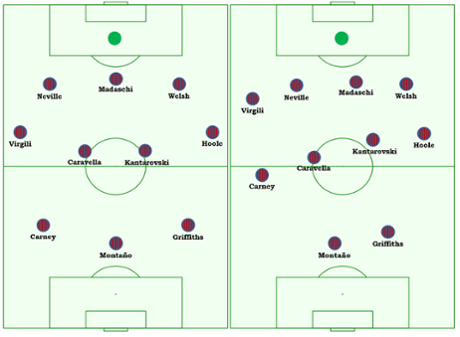
Without a win in 10, Newcastle had to try something different so why not go with something no one would ever expect? No one would have expected a 3-4-3 as the formation of choice.
“We were a little bit pragmatic in the approach we took against Adelaide tonight,” said Stubbins post-game. “I’m a good coach tonight and I feel pretty good about myself. We changed something and the players, to their credit, bought into what we were trying to do.
“We went with three at the back and we decided to drop our wing-backs back on to their wingers and subsequently frustrate them and catch them in transition, which I think we did at times.”
But it was far from a conventional, symmetrical 3-4-3 formation that some may have visualised. At times, the formation could have been classified as a lopsided 4-4-2. This was due to the balance of players in the starting eleven, their individual tendencies, and also the flow of the match.
David Carney, a wide player by trade, dropped back deeper than Joel Griffiths, a natural striker, who stayed more narrow, which created the appearance of a front two. And in the wing-back positions, Andrew Hoole on the left got forward more than James Virgili on the right. This was compounded by Adelaide’s bias to attack down Virgili’s side which forced him deeper when out of possession.
Communication and understanding of the system was vital in nullifying Adelaide’s wingers. When Adelaide progressed down their left, wing-back Virgili would move across to close down the ball. This required Scott Neville to move across to pick up the now free left winger Sergio Cirio. As the back line slid across to remain compact, left centre-back Allan Welsh would end up picking up striker Pablo Sanchez. This left opposite winger Fabio Ferreira free in space as he hugged the right touchline in anticipation of a switch of play, a common sight when watching Adelaide.
In order to nullify the threat posed from a switch of play as Newcastle’s back line slid across, Hoole would drop back from his slightly more advanced position to pick up Ferreira. On a number of occasions in the first half, this pattern was visible as Welsh motioned for Hoole to drop back in to cover.
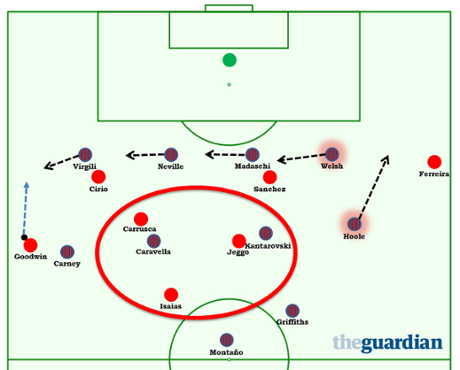
But despite this tactic to nullify Adelaide’s wingers, Newcastle were left outnumbered in the middle of the park and at times rode their luck when pressing high.
An example of this came in the 39th minute when Adelaide midfielder Jimmy Jeggo found space in the middle of the park to pick out Cirio in behind Newcastle’s defence.
Just a minute later, Newcastle’s numerical disadvantage was again evident when midfielders Zenon Caravella and Ben Kantarovski were pulled out of position to press Adelaide as they played out from the back. Caravella charged forward to pressure Adelaide’s Dylan McGowan and Kantarovski found himself stranded on the right touchline as he moved from central midfield to pressure Goodwin at left-back.
Once Adelaide had played around the manic pressure with ease, they found their midfield trio of Isaias, Jeggo and Marcelo Carrusca in acres of space in the middle of the park. As they advanced up the park and looked to switch the ball out to Ferreira on the right, the move came unstuck as the Portuguese winger found himself inexcusably offside.
Adelaide were uncharacteristically poor as they backed up from their midweek FFA Cup triumph and failed to make Newcastle pay when the flaws of their approach proved to be evident.
In many ways, Newcastle deserved a bit of luck to fall their way and worked hard for their three points. The question that now needs answering is how they will move forward with their season.
Their first win came after Stubbins switched to a unique system in order to stifle a unique team with very specific threats. Is this a system that can be replicated against the different threats of other A-League opponents? Or will Newcastle continue to be reactive week-to-week and change styles, systems and personnel depending on who they face?