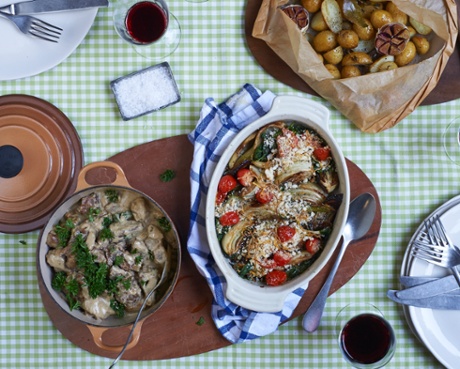
My wife, Jemima, often complains that the person who cooks gets all the glory, while the poor sod who cleans, tidies and puts away (yep, that’s her) is forgotten. She has a point. The most extreme example of this I have encountered was during a trip to Jordan a few years back. I was learning to cook the dish that inspired today’s column, and found myself surrounded by a choir literally singing my praises.
“Kill the great goat, Mr Henry!” they sang, as the sheep’s head I was stirring in a large pot peered up at me from its milky broth. “Let the people eat! You are generous enough to feed everyone!” The dish was mansaf. In Jordan, apparently, its preparation is always accompanied by this “feasting song”. It felt marvellous.
Jordanian cuisine is defined by the relationship between the Bedouin nomads and settled farmers; “the desert and the sown”. It is bland (in a moreish way), rather than hot or strongly flavoured with spices. It has four distinctive characteristics: the use of milk (sheep’s, goat’s and cow’s); the taste of liya, the concentrated fat at the back end of the indigenous Awassi sheep; the taste of olive oil; and the flavours of native wild herbs, plants and trees.
Due to the harsh climate and the difficulties of storing fresh food, milk is quickly turned into cheese. The byproduct of this, buttermilk, is evaporated to create jamid, a hard chalk-like substance that can be carried about in large blocks. To make mansaf, you grind these blocks, and then boil the crumbs in water, then add onions and a whole lamb, cut roughly into fist-sized chunks, its head and testicles included. The lamb is stewed to buttery tenderness, laid elegantly on a large platter of rice, barley, or bread, and then drenched in the exquisite sour, yoghurty juice.
As we have fridges in the UK and jamid is hard to get hold of, our recipe is a much-anglicised version. We’ve used milk and substituted the whole lamb for a shoulder (but don’t let us stop you if you want to go large). And we’ve gone for new potatoes as the accompanying carb, because they are impossible to resist at this time of year.
We hope you’ll find it an easy recipe, the cooking of which will be much improved by the presence of a hagiographic choir.
Lamb in milk
Serves 6 –8
1.5kg lamb shoulder, trimmed and cut into 3-4cm chunks
2 tbsp olive oil
6 garlic cloves, crushed
3 tbsp ground fennel seeds
900ml milk (approx)
100ml double cream
3 tbsp chopped parsley
Salt and black pepper
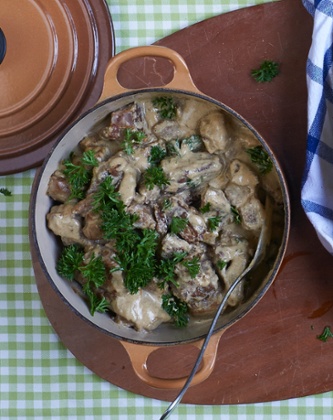
1 In a large, heavy-based saucepan, heat the oil until very hot. Season and brown the lamb in 2-3 batches, depending on the size of your pan, heating the pan between each batch and putting the browned meat into a bowl. (If you put all the lamb in one go it will stew and you won’t get the flavour from the browned meat.)
2 When you have removed the last of the lamb, add the garlic and fennel seeds to the pan. Cook gently for a minute without browning, scraping the pan with a wooden spoon as you do. Return the lamb to the pan and cook for a few minutes, then add the milk and cream. The milk should just cover the lamb. Scrape the base of the pan again and bring the milk up to a simmer. Turn down the heat, cover and cook gently for about 1–1 ½ hours, or until the meat is very tender. It is hard to overdo it.
3 Remove the meat from the pan and set to one side. Reduce the liquid over a high heat until it has thickened. Pass through a sieve, pushing all the juices through. Combine the meat with the sauce and warm through gently. Sprinkle with lots of chopped parsley
New potatoes in a bag
1kg new potatoes, washed
1 garlic bulb, sliced in two
2 tbsp olive oil
1 sprig thyme
1 bay leaf
Salt and black pepper
1 Preheat the oven to 190C/375F/gas mark 5. Cut the potatoes so they are all roughly the same size. If they are really small, this shouldn’t be necessary. Mix them in a large bowl with all the other ingredients. Season well.
2 To make the bag, cut a long strip of baking parchment and fold in half. Open up and transfer the potatoes to the lower half. Fold the other half over and roll the open edges tightly to seal. You could make two bags if needed. Stapling the edges makes a good seal, but remember not to serve staples with your potatoes.
3 Slide the bag on to a baking tray and place in the oven for about 40 minutes. If the bags are sealed properly, they should puff up and the potatoes cook inside. Break the bags open at the table for maximum effect.
Baked fennel and spinach
3 heads of fennel
2 tbsp olive oil
1 garlic clove, crushed
1 tsp chopped rosemary
400g spinach, washed
8 cherry tomatoes, halved
3 tbsp soft breadcrumbs
3 tbp finely grated parmesan
Finely grated zest of 1 lemon
1 Trim the fennel and cut into wedges. Heat the oil until hot in a large pan and brown the fennel in batches. Return to the pan with the garlic and chopped rosemary. Add a little water and cover. Cook over a low heat for about 20 minutes or until the fennel is tender. Season well. Preheat the oven to 190C/375F/gas mark 5.
2 Remove any thick long stalks from the spinach. Heat a large pan with a little olive oil until hot. Tip the spinach into the pan, season, stir quickly and cover. Give the pan a shake and leave for 1 minute. Remove the lid and stir well: the spinach should be wilted or well on the way. When cooked, tip it into a colander over a bowl (or sink) and press out any excess liquid. Let it cool.
3 Fold together the fennel and spinach and check the seasoning. Transfer into a gratin or baking dish. Mix together the tomatoes, breadcrumbs, parmesan and zest with a little black pepper. Sprinkle over the fennel mix. Bake for 15 minutes or until browned on the top.
- Henry Dimbleby is co-founder of the natural fast-food restaurant chain Leon; Twitter: @HenryDimbleby.
- Jane Baxter is a chef and food writer based in Devon; Twitter: @baxcooka