It was Sunday morning, 30 August. Hot. In Aszód, 40km from Budapest, Istvan Zsiros was up early. For days, weeks now, the Hungarian media had been filled with stories and pictures of the swelling number of mainly Syrian refugees arriving in the country, heading north and west for Germany or Sweden.
At the capital’s main international railway station, Keleti, a makeshift transit camp had formed as the increasingly desperate migrants waited to board trains for Austria, and the Hungarian authorities declined to let them. Between 2,000 and 3,000 people, including many families with young children, were camped in the station concourse in rapidly worsening conditions. Five days later, more than 1,000 of them would become so frustrated that they would set off for the Austrian border – some 170km (125 miles) away – on foot.
Zsiros, a 30-year-old IT worker who recently gave up his day job to try to make a living from photography, wanted to see for himself: “It is important,” he says, “to be open and curious to the world. Something told me to go. To see for myself, not through the media.” An hour’s bus ride and half an hour’s walk later, he was at the station with his camera.
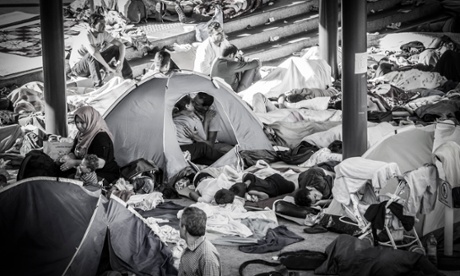
He was in the crowded station for barely half an hour, but it was long enough to capture one of the more memorable images of Europe’s biggest refugee crisis since the second world war; a life-affirming picture that, in its intimacy and tenderness, is a moving counterpart to the heart-stopping photographs of Alan Kurdi, the Syrian toddler washed up on a Turkish beach, that shocked a continent.
Inside a small tent, at 8.40 in the morning, surrounded by squalor and exhaustion – piles of clothing, empty sleeping bags, prone and sleeping people – a young refugee couple turn to each other, hug, and kiss.
“I didn’t speak to them,” he says. “I’m not a journalist, I wasn’t making a reportage. I do weddings, for friends and acquaintances. I rarely photograph in town; I prefer nature. But I try to catch moments. I saw this couple, and it was very touching – especially in those surroundings. So I took the shot.”
Soon after, he posted a black-and-white version of the photograph to a Facebook page hosting a photography competition about the refugees. “The colour image is too vibrant,” he says. “Red and blue sleeping bags, bright-coloured clothes - it distracts you from the moment between the couple. In black and white, it is just one big, touching moment, without annoying things around it.”
From there, it was shared perhaps 50 times, accompanied – apart from the inevitable few who questioned whether it was photoshopped, or posed – by “very nice comments. Everyone needs love, and they can see it here, in this image.”
Two weeks later, a well-known Greek photographer and activist, Yannis Androulidakis, spotted the picture and posted it on his Facebook page, captioned (in Greek): “The refugees will win. Love will win.” From there, it has gone viral.
“I hope every refugee finds a their place in the world, finds peace as quickly as possible,” Zsiros says. “That everyone is happy. It’s a very difficult situation, a very complex situation.”
And he hopes his photograph might change the way people see the situation: “Love,” he says, quoting the movie Interstellar, “is the one thing we’re capable of perceiving that transcends time and space.” And, perhaps, borders.