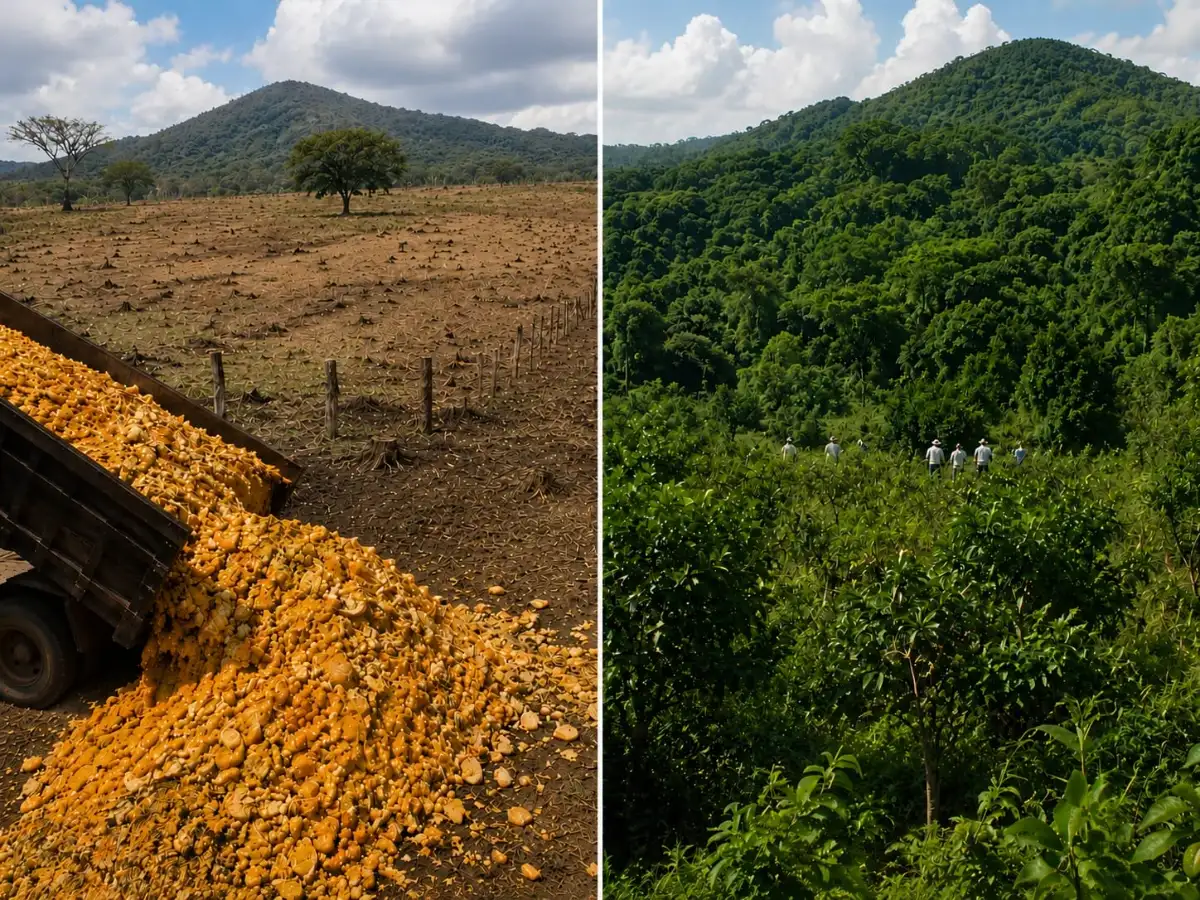
Sometimes nature upends our values: one person's waste is another person's treasure. At times, however, it's an entire ecosystem. One of the most amazing successes in the environmental sphere was sparked by what seemed like illicit dumping in an age where climate impacts and landfill square footage assess food waste. A Costa Rican juice company offloaded about 1000 truckloads of orange peels and pulp onto a barren cattle pasture within the Guanacaste Conservation Area in 1997.
Both critics and environmentalists were given the chance to see the rotting citrus and its potential. Then a lawsuit put the brakes on the project, the site was abandoned, and nearly everyone forgot about it. Sixteen years later, Princeton University researchers carried out a survey, published in the journal Restoration Ecology, and found that the land where the orange peels were dumped had almost three times as much plant growth as the untreated land next to it.
Ecological neglect had subtly given way to a thick tropical forest, with more fertile soils, more diverse tree species, and a closed canopy. The results are still one of the most interesting case studies in real-world restoration ecology. This was no Pulp Fiction; the discarded orange peels helped write a very real restoration story. A story about what happens when waste becomes a resource, business competitions meet conservation, and nature is given 16 uninterrupted years to make its case.
The deal that started with citrus and ended in court
The experiment began in the mid-1990s through an unusual collaboration between Del Oro, an orange juice company, and ecologists Daniel Janzen and Winnie Hallwachs from the University of Pennsylvania, who served as researchers and technical advisers for the Área de Conservación Guanacaste in Costa Rica. The UNESCO listing describes Área de Conservación Guanacaste as a 147,000-hectare mosaic of land and sea, spanning roughly 100 kilometres from the Pacific coast to the Caribbean lowlands. It highlights its tropical dry forest, wetlands, oak forests and savannahs, and notes the site’s importance for endangered and rare species.