Beneath the flyover, the dried stems of wild herbs remain upright despite winter gales. Burdock, mugwort and the dye-plant weld grow here among angular rocks, their basal leaves just starting to show green again.
From overhead comes the constant throb of traffic on the A69, the road linking Carlisle and Newcastle, west with east. This long concrete bridge crosses railway, footpath and the river Tyne, which today is surprisingly low despite the snow melting higher up. I’ve walked this path in all seasons and in all weathers. Today there’s the possibility of spring in the air, along with a scented trace of garden bonfire.
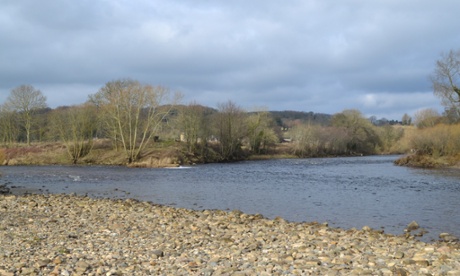
The footpath from Hexham is dank and wooded but, after ducking under the flyover, it curves with the river through a flat, open valley. The long sweep of a levee, pocked with rabbit holes, protects sheep-grazed fields. Between levee and river is a wide scrubby floodplain which, come May, will flaunt confetti colours of sweet rocket – pink, white and mauve. Now, brittle stems of hogweed snap like water biscuits underfoot and isolated clumps of snowdrops gleam under dense blackberry thickets. It’s easy to be snagged by these arching stems which, leafless and rusty pink, echo the colour of the tight catkins on the riverside alders. Everywhere are rabbit holes; among the impenetrable brambles, beneath the willows where they have stripped the bark, even under a wooden bench.
On the river a pair of mallard glide with the current, and a female goosander faces upstream, paddling to just keep pace against the tide. She turns her head to preen under the wing, making her rufous neck feathers quiver. From above the level field comes the joyous sound of a skylark.
In the distance are the smoky blue woods on top of Warden Hill and through the willows I can just glimpse the square tower of Warden church. Here the North and South Tyne waters meet in a white line of ever-changing patterns that bubbles down the centre of the river until the distinction can no longer be seen and the wide Tyne flows away down to Newcastle.