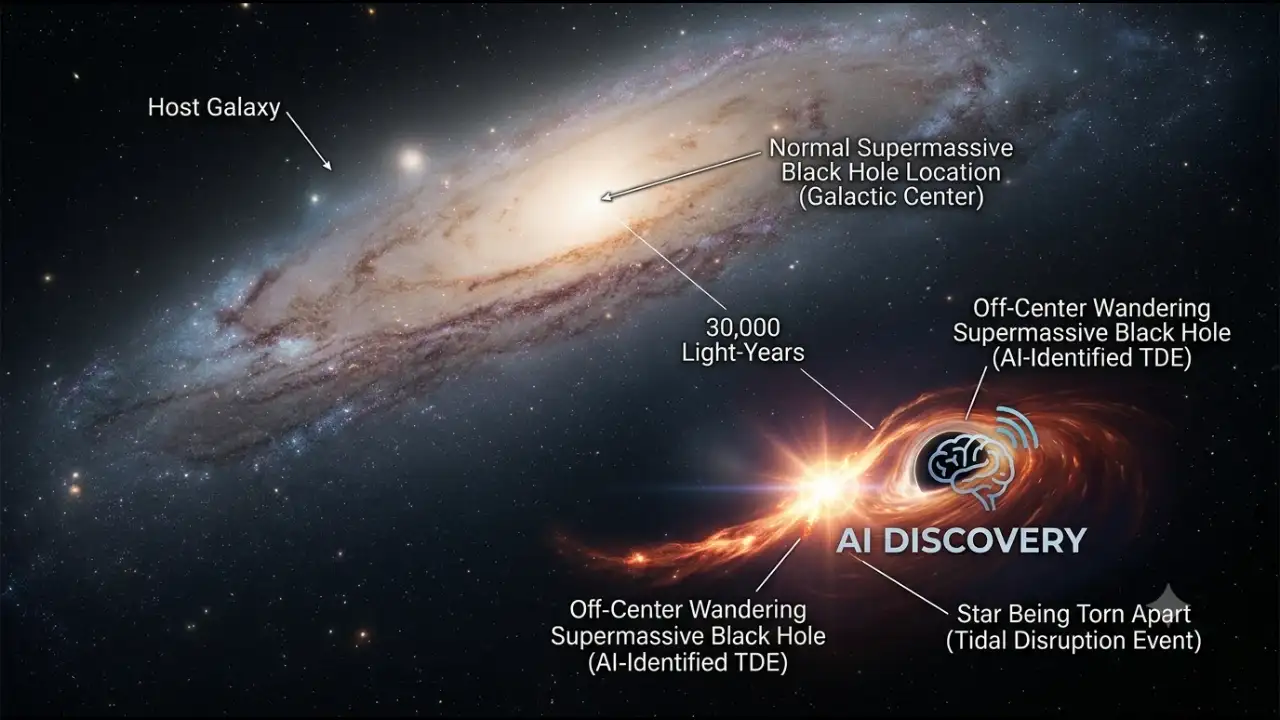
For the first time, astronomers have identified a dormant supermassive black hole located far from the center of its host galaxy. The discovery was possible only because the hidden object briefly revealed itself by tearing apart a passing star and producing a powerful burst of light.
Researchers from the University of Maryland identified the dormant black hole about 9.3 kiloparsecs, or roughly 30,000 light-years, from the center of its host galaxy. The findings were published in The Astrophysical Journal Letters on July 27, 2026.
The discovery challenges the long-held assumption that supermassive black holes are always found at the centers of massive galaxies and could help researchers better understand how galaxies and their black holes merge and build up over time.
A hidden black hole revealed by a dying star
Most dormant black holes are difficult to detect because they are not actively consuming nearby material and do not produce detectable light.
This black hole was discovered because a star passed too close to it and was pulled apart by the object's gravity. The event, known as a tidal disruption event, created a temporary flare that allowed astronomers to identify the otherwise invisible black hole.
Suvi Gezari, an associate professor of astronomy at the University of Maryland said that, "This is a novel result. What's new is that, until now, we've started with the assumption that supermassive black holes reside in the centers of massive galaxies," as quoted by ScienceDaily.
The researchers said the discovery suggests that many more wandering black holes may exist and could help scientists understand how galaxies and their black holes merge and build up over time.
Scientists have predicted wandering black holes for years
Astronomers have long predicted that some supermassive black holes could be displaced toward the outer regions of galaxies during galactic collisions and mergers.
These objects, often called wandering black holes, are extremely difficult to find because many are dormant and do not emit detectable light.
The research team first detected the quiescent black hole using the Zwicky Transient Facility (ZTF), which surveys the northern sky every two days and records hundreds of thousands of changing celestial events each night.
Because examining every event manually would be nearly impossible, the researchers developed an artificial intelligence program trained to recognize the distinctive light pattern produced during a tidal disruption event, when a black hole tears apart a passing star.
AI helped identify the rare cosmic event
The University of Maryland team began operating the AI system in August 2025. Just three months later, it identified the tidal disruption event that led researchers to the wandering black hole.
Study lead author Robert David Stein said the discovery happened much sooner than the team expected.
Stein said, "I remember the moment we discovered it very clearly. It was a Saturday, and everyone was very excited to be messaging. We dropped everything and started triggering all kinds of other instruments to get more data," as quoted by ScienceDaily.
After identifying the event, the researchers quickly used additional instruments to collect more data and study the unusual object.
A massive black hole with no obvious galaxy around it
The black hole has a mass comparable to the supermassive black hole at the center of the Milky Way. However, researchers were surprised because they could not find a visible galaxy surrounding it.
Sylvain Veilleux, a professor of astronomy at the University of Maryland, "To have such a big black hole outside of a galaxy is surprising to me," adding, "There should be a Milky Way-like object around it -- and that's definitely not the case," as quoted by ScienceDaily.
Researchers believe the black hole's unusual location is probably linked to a past collision between galaxies.
One possibility is that a larger galaxy absorbed a smaller companion, stripping away nearly all of its stars and leaving behind only its dense central core and black hole.
Another possibility is that a galaxy already contained two black holes orbiting closely around one another at its center. If a third black hole arrived during another galactic merger, the resulting three-body interaction could have expelled the smallest black hole from the galactic center.
Researchers hope additional observations of the tidal disruption event will help determine which explanation is more likely.
READ ALSO: Scientists uncover how ancient Roman concrete became more durable over nearly 2,000 years
The discovery could open a new search for wandering black holes
Scientists say most known black holes are dormant, including the supermassive black hole at the center of the Milky Way.
The researchers are continuing to search for more wandering black holes to better understand how galaxies form and how many wandering black holes may exist.
The discovery also shows that conventional sky surveys combined with artificial intelligence can identify hidden black holes without relying exclusively on more expensive observational methods.
Gezari said, "It's an example of machine learning opening up a whole new area of research," as quoted by ScienceDaily.
Future observatories could find many more
Researchers expect future observatories, including the Vera C. Rubin Observatory, to identify dozens or possibly hundreds of wandering black holes each year.
Other instruments, including the Lowell Discovery Telescope and its Rapid infrared IMAger-Spectrometer, may also help scientists detect tidal disruption events at much greater distances from Earth.
Veilleux said, "This is the strongest case of a wandering black hole that we know. This is going to set the standard," as quoted by ScienceDaily.
READ ALSO: A rare Greenland shark found in Ireland gave scientists new clues about how it lives for centuries