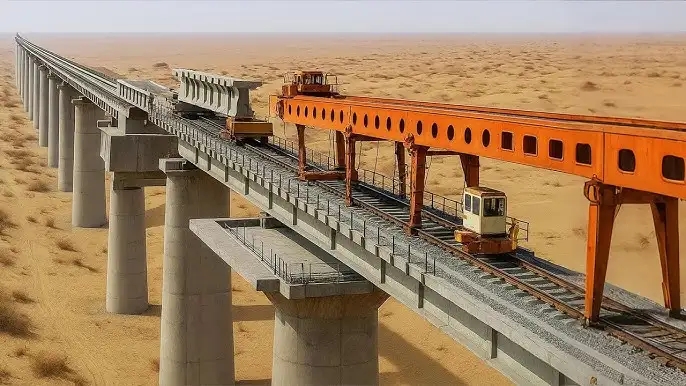
China’s Gobi railway bridge project has captured global attention after claims of a massive 1,118-mile rail bridge crossing the desert spread online. The verified reality is different, but the real story is still enormous. The project connects China’s Ganqimaodu region with Mongolia’s Gashuun Sukhait border route, creating a major freight corridor through one of the planet’s harshest landscapes.
The China Gobi railway project is not simply about building tracks across sand. It represents a bigger shift in global trade, mineral supply chains, and energy security. The planned cross-border railway is expected to handle around 30 million metric tons of freight every year, moving valuable resources between Mongolia and China.
The Gobi Desert has always challenged human ambition. Extreme temperatures, powerful winds, and frequent sandstorms make construction difficult. Engineers are not only fighting distance but also nature itself. The railway infrastructure must survive freezing winters, scorching summers, and constant desert pressure.
The attention around the Gobi railway bridge project shows how modern infrastructure stories can become larger than their original facts. While there is no confirmed 1,118-mile elevated bridge, the actual railway development carries strategic importance. It links major mining areas with one of the world’s largest industrial economies.
Why China’s Gobi railway bridge project matters for global trade
The China Gobi railway bridge project is built around a simple but powerful idea: faster movement of resources. The railway corridor connects important mining zones with China’s transport network. It aims to reduce border delays and improve freight efficiency.
The project comes nearly seven decades after the first China-Mongolia rail connection between Erenhot and Zamyn-Uud opened in 1956. The new railway creates another pathway for growing trade between both nations.
Construction in the Gobi Desert requires extreme precision. Recently, workers completed the installation of 94 T-beams on the Chinese section. These bridge components reached lengths of about 79 to 105 feet, with some weighing around 165 U.S. tons. Such engineering details reveal the real scale behind the headlines. Heavy bridge structures must be placed accurately despite unpredictable weather conditions. A small mistake can create major safety risks when carrying thousands of tons of freight.
How the Gobi Desert railway faces nature and engineering challenges
Building a Gobi railway bridge project across desert terrain requires solving problems that ordinary railways rarely face. The Gobi experiences extreme temperature changes, strong winds, and dangerous sandstorms.
Winter temperatures can fall near minus 40 degrees Fahrenheit, while summer heat can rise above 110 degrees Fahrenheit. These conditions test construction materials, machines, and human endurance. Sand is another major challenge. Desert particles can interfere with equipment and reduce visibility during important construction work. Engineers must carefully monitor structures to ensure long-term stability.
The railway also faces technical challenges because China and Mongolia use different rail gauges. China uses standard gauge tracks, while Mongolia uses a broader system connected historically with Russian rail networks. To solve this issue, the project uses a combined track design. This approach is expected to make cross-border freight movement smoother and reduce delays.
What the China Gobi railway bridge means for the future
The China Gobi railway bridge project is not only a transportation story. It reflects the competition for resources shaping the next decades. Countries are racing to secure supplies of critical minerals needed for technological growth.
China’s role in global mineral processing makes this railway strategically important. Rare earth elements and other materials are central to modern industries. Demand for these resources continues to rise as clean energy investments expand.
However, the desert route also brings environmental concerns. The Gobi ecosystem is fragile, and large infrastructure projects can affect wildlife, land conditions, and natural balance. A railway may reduce some truck traffic and lower transportation pressure. But construction itself can disturb sensitive landscapes. The challenge is finding a balance between economic development and environmental responsibility.
The verified project is not a 1,118-mile bridge floating across the desert. It is something more realistic and perhaps more significant: a strategic corridor connecting resources, industries, and future energy demands.
FAQs:
Why is the Gobi Desert considered one of the most challenging places for infrastructure projects?
The Gobi experiences extreme temperature swings, strong winds, scarce water resources, and vast remote areas, making construction, maintenance, and logistics far more difficult than in most regions.
What industries benefit most from large desert transportation networks?
Mining, energy, manufacturing, logistics, agriculture, and international trade often see the greatest benefits from improved rail connectivity.
Are desert rail projects becoming more common worldwide?
Yes. Countries in Asia, the Middle East, and Africa are increasingly investing in desert transportation corridors to support trade, resource development, and regional integration.
How does climate affect the lifespan of rail infrastructure?
Extreme heat, cold, wind, and sand exposure can accelerate wear on tracks, bridges, and equipment, requiring specialized engineering and regular maintenance.
Could desert rail corridors support future trade routes?
Yes. Strategic rail links can strengthen cross-border commerce, connect resource-rich regions to manufacturing hubs, and become key parts of international supply chains.
What makes railway engineering different from road construction in deserts?
Railways require stricter alignment standards, greater structural stability, and more precise maintenance because even small shifts in track position can affect safety and performance.