MIAMI — LaToya Ratlieff was nearly another name on the ever-growing list of Black people killed by police in America. She was perhaps half an inch away from being memorialized with the next "Say Their Name" hashtag.
She got lucky. That's what doctors said when she arrived at the Broward Health Medical Center on May 31, bleeding from a two-inch gash on her forehead, her eyes swelling shut. Half an inch lower and the "rubber bullet" that fractured her right eye socket could have exploded her eye. The blunt force of the impact could have caused catastrophic brain injury.
She could have died.
Ratlieff — who friends and family describe as a soft-spoken do-gooder — had been attending a Black Lives Matter protest in Fort Lauderdale when she was shot. It her instinct to do the right thing that put her in harm's way.
It was the end of a day of peaceful marching. On her way back to her car, Ratlieff stopped to help calm a small group of protesters who had been antagonized by an aggressive officer as they walked away from the main rally. Worried for their safety, she asked the group of mostly young Black men to kneel to show the line of police in riot gear they weren't dangerous. Then an officer shot the one-and-a-half-inch hard-packed foam projectile at her forehead from just over 30 feet away. "The potential for causing death ... is a reality" especially from shots to the head, according to the Fort Lauderdale police training manual for those weapons.
Ratlieff, a 35-year-old woman from Delray Beach, survived — but her life was shattered. Side effects from the rubber bullet's impact include debilitating migraines, difficulty remembering words and a strange flashing in her right eye that doctors still cannot explain. They still don't know if she has permanent brain damage.
In a series of interviews with the Herald over the past six months, Ratlieff described the mental toll of her drawn-out fight for justice and police reform. She has never received an official apology from police or the city.
"I don't know if I'm depressed. I don't know if I'm exhausted. I don't feel like myself anymore," Ratlieff said. "It feels really difficult."
Ratlieff doesn't talk much about what she is going through. She doesn't want to put the burden on anyone else, especially her family. She also worries that if she is perceived as angry or frustrated, even for a moment, it will cause people to get uncomfortable and ignore her. She does not want that to affect her ability to bring something positive out of the situation.
But if she's being honest, Ratlieff says she is "pissed."
She is angry that half a year after she was shot, no significant changes have been made to policing in Fort Lauderdale. The police chief who blamed protesters for provoking officers and starting the violence was removed. But the officer who shot her is still on the street. She doesn't even know what he looks like, something that makes her uncomfortable being in public.
"It's not so much mind-boggling as much as it's a slap in the f---ing face," Ratlieff said.
But more than anything, Ratlieff is frustrated with herself. She feels like she should be better by now. She should be able to ride her bike and do other things she used to love. She shouldn't be so tired or lonely. She wishes she weren't so angry. Or so hurt. Or nervous.
"They don't realize what they take because it's not just physical stuff," Ratlieff said. "It's my confidence. It's my eagerness, my desire, my optimism that no matter what happens things always get better."
Once, just a few weeks after she was shot, the wind blew a door in her home closed with a loud bang. Ratlieff said she fell to the ground shaking and had to take the rest of the day off of work. The next day she decided to temporarily move in with her family. The fiercely independent woman was too terrified to be alone.
Before being shot, Ratlieff volunteered on her community's police advisory committee. And though she was hyper-aware of systemic racism in policing and often worried about her 6'2" nephew being seen as "dangerous" because of the color of his skin, she was not anti-police. She's still not. "I really want to believe there are more good officers, than bad," she said. But now when she passes an officer on the street, she is afraid. And even though she said she feels "stupid," sometimes she walks a few extra blocks just to avoid crossing paths.
"She wasn't like that before. It started since this situation," said her cousin Zwinika Robinson. "I think she has PTSD."
Other people interviewed by the Herald think so, too.
In her good moments, Ratlieff can see she's made a difference. She feels good about using her platform to shed light on systemic injustice and call for reforms in the Fort Lauderdale Police Department. She testified remotely before the U.S. House's Oversight Subcommittee on Civil Rights and Civil Liberties. But she is also tired. And the bad moments are starting to get really bad — and more frequent.
"I'm scared I may not get out of it," Ratlieff said in a recent interview.
Clinical psychologist Monnica Williams, who specializes in racial trauma, said most victims of police violence, especially those who speak out, experience burnout similar to what Ratlieff is describing.
"The reality is she spoke before Congress. Did anything change? Probably not. That just gives you a sense of futility," Williams said. "There's only so many times you can hit your head against the wall before your head starts to bleed and you pass out."
Sometimes Ratlieff wonders if it would have been better if she would have just gone home for dinner on May 31 instead of stopping to defuse a conflict. Her life would be so different if she would have just walked by and hadn't tried to help. She would not have been shot. She could be out volunteering for good causes now, like she used to. But her doubts are fleeting.
"I don't change anything that happened because it could have been someone else," she said. "It could have been someone else and society would have pulled their past and used that against whether or not they were allowed to be a victim. So I don't regret that it happened to me."
Every time a Black person is injured or killed by police in America, Ratlieff noted, there is an effort to undermine their validity as a victim. Michael Brown was a shoplifter. Eric Garner was selling loose cigarettes. Breonna Taylor's boyfriend was an alleged drug dealer. Trayvon Martin wore a hoodie and looked suspicious. George Floyd bought cigarettes with a fake $20 bill.
There is no possibility of a similar narrative with Ratlieff. Video shows her doing nothing illegal, or even remotely aggressive, before being shot. She has no criminal record. Barely a speeding ticket. She works for a nonprofits that care for children and the needy. Her favorite pastime is volunteering, especially for causes that support animals. She's the great niece of civil rights icon Fannie Lou Hamer. She is the so-called perfect victim many pundits have always claimed they were waiting to support.
Yet public opinion shifted in the second half of the year as President Trump's reelection campaign, aligned with Republicans in South Florida and elsewhere, spent millions demonizing protesters. Persistent messaging lumped arsonists, looters, antifa "terrorists" and Black Lives Matter supporters into the same bucket. And after initial outrage, as weeks turned to months even most of Ratlieff's initial supporters seemed to move on to their next cause célèbre.
Rather than working with Ratlieff, the City of Fort Lauderdale asked the National Police Foundation to recommend possible reforms. Some changes have already been made, city spokesman Mike Jachles said in a statement. "This outside review will assure that we are in alignment with best practices consistent with 21st-century policing," Jachles said. He did not respond to questions about whether the city or police department plan to formally apologize.
The details of the review have never been made public. In response to the Herald's request for more information about the implemented reforms, Jachles provided a short list of changes at the department: two updates to the policy on extending the review of "use of force" during "resistance incidents" that result in injury, a "procedural justice and communication class" for all officers and the addition of a pepperball multi-launcher to the department's already robust arsenal of "less lethal" weapons used for crowd control.
Ratlieff said she hasn't heard anything from the city in months. She wanted reforms that addressed racial bias and allowed more oversight and accountability.
"We worked so hard to get nothing," Ratlieff said. "We're not getting any type of answer or response or addressing of the issues as to why people were out there protesting to begin with."
Black lives matter
Nineteen-year-old Bradley Placide watched police lob tear gas at a group of kneeling protesters outside a parking garage after a Black Lives Matter rally in Fort Lauderdale on May 31. He didn't know what started it — the protest had been peaceful all day — but didn't want to get involved in any trouble. Placide backed away. He was standing outside of his black Infiniti about a block down the street when he heard a loud sound — something between a pop and a crack like a whip. Then the screaming started.
An officer had shot a woman with a rubber bullet.
Through the fog of tear gas, Placide saw a woman stumbling toward him, holding her forehead, supported by other protesters. She was bleeding. A lot. He didn't think twice. He offered to drive.
"I knew I had a way of helping. I would feel bad if I didn't do anything," Placide said.
The group piled into Placide's car. None of the helpers knew each other. Nor did any of them know Ratlieff, the woman apologizing for bleeding in the backseat. They'd just seen what happened and knew she needed a hospital. One man tried to comfort Ratlieff, who seemed to be going into some kind of shock. Another pressed a T-shirt to Ratlieff's wound to try to stop the bleeding. Placide pulled up his GPS and began to drive to the nearest hospital.
Somewhere along the drive, Ratlieff called Robinson, her cousin. She would need a ride home from the hospital, she said as she described what happened.
"Oh my god, somebody shot you in the face!" Robinson remembered yelling into the phone.
"We were like chickens with our heads cut off trying to figure out what was going on," Robinson said. She could not understand why anyone would shoot Ratlieff, a woman she described as "fragile" and one of the sweetest people she knows. The incident traumatized the whole family, she said.
Doctors at Broward Health told Ratlieff she had a fractured eye socket, but luckily there was no bleeding in her brain. They weren't sure if she would permanently lose vision. They weren't sure if she had brain damage. Only time would tell. The 20 stitches that would surely cause a permanent scar above her right eye were an afterthought.
Placide and the two others stayed in the waiting room until Ratlieff was released.
"I told them they're my friends and they're stuck with me for life," Ratlieff said.
It wasn't until the next day, when the adrenaline started to wear off, that a realization of what happened began to sink in. She wasn't totally sure what happened. Could she have been hit with a rock? Or maybe a tear gas canister? That would make more sense than getting shot for no reason, she thought. But doctors and other protesters told her they thought her injuries were caused by a rubber bullet. Ratlieff spent her first day of recovery wondering what she possibly did to make an officer feel so unsafe that he would take a potentially lethal shot.
"Was there a point that I moved in a certain way?" Ratlieff wondered. The feelings of uncertainty worsened as she began to receive hate mail online from people who discovered her identity. Some said she deserved it for being at the protest.
Then a Miami Herald reporter who had seen what happened called Ratlieff.
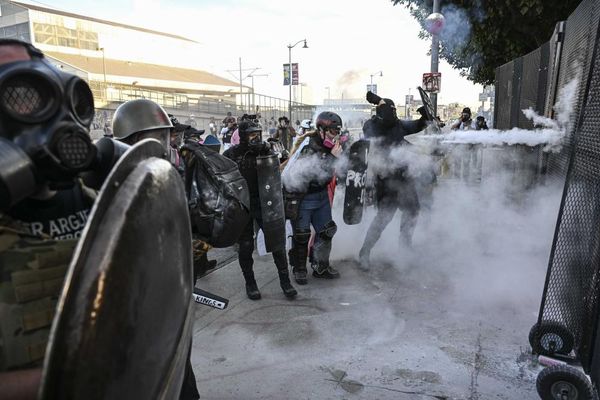
The reporter described — and video footage would subsequently show — that group of several dozen protesters splintered off the main group after the official rally ended and marched down a side street when an officer, later identified as Fort Lauderdale PD Officer Steven Poherence, walked into the crowd unprovoked and shoved a kneeling woman in the head. The crowd erupted, pelting the officer with plastic water bottles. Police responded with several rounds of tear gas.
Ratlieff arrived outside the parking garage as the tear gas began to clear. She said she was on her way home for dinner but sensed things were tense and stayed to help deescalate the situation. She convinced the protesters who were still in the area to kneel peacefully to show the officers holding batons that the group meant no harm. Without warning, police began to shoot tear gas again.
Ratlieff was stumbling away, choking on gas when an officer — later identified as Detective Eliezer Ramos — raised his launcher and shot, apparently blindly, into the cloud of gas. The rubber bullet hit Ratlieff's forehead at twice the speed of a major league fastball and ricocheted 50 feet down the side street.
The police training manual says a shot to the head with a rubber bullet is potentially lethal and should not be taken unless deadly force is justified. (Everyone seems to agree it wasn't.) And all officers cleared to use "less-lethal" munitions — meaning those less likely to kill than a standard bullet — take marksmanship training where they are taught to aim low, for the thighs or other large muscle groups, in crowd-control settings. (In his after-action report, Ramos said he was aiming for a protester who protester threw a tear gas canister back in the direction of the line of officers. Video shows that protester around 20 feet behind and off to the side from Ratlieff.)
"I wasn't crazy," Ratlieff said she realized as she gathered more information. She remembers thinking to herself: "You didn't do anything wrong, you've been trying to find a reason to justify what happened to you. Now you can stop doing that."
The next month and a half were full of interviews on network television — an uncomfortable new experience for a lifelong introvert like Ratlieff. Still, she was determined to speak out. "If no one talks about it, then people will move on and things will continue to happen," Ratlieff said.
Gone was her quiet existence walking around Delray Beach with the love of her life, a tiny Bichon-Poodle mix named Fluff. She was suddenly responsible for telling Don Lemon how to understand a movement that she had been a part of — but by no means as a leader. Social media followers demanded an opinion on how she felt about every political issue that Rachel Maddow mentioned. Others just wanted to know if she was OK.
Instead of resting, Ratlieff has been busier than ever: reading up on current events to never get caught flat footed, attending doctor appointments, prepping for TV interviews, responding to supporters and trying to ignore the hundreds of messages that come in telling her she deserved the shot to the fractured eye socket. In a way, she was grateful the pandemic necessitated wearing a mask in public and ensured her some level of anonymity.
"I don't exist in a middle ground with people," Ratlieff said. "I'm either a terrible person. Or I'm a martyr. I don't want to be that. I want to be just a normal person going out for the day."
Blacklash, then nothing
Ratlieff always knew her getting justice would be an uphill battle. But she said the lack accountability or even an apology from the city has been even more disappointing than she expected.
"It makes me wonder if I looked differently, would they be more empathetic?" Ratlieff said. "Am I being treated this way because the protest was about police brutality, or because of my race, or they just don't care?"
When the Herald first contacted Fort Lauderdale Mayor Dean Trantalis for comment about Ratlieff on June 2, he suggested she was at fault for being in the crowd at all. "There would be no reason why I would stay there if I saw tear gas and rocks being thrown," he said. Within days, as more video evidence emerged showing Ratlieff had not been part of any violence as so many assumed, he walked back the statement.
"I don't know the circumstances," Trantalis said on June 4. "All I know is this woman was hurt. No one should be hurt during a demonstration." In a news released issued the same day, he called what happened to Ratlieff "reprehensible" and claimed he "personally apologized" to Ratlieff. (In response to questions from the Herald, he qualified that to say he left her a voicemail.) Ratlieff said she does not remember receiving any such messages, and when she checked her phone there was no record of one.
"LaToya missed a call from the mayor in early June," said Evan Ross, Ratlieff's communications consultant. "I reached out to the mayor at the time to let him know she looked forward to speaking with him once she was able." Ross said Ratlieff has not received an apology from any of the city leadership.
Then-Police Chief Rick Maglione also blamed protesters for starting the violence, and did not apologize for what happened to Ratlieff either. "We are trying to preserve people's First Amendment rights," he said in the days following the protest. "But violence will not be tolerated at all."
Maglione said a female officer had been attacked in her car, prompting police to use tear gas and rubber bullets. The Herald reviewed body cam footage and more than 100 photos taken by journalists and protesters at the time and place of the alleged attack. While the officer's car did appear to have footprints on the trunk, there was no documentation of an attack as described. But the review did reveal a group of officers on the scene laughing and joking while shooting rubber bullets at protesters from close range. "Beat it little f---er," one yelled as he shot. Still, the chief defended their actions.
"Although the language is extreme, and offensive to some, our officers were dealing with the chaos of a developing situation," Maglione said. Soon after, Maglione was removed from his position as chief, although he remains active on the force.
"We changed our police chief because we felt his philosophy was not consistent with the goals of our community," Trantalis told the Herald. "What was important was for the community to understand that the men and women who make up our police department are there to protect people and they shouldn't fear officers and we weren't sure that message was resonating with the leadership of the department."
Despite clear departmental policies against shooting rubber bullets at the head, internal affairs investigators initially said they could not investigate whether the shot that injured Ratlieff was in line with protocols because Ratlieff had not filed a complaint. Within a week, they changed their position in the face of mounting public pressure. When Ratlieff did not immediately feel comfortable doing an interview with the police, the department issued a statement seemingly criticizing Ratlieff for speaking to the media but not to them — a sentiment the mayor also initially echoed. Online, people said she was whining and told her to "get a job."
"In some ways, it felt like being a normal Black woman in the world," Ratlieff said about the response. " I always feel like I shouldn't be talking about something. I always feel like I'm not allowed to share how I feel about things."
In August, after she had recovered enough, Ratlieff met with city officials to present a list of reforms that she hoped the city would implement. The city seemed willing enough at the time. Ratlieff also agreed to meet with internal affairs investigators that day. But she said when she arrived, the officer in charge told her he was friends with Ramos and that he was sure the shooting had been "an accident" because he was a "good guy."
She left without doing the interview. The investigator was removed from the position and the investigation was temporarily put on hold.
"The City of Fort Lauderdale remains committed to conducting a thorough and objective investigation into this incident," said Jachles, the spokesman, in a statement to the Herald on Dec. 10. "The investigation continues and we plan to meet with her prior to its conclusion."
Ratlieff's attorneys have indicated that they are considering a federal civil rights lawsuit if the city does not sit down with Ratlieff for a meaningful discussion about reforms.
Thinking about the future is difficult for Ratlieff, who says right now, she's taking it a day at a time. She tries to count her small victories, like the first day she got to eat solid food (a banana, avocado and boiled egg). She also talks to her friends and family more. ("It does put things into perspective," she said "I tell them I love them all the time now.") And she is finally going to take a break to focus on herself and getting better. ("I don't want to wake up on January 1 and feel like I feel now," she said before Thanksgiving.)
"I want to be able to move on from it just like everybody gets the opportunity to move on," Ratlieff said. "Because I'm pretty sure Officer Ramos doesn't hear about this anymore. He doesn't have to."
Meanwhile, Ratlieff's life — specifically, thanks to Google, any future job interviews or dates — will forever be shaped by a single shot Ramos fired.
_____
(Miami Herald investigative reporter Nicholas Nehamas contributed to this report.)