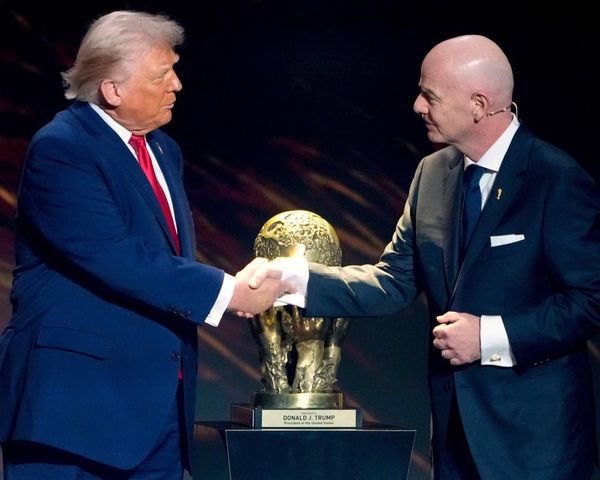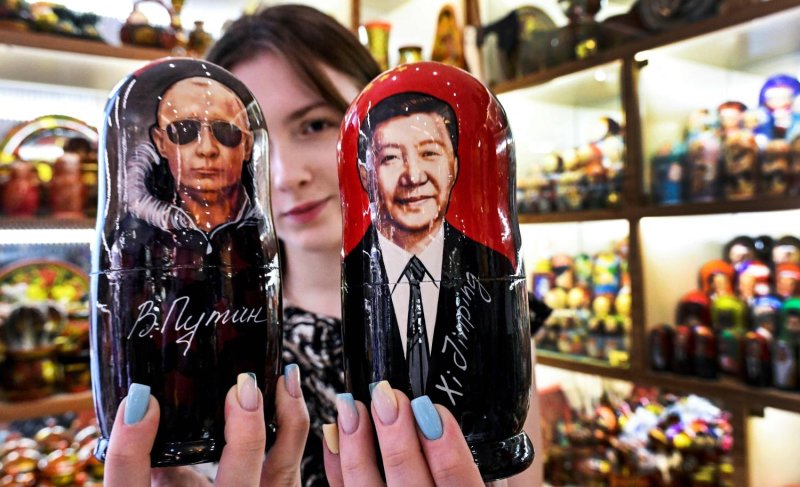
More geostrategic roads are undeniably leading to Beijing. Russian President Vladimir Putin's visit to the Chinese capital this week and his summit meeting with President Xi Jinping should be viewed both in conjunction with and in contrast to American President Donald Trump's similar outing less than a week earlier.
Given recent fluid manoeuvres on the global geostrategic chessboard, China under Mr Xi has become the pivotal, central player above others at this time. Russia needs China's support to see through its war in Ukraine toward a workable settlement. Mr Trump needs Mr Xi's help in persuading Iran to make concessions on uranium enrichment and on Tehran's blockade of the globally vital Strait of Hormuz and Washington's denial of Iranian shipping on the same waterway. China is now the senior in Russia's junior partnership and patron to Iran. Beijing's geostrategic capital and leverage have never been higher.
What is taking place on the global chessboard at this juncture is profound and comparable only to two prior inflection periods in the past 80 years. One was America's realignment to outflank the Soviet Union, which culminated in President Richard Nixon's visit to China in 1972. The other was the fall of the Berlin Wall in 1989 and the related collapse of the Soviet Union in 1991, officially ending more than four decades of the Cold War. It is plausible great-power preferences and movements over the coming months may reshape the international system for years to come.
Such reshaping used to pivot largely on how America perceives and influences the rules, norms, and institutions that underpin the global order, in coordination and cooperation with partners and allies. That Washington, under the second Trump administration, has upended the eight-decades-old global order has given China an unprecedented opportunity to mould and determine geostrategic outcomes in the international system. This turning of the tables manifested with Mr Trump's recent visit to Beijing. After having to postpone it from March 31 because of the unanticipated conflagration and complications over the prolonged Iran war since Feb 28, Mr Trump's visit on May 13-15 reinforced the guardrails and de-escalation of the trade and tech war when Mr Trump and Mr Xi met in Busan on Oct 30 last year.
As Mr Trump's miscalculation over the US joint attack with Israel against Iran effectively violated international law and the United Nations charter, America's loss of a semblance of moral authority is already a major casualty of the war. When the US, as the chief architect, underwriter and guarantor of global order, turns against it, as Trump II has, the international system effectively reverts to self-help as states scramble to shift and form alliances and partnerships for survival.
In China's case, at issue is how to survive but how to seize opportunities to maximise interests. Mr Xi's opening remarks to welcome Mr Trump were instructive. As the Chinese president put it, "The world is at a crossroads. Can China and the United States (sic) transcend the so-called 'Thucydides Trap' and forge a new paradigm for major-power relations? … Can the United States (sic) and China create a new paradigm of relations to meet these global challenges together?"
Mr Xi's framing of the China-US relationship remarkably harks back to the geostrategic language coming out of Beijing in 2013, shortly after he took power. Back then, the Chinese leadership peddled the concept known as "a new type of great-power relations", implying China was becoming a geostrategic peer of the US. In spheres where China was dominant, it should be second to none. In others, however, the US can maintain its preeminence and preponderance. Some 13 years later, the tenor and tone have shifted from co-equal and even a junior partner in some areas to a complete equal in all spheres.
What Mr Xi said at his Beijing reception for Trump can be interpreted as a proposition of sorts for mutual accommodation and understanding within their respective spheres of influence. It was couched as "a new vision for building a constructive China-United States relationship of strategic stability". That Mr Xi alluded to the Thucydides Trap, whereby a declining power is surpassed and displaced by a rising challenger, is telling. Mr Xi and the Chinese leadership evidently did their homework and thought through what kind of bilateral relations they preferred. Unsurprisingly, Mr Xi drew a red line around China's self-entitled sovereignty over Taiwan.
Mr Trump was coy and did not address Taiwan in front of Xi, but subsequently suggested that the successful capitalist and democratic island-state could be a bargaining chip in dealing with China. While his conciliatory stance unnerved the Taiwanese, Mr Trump tried to keep Japan on side by calling Prime Minister Sanae Takaichi immediately after his departure, although the short conversation appeared perfunctory. What happens next is to be determined in subsequent summits in September, when Mr Xi is invited to the White House, and perhaps in November, when China hosts the Asia-Pacific Economic Cooperation's leaders' meeting.
Unlike Mr Trump's visit, Mr Putin's was smoother and reaffirmed close China-Russia relations on the 25th anniversary of a bilateral cooperation treaty. The two sides stressed a "multipolar world order" and issued a joint statement calling out US unilateralism and "irresponsible" security policies, whereby Beijing again has seized the moral higher ground and presented itself as the adult in the room trying to mediate and resolve international conflicts rather than causing them. A major benefit to China from the Russia-Ukraine war is that Moscow now accepts its dependent junior role in bilateral relations. Mr Xi appeared intent on reassuring that the China-Russia partnership remained on course in view of his ongoing dealings with Mr Trump.
China now holds more geostrategic cards than the US. The "strategic stability" that emerged from this summit will be tested in future meetings this year between Mr Xi and Mr Trump. If Mr Trump somehow rebukes the Chinese leader's overture for mutual accommodation and co-equal superpower status, bilateral ties may become rocky and unstable.