If you eavesdrop on the conversations of naturalists like as not you’ll hear them trading tales of rarities that they have found. We all do it. In my case I blame the Collins Pocket Guide to Wild Flowers of my youth, which had star ratings for elusive species, an open invitation to search these out and establish boasting rights for having ticked off the rarest.
There is not much botanical kudos in announcing that you’ve found a ubiquitous, common, species, such as coltsfoot.
But it was when we discovered its first radiant, chrome-yellow blooms of the season, packed between jagged grey rocks armouring the sea wall against the waves at the mouth of the river Wear, that I realised I’d never really looked at the flowers of Tussilago farfara closely.
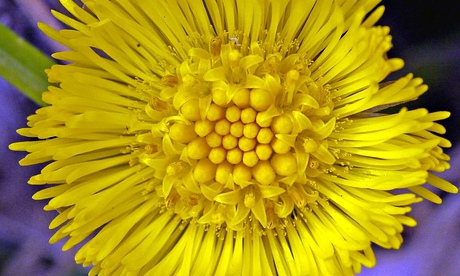
The plants are always a welcome signpost to spring, but you really need to dismantle a coltsfoot inflorescence to appreciate that it is an evolutionary masterpiece. Each of the plant’s slender ray florets is female, with a long stigma which is split at its tip into a curled, receptive, surface waiting for the arrival of an insect laden with pollen.
Seen under a hand lens, the central disc florets in this composite flower proved to be hermaphrodite. Each had a central stigma rising like a piston through a ring of stamens, guaranteeing self-pollination but at the same time sweeping pollen into the path of a visiting insect, for onward transport to a female ray floret of another plant.
The disc florets open in a centripetal, spiral sequence over several days, so no bee can collect all the pollen in a single visit; coltsfoot is parsimonious with its genes, eking out their distribution for maximum effect.
Down among the rocks, a queen bumblebee, which might have spent the winter sheltering there, had landed on a coltsfoot flower, which bent under her weight.
As she scrabbled for grip on her sagging perch and clambered between the blooms in search of pollen and nectar, her efforts seemed clumsy compared with the intricacy of the floral mechanism that was exploiting her.
Phil Gates @seymourdaily
• This article was amended on 19 March 2015. Because of an editing error, an earlier version said that the “central disc florets in this composite flower are male. Each has a central anther rising like a piston through the rest of the stamen”. See the writer’s comment below for further details.