I know nothing at all about ice skating. OK, I’ve been a few times, and I don’t usually fall over – but this is because it’s quite easy to avoid falling over if you just shuffle around the edge of the rink, staying at finger length from the handrail at all times, muttering about all the mulled wine you’re going to consume as soon as someone yanks these murderous boots off your feet. I know so little about proper, actual ice skating that I didn’t even realise Robert Burgerman, who has agreed to give me a lesson at Lea Valley ice centre in east London, has also worked as a coach on Dancing on Ice, which is rather a big deal on ITV. I’ll be honest – the whole thing has always just seemed a bit sparkly and showy to me.
And so it is I find myself nervously getting on to the ice on a weekday afternoon, where it turns out lots of people are practising their moves already. One of them is dressed up like an ice skater off the telly, all glittery white leotard and shiny blonde hair, but there’s also a woman practising her moves in a Batman T-shirt, tracksuit bottoms and a hijab. A middle-aged man is doing it therapeutically, to recover from an accident.
At 4pm, a load of schoolkids turn up, and they all seem to know exactly what they’re doing. It’s a sunny day outside. Ice-skating is starting to feel like a secret society that unites the community behind closed doors. Who knew?
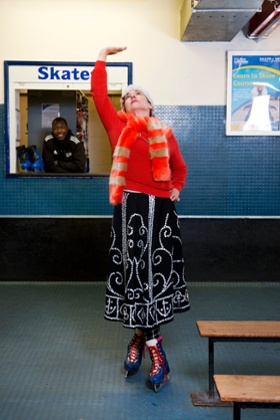
But we are here to learn ice dancing, not just skating, which means I will be trying to spin on the spot like a pirouetting ballerina, glide backwards, and dance with Rob on my arm.
We start by marching on the spot, which gradually turns into a sort of gliding on the spot, rather than trying to head off too fast into the wild yonder of the rink. Rob is a very entertaining bloke, who doesn’t have any expectations of talent, so he’s used to starting right at the beginning. But my God he has his work cut out trying to keep my legs together. It sounds like a Carry On joke until it becomes apparent that I really do struggle keeping my thighs anywhere near each other at all. How bad has this been, all my life? Have I been taking up two seats on the bus like a sprawly bloke? Or subconsciously trying to fake a thigh gap?
Finally, he makes me skate with a glove between them. Letting it drop means my thighs have come apart. This trick works: I can keep the glove there for up to, well, a couple of seconds at a time, at least. And I learn to glide, and – wow, it feels quite wonderful, actually.
The fact I can ski proves helpful: I understand the idea of leaning out and leaning in. (Well, it’s either from skiing or reading Sheryl Sandberg.) I remember a few old ballet positions from childhood, too, and these come in useful when learning different moves. One thing is the same though – and this goes for skiing and skating, rollerblading, even salsa and yoga – and that’s what you do with your core. We use the old Alexander technique trick of sorting out your posture by pretending you’re a puppet with your head being pulled up by a string. After that you can bend your knees, but you do need to be in a line to start with. Feet, hips and shoulders all working together on this.
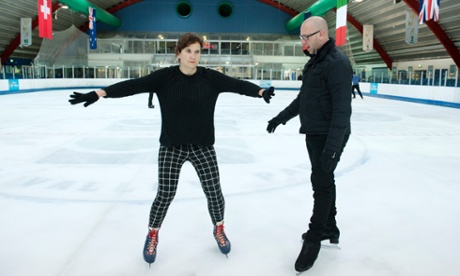
The most terrifying moment is when we do a lift. It seems incredibly strong on Rob’s part, pulling me into the air like that – but he reveals that although “it looks like the blokes are doing all the work, really it takes a lot of strength on the woman’s part too.”
It is a genuinely emotional experience. The note I took at the time says that I “felt like swirling vortex of chaos uprooting myself from Earth like tree in a storm”. A friend who does advanced yoga says that some positions open up buried emotions she hasn’t felt in a long time, and I’m finally starting to get what she means.
When I land back on Earth from that lift I find myself talking in a Yorkshire accent, something I lost after moving south 20 years ago. Honestly, it is very weird indeed. Something has shifted in me, and it isn’t sparkly or showy. It’s human.
For lessons with Robert Burgerman, visit ice-burg.co.uk. For information about skating at the Lee Valley Ice Centre, go to visitleevalley.org.uk/go/iceskating.
How to fall over – and get up again – with dignity
(Illustrations: Son of Alan)
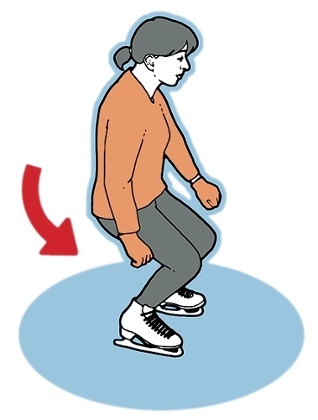
If you feel as though you’re about to fall, begin to kneel. Keep fists clenched to protect your fingers.
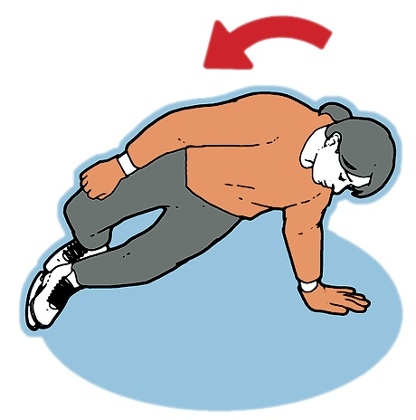
If you’re still heading iceward, fall in a controlled manner to one side and forwards, as slowly as you can.
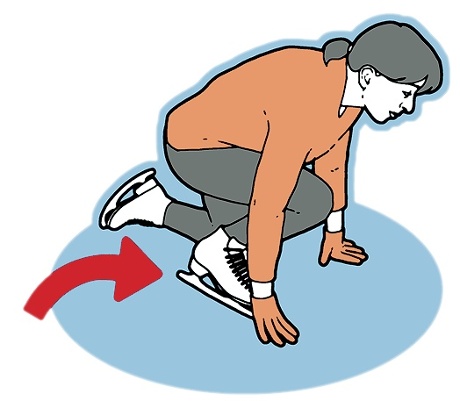
When you’re ready, get on to your hands and knees, keeping your fingers well clear of your skates.
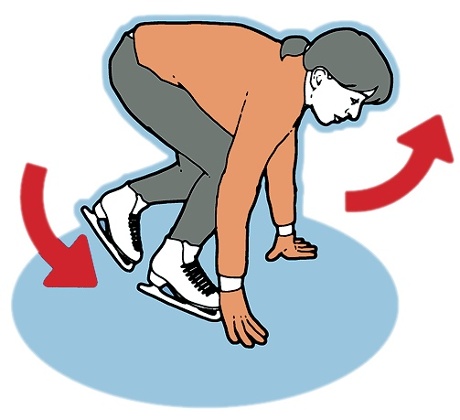
Using the sharp point of your skates to avoid slipping, get your other foot between your hands and stand up.


.jpg?w=600)