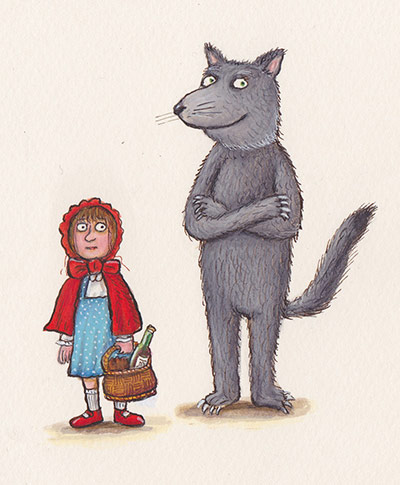
'An encounter in the deep dark wood, a hungry furry predator looking for a meal ... sound familiar? But this little girl is slightly less cunning than a certain little mouse – she looks a little clueless and naive. Still, it ends well for her – not for the wolf however, while a certain big monster got away – still hungry, but alive' Photograph: Booktrust
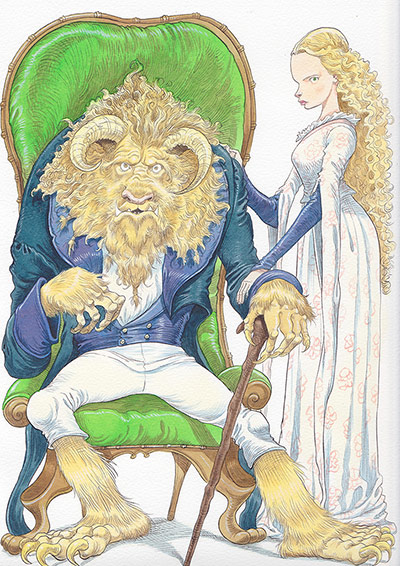
'I've always loved this fairytale and its message that inner beauty is more important than outward appearance. Beauty is indeed beautiful but, unlike her sisters, she is also unselfish and tenderhearted. Despite his fearsome looks, the beast is noble and kind and this earns Beauty's love, something I found peculiarly compelling as a teenager watching the Jean Cocteau film of the fairytale. My favourite part is when Beauty returns to the Beast's castle to find him dying in the rose garden and declares her love for him – far more powerful than anything in the Twilight Saga. I gave my beast a leonine appearance to reflect his noble character and gave Beauty's dress a rose pattern to echo the rose garden. I liked the design of the Beast in the Disney film and am sure I'm not the only one who was disappointed when, at the end, this magnificent beast was transformed into a rather anodyne prince. I suspect Beauty was too' Photograph: Booktrust
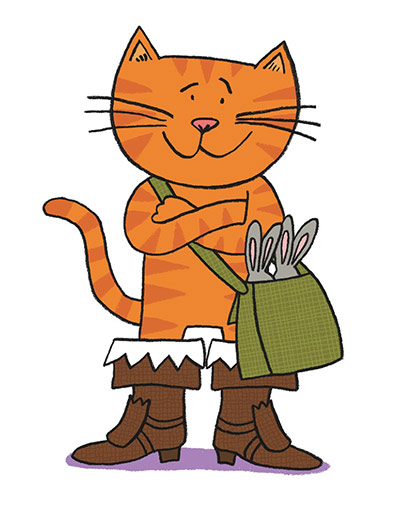
'I've drawn most fairytale characters in the course of my career (and I must have portrayed Goldilocks in books at least half a dozen times – one version sported dreadlocks and another got renamed "Goldisocks"), but I haven't had a proper go at Puss in Boots, and I really like drawing cats. It's an intriguing, peculiar story and actually a bit amoral if you think about it. But with fairytales it's best not to analyse them too much; if you do it spoils the fun and you find yourself asking why on earth a cat would be so keen to own a pair of boots in the first place' Photograph: Booktrust
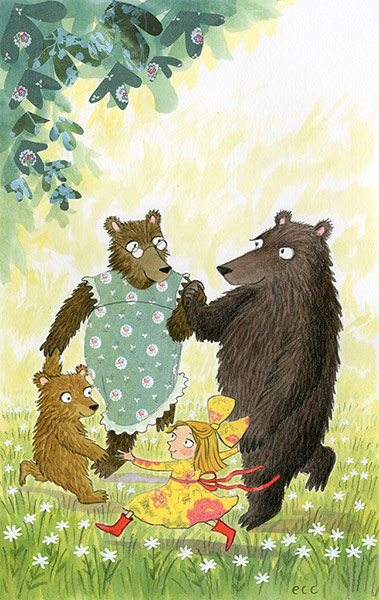
'Goldilocks is my favourite of all the well-known traditional story heroines. I love her reckless, unashamed naughtiness; her brazen disregard for rules or manners, which few heroines are allowed to get away with nowadays. I've drawn her twice before in two other books, so making her look different was a fun challenge, as were the glorious bears. I can hardly think of anything I like to draw more than bears (apart from my dog, Plum). These bears, as ordinary as a family of bears can be, are suddenly propelled from surprise to shock to outrage, all because of one little girl's bad behavior. But I never really believed they'd be very cross with her – she's just a little girl, after all – which is why I've drawn them dancing together. I think they probably forgive her in the end' Photograph: Booktrust
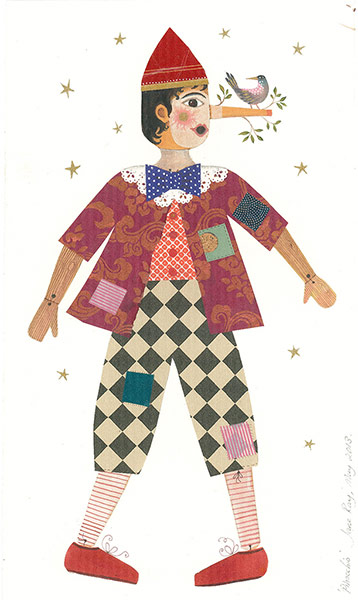
'I've been illustrating fairytales for many years now – Cinderella, Snow White, Sleeping Beauty, Hansel and Gretel – I've done them all. I've drawn princesses, witches, lost children and enchanted creatures too numerous to mention. But I've never illustrated Pinocchio. (Strictly speaking, Pinocchio isn't actually a fairytale, but a children's novel, The Adventures of Pinocchio, written by the Italian author Carlo Collodi in 1883.) When my children were little we watched the Disney Pinocchio video until it disintegrated, and the character has always been a favourite. What appeals to me is the idea, both enchanting and sinister, of a doll coming to life, and that the wood from the once-living tree retains some magical property that gives life to the carved puppet. I also like the idea that it is through Gepetto's longing for a son that his carving becomes a "real boy"' Photograph: Booktrust