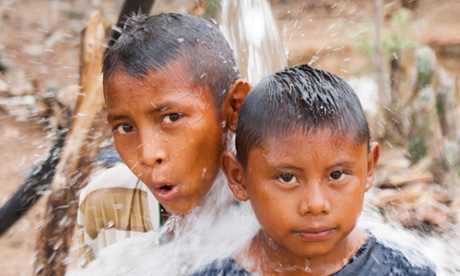
In the latter part of July there was not a cloud in sight over La Guajira, Colombia. The rainy season should have begun in late April or early May, but during the past months only a few drops of precious rain have fallen on the parched landscape surrounding the departmental capital of Riohacha. As you drive along dusty roads to outlying ‘rancherías’ – isolated rural villages inhabited by the predominant Wayúu indigenous population – there is a visible line about 5 feet up the trunks of the scrub trees and bushes that line the road, where wandering herds of goats have eaten every piece of green within their reach. “It’s El Niño” the villagers say, referring to the periodic effect of the rain-stealing weather pattern. “The bad little boy has come again to make our lives even harder.”
This is the second year in a row that a lack of rain has assailed the people of La Guajira. In this northern peninsula of Colombia where the presence of water can mean life or death, the continued scarcity of rainfall is taking its toll. During last year’s prolonged drought, infant malnutrition and mortality from water-related illness rose alarmingly. Approximately 20,000 livestock – crucial to the livelihoods of the Wayúu – perished from lack of water and forage.
According to the latest predictions of the Colombian Institute of Hydrology, Meteorology and Environmental Studies (known as IDEAM for its acronym in Spanish), the current climatic conditions will most likely extend through August – possibly right on through the next rainy season that normally occurs in September and October.
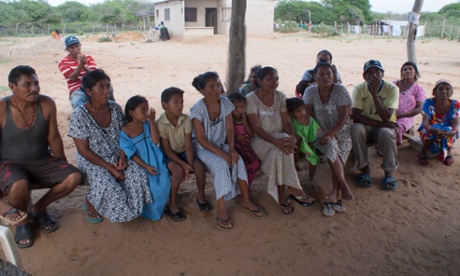
The impact of this year’s El Niño phenomenon can be easily seen: traditional jagüeys – rain catchment ponds that provide water to both the Wayúu villagers and their animals – have dried. Community wells produce less and less water and the water they do provide is becoming increasingly salty – to the point of being unfit for human consumption. Stopgap government and privately – funded programs designed to provide temporary relief by sending tanker trucks of water out to the rural villages are becoming the rule rather than the exception, and are often the only source of water to which a community has access.
It is in this environment that the non-profit organisation Aguayuda (Water Help) carries out its work to help alleviate the situation and bring a ray of hope to the villages it serves. A member of an international grouping of sixteen organisations brought together by the Millennium Water Alliance (MWA), Aguayuda is also part of Lazos de Agua, a program which was launched by FEMSA Foundation MWA, and Coca-Cola Latin America with the goal of giving access to safe water, sanitation, and hygiene to over 100,000 people, including the Wayúu, in five Latin American countries.
Paola Lopez, a bi-lingual social worker helping to coordinate Aguayuda’s efforts in the Wayúu villages – work that includes the repair of windmills, the installation of water storage tanks and important training and organisation in water, sanitation and hygiene – says this about her experience: “When we go into the villages, we see how great the need for water is and how much it affects every aspect of their life.
“Sometimes the most important thing is to just provide immediate relief with a water truck delivery. Then we can look at other solutions, such as training in how to better manage the water resources they have and community organisation so they can begin to take control of and address their own water needs.”
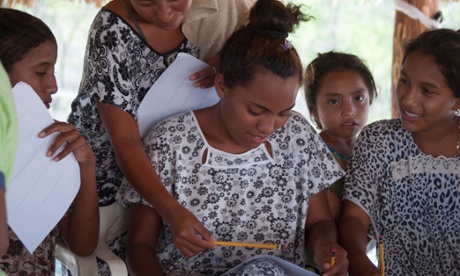
Addressing the water crisis in La Guajira is not easy or glamorous. It requires long days and hard travel on dusty roads to isolated Wayúu communities. Often the solution isn’t readily seen or available and involves a long process of working alongside the villagers to identify the best way forward. What is most important is to foment a sense of hope and determination as they make their way through the immediate crisis and turn their attention to ensuring that their water and sanitation needs are met well into the future.
“We try to take a long-term approach to addressing the effects of the drought.” states Simón Zimmer, Aguayuda co-founder and program director. “Climate change is an ongoing fact of life here, and while we can do little to stop it, we can help prepare the people of La Guajira to better confront it. In addition to providing the Wayúu community with basic tools and knowledge to ensure their health and wellbeing during this period of crisis, we work with other organisations in the area in order to develop strategies for supporting the Wayúu community in their quest for long-lasting solutions that ensure safe and secure access to water that meets all of their daily needs. It may be a dream, but it’s a dream worth having.”
Bill Weaver is executive director of Aguayuda, Colombia.
Content on this page is paid for and provided by FEMSA Foundation, a sponsor of the Guardian Global Development Professionals Network.