I pulled the zip as high as it would go on my down jacket and took the white-frosted path to the river Yare. I was out to catch something of the soundscape in the last light, with the moon’s reflection in Carleton Beck following me down for half a mile as a watery half‑coin on its surface.
The first sound of the marsh came from a snipe jinking and twisting low over the ground. Its undersides blinked momentarily white among the general brown vision of its going and, as it flew, it let out that series of small gruff snipe monosyllables – notes so rudimentary they’re just dirt made into noise – until they were lost beneath the chorus from the wigeon on the river.
The wigeon were immersed in a cloud of their sweet whistled calls. The individual note of each one has a slewed, trailing-away quality, like a glass bottle skidding on thick ice. It also has an upwardly inflected interrogative tone, yet in concert the sounds created an answering reassurance for the whole flock and there was a wonderfully settled aura to their steady drift downstream.
I could hear those softly murmured questions almost to the end of my walk and until there was just a final glow in the southern sky.
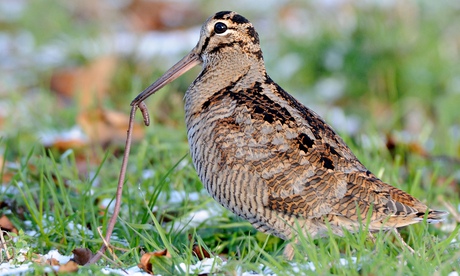
Out of this warm-toned horizon came the sound I’d come to see: the distant silence of a woodcock. So far the winter has been poor for this northern wader. Occasionally, when startled during daylight at their roosts in wet ground among sallows, woodcock rise vertically in alarm.
These winter birds utter no call, but as they come up their wings make a strange clean snick sound, like a linen sheet pulled taut. If one could drill down into the cell structure of the bird it would be possible to locate geochemical signatures that would pinpoint its origins to some specific Russian marsh or Swedish bog. Here tonight, however, it’s just a fleeting boreal mystery – a heart and dark wings made from worms and, thus, of mud – silhouetted briefly in a Norfolk sky.
Twitter: @MarkCocker2