1. Down, down, commodity prices and the dollar are down
It is perhaps in keeping with the overall depressing story of the 2014 economic year that we begin by talking about things that went down. A lot went down this year, and nothing more so than the prices of commodities.
Iron ore, that most valuable of minerals to our economy, became rather less valuable this year. In December 2013 it was going for US$135 per tonne; now it is half that at US$69.80:
Coal continued its four-year slide, falling 26% in the year to around US$62.25 per tonne, while oil (depending on which price you use) has fallen around 44%. Twelve months ago Brent crude was selling for US$110.67 a barrel; by June it had even risen slightly to US$111.87. By mid December, it was down to US$61.
With these falls the price of the Australian dollar has also fallen. The market, finally waking up to the fact that the value of our currency is linked to the value of our exports fell drastically from September onwards:
After starting the year around US$0.90 it rose to reach nearly US$0.95 in June. But in the last four months of the year, the value of the dollar finally fell to levels near the long-term average. It dropped 11% to around US$0.80-82 now.
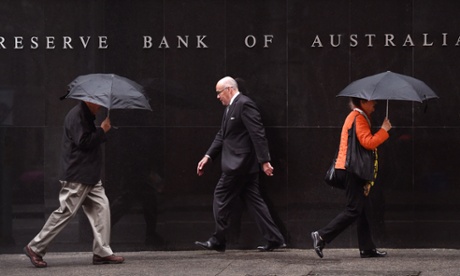
The drop in oil prices and the fall in the dollar will help the non-mining sectors of the economy, so it’s not all bad. The governor of the Reserve Bank, Glenn Stevens, would like to see the dollar below US$0.75. To get there, another interest rate cut may be necessary. And that is another thing that has fallen this year – not interest rates themselves, but the expectations of where they will next move:
In February, the market was predicting a 48% chance that by now the cash rate would have risen to 2.75% and an 83% chance that by June next year it would be 3.0%.
Now the market has already priced in an interest rate cut by June, and doesn’t expect them to rise again till well into 2016.
2. What happened to the Coalition’s predictions for a surge in confidence?
In the run up to last year’s election and then, after winning it, the government ministers were rather confident that they would be able to “restore” confidence in the economy.
In August last year, Andrew Robb said of the ALP: “They do not have a feel for the economy. They know that they have killed confidence, killed investment and killed interest from foreign investors”.
At this point it’s probably worth noting that investment this year fell back to 2011 levels. Of course this was due to the falling iron ore prices rather than anything the government did (as was the case under the ALP government). Pleasingly, there was a rise in investment in the non-mining/ non-manufacturing sectors:
But as for consumer confidence?
Not good.
Back in December 2011, when the Westpac-Melbourne Institute consumer confidence index fell to 94.7, Joe Hockey said “Consumers have clearly lost confidence in the Labor government’s ability to deliver stable and consistent government”.
In December this year, the index fell to 91.1.
In August 2012, when the Index fell to 96.6, Joe Hockey said that Australians should rightly be concerned when Westpac’s chief economist, Bill Evans, calls it “a disappointing result” and that the “persistent weakness is unusual” and that “the Gillard government should immediately call an election and let Australians decide who best is placed to run the economy.”
In December this year, when it fell to 91.1, Evans called it “a very disturbing result” and that there was “consistent weakness” and that consumers “are clearly concerned about the outlook for the economy and job security” and just to add into the mix “there is ongoing disillusionment about the May budget six months after it was announced”.
Now I am always a bit sceptical about the impact of consumer confidence – retail sales have actually improved a bit in the latter half of the year, after a disastrous run up and immediate follow from the budget.
But what’s good for the goose is good for the gander, and given his statements about consumer confidence while in opposition, Joe Hockey looks rather a goose now.
3. Budget revenue is downgraded – it sounds all too familiar
Which brings us to the budget. The falling commodity prices pretty much had the effect of taking the budget out back and beating the crap out of it.
The mid-year economic and fiscal outlook (Myefo) showed that company tax revenue fell 3.7% below expectations ($2.6bn). Income tax revenue was 1.6% below what was predicted in the May budget, for a $2.7bn fall.
The write downs for this year and the next three saw the cumulative budget deficit end up $43bn larger than Joe Hockey was saying it would be in May:
When he became the treasurer, Joe Hockey suggested he was going to commission an audit of Treasury’s forecasts. What the Myefo showed, as was the case with the budgets under Wayne Swan, is that in these volatile economic times getting the forecasts right is a hell of a lot easier when you’re sitting on the opposition benches and able to indulge in 20/20 hindsight.
4. Not everything was down this year: unemployment was up
We started the year with an unemployment rate of 5.9% and, after a rather large kerfuffle over the seasonally adjusted measure, by November the rate had reached 6.3% – a 12 year high:
At best we can say the speed of the rise appears to be slowing, but a 6.5% unemployment rate next year looks on the cards – especially as the Department of Employment’s leading indicator index remains in the negative, albeit slightly less negative than it was earlier in the year:
5. House prices also rocketed – but mostly in Sydney
Despite the unemployment situation being pretty grim, housing prices continued to rise –especially in Sydney:
Sydney’s house prices were rising on average around 15% through the year. Although the rest of the nation wasn’t seeing such strong growth, the low interest rates were definitely bringing buyers in to the housing market.
One problem was that the strongest buyers were investors. The annual growth of investor credit for housing loans reached 9.9%, outpacing the owner-occupier credit growth of 5.6% in a way not seen since the housing boom of 2002-2004:
Little wonder then that earlier this month the Australian Prudential Regulation Authority announced it would use the threshold of 10% investor credit growth as “an important risk indicator for APRA supervisors in considering the need for further action” with regards to risky bank lending.
6. Surging exports moved out to WA, state demand to NSW
This was the year the mining boom moved definitively from the investment phase to the production/export phase.
It meant that the year of Western Australia showing surging demand for goods and services fell away completely, replaced by surging exports.
It also showed a drastic difference between the quarterly figures for “state final demand” and “gross state product”. WA was had the lowest state demand, and the highest GSP. NSW, fuelled by building construction, saw its final demand growth become the fastest in the nation:
It was also the year that saw investment from the mining sector move to other sectors. The September capital expenditure figures showed a nice improvement in investment in “other selected industries”:
If we are to hope the recap of 2015 contains fewer “downs” and more “ups” we need such investment to continue.