The Cuban government has unwittingly created a powerful symbol of its fear of an increasing opposition movement led by young Cubans, after state security agents and government supporters prevented playwright Yunior García from going outside his apartment on a solo walk Sunday carrying a white rose.
Instead, García was forced to show the rose through the blinds in his window to journalists standing afar, creating an iconic image for the dissident movement.
A white rose is a powerful symbol in Cuban history, harking back to one of the most famous poems by Cuban writer and independence war hero José Martí, who wrote that he would grow a white rose for both friends and enemies.
Fearing the images that spread around the world on July 11, when thousands of Cubans unexpectedly took to the streets to call for political change in the communist island, the Cuban government unleashed a wave of arrests and intimidation over the weekend to thwart the plans of the opposition group Archipiélago, which has called for a peaceful march on Monday to protest against state violence and advocate for the release of political prisoners.
Early Monday morning, an all-female pro-government mob gathered around the house of Saily González, a Cuban entrepreneur who has led the march plans in Santa Clara, a city in central Cuba.
“None of these people is from around here. They brought them here since 5:30 in the morning,” González told the Herald. “What they are trying to do is prevent me from going outside. Still, I am firm in my determination to walk out at 3:00 in the afternoon, dressed in white, whatever happens.”
In images that remind the acts of repudiation that preceded the Mariel exodus in 1980, the mob started shouting “Pin, pon, fuera, abajo la gusanera!” That roughly translates to “Down with the worms.”
González replied, “Not a worm; I am a butterfly.”
As the mob continued shouting insults, González went out to her yard to hang white sheets, another video shows. Archipiélago, the group made up of young intellectuals, artists, and activists who called the march, told supporters to be creative and find ways to show their discontent. One suggestion to show support for the protests: hanging white sheets from windows and balconies. The group acknowledged that government repression would likely prevent many from joining the protest, which was initially scheduled for 3 p.m.
Cuban journalist Yoani Sánchez said her apartment in Havana, which doubles as website 14ymedio’s newsroom, is surrounded by state security agents, members of the Communist Party, and members of the Committees for the Defense of the Revolution. Luz Escobar, a 14ymedio reporter, and Cubanet’s reporter Camila Acosta are under house arrest.
On Sunday, state security agents also surrounded the home of García, the actor and playwright who has served as the leading voice of Archipiélago.
On Sunday morning, García told the Miami Herald he would attempt the solo walk the day before the so-called “march for change.” The plan apparently frightened authorities so much that security agents and government supporters were bused to the impoverished La Coronela neighborhood, on the outskirts of the city of Havana, and not only prevented García from leaving his apartment but also blocked the window, through which the young man showed the rose, with a giant Cuban flag.
“They can knock down my door at any moment,” García said of the agents surrounding his apartment.
At one point, García exchanged words with government supporters and agents standing outside his apartment, according to a video circulating Monday morning. An unidentified woman tells him, “You work for the enemies of our government.” When he denies it, she goes on to say, “I am defending my history, my children’s history.” García then replied, “But you’re doing it in front of my door.” She shrugs and continues, “That’s right, and I’ll repeat it; we will not allow this activity.”
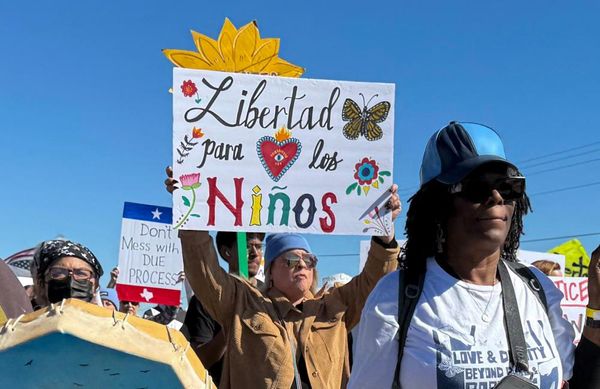
The scenes in Havana and Santa Clara show a generational clash as younger Cubans, with little emotional attachment to the revolutionary ideology and history, are pushing for changes. The widespread protests on July 11 showed a significant fracture in an island that was once ruled by the iron fist of Fidel Castro.
Many artists, intellectuals, famous musicians, and even former government supporters have joined the ranks of the opposition, criticized the violence unleashed on the protesters, or showed some public support for Archipiélago.
Once a symbol of the Cuban revolution, Cuban singer-songwriter Pablo Milanés published a message of support for García on Monday.
“My support for Yunior García Aguilera and all the Cubans he represents and who fight inside and outside Cuba,” said a statement posted to Milanés’ official Facebook page.
“My contempt for those mobs they use to ‘represent the best of the people.’ I am ashamed of the people of my race who agree to be used as the old hunters of runaway slaves,“ he said in reference to how the government uses impoverished Afro-Cubans to stage the acts of repudiation. “They are using them. Wake up!”
Videos posted online by activists late Sunday and Monday morning show a vast deployment of police and special units known as “black berets” throughout the country. Santa Clara’s central park is packed with state security agents and pro-government supporters dressed in red, some carrying sticks, according to an image shared in a private message chat and seen by the Herald. Another photo shared with the Herald shows several trucks parked along one of Holguín’s main streets. It is not clear if the trucks belonging to state companies were used to carry state workers to stage counter-protests or if they’re positioned in case authorities want to block off a street, the person sharing the image said.
The Herald granted anonymity to Cubans sharing images and information who requested that their names not be used out of fear of government retaliation.
There were several reports of detentions and house arrests of long-standing dissidents such as Guillermo Fariñas, members of the Archipiélago, and promoters of the march.
The extensive security operation as well as the time and space devoted to criticizing Archipiélago in state media, incidentally granting its central figures internal notoriety, has suggested to the population that despite the triumphalist rhetoric and the accusations about U.S. involvement, the government of Miguel Díaz-Canel considers that the opposition movement poses a significant challenge to its legitimacy.
Even if the government suppresses the march, activists say, it has already fulfilled its goal to be a wake-up call.
“Whatever happens, the message has to be that the Cuban people need to start thinking as citizens,” García told the Herald Sunday. “Civility is what will lead us to end this dictatorship.”
———