Rapid growth in digital and mobile technology is changing the advertising industry, and the UK is leading the charge, with digital set to claim more than half of all advertising spend in 2016, according to a recent report from marketing research company eMarketer. Accompanying this shift is the increasing amount of display advertising being purchased programmatically, rather than sites and positions being selected individually by a media agency. Programmatic buying enables advertisers to take advantage of data held by advertising platforms to target specific audiences, or match ads to the context of web or mobile content.
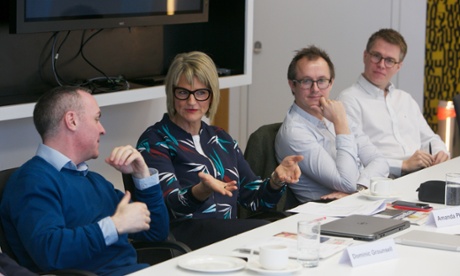
What are the consequences of this data-driven approach for the advertising industry, and is it stifling or enhancing traditional creative roles? An expert panel, held in association with advertising technology company AppNexus, met at the Guardian to analyse the impact of programmatic advertising. The discussion was held under the Chatham House rule, which means that quotes are not attributed, in order to encourage free and frank debate.
“Programmatic can solve a lot of challenges in a fragmented market,” explained one attendee. Through programmatic advertising platforms, publishers can manage the pricing of their offerings while advertisers get precise customer targeting, as well as analytics drilling into how their ads are performing. There is a perception, though, that creativity and data-driven advertising are opposing forces. “It would be great to break through that and see the opportunities,” the room heard.
One panel member was quick to come up with an example – an experiment with an outdoor display that varied in real time, along with eye-tracking software built into the unit that tracked people’s attention. The impact of things such as moving a logo to the top right was analysed. “On the basis of that we algorithmically came up with the perfect ad,” said the participant, who also explained that moving the display to a different street that was less upmarket changed what constituted the optimum layout and content.
A key point was that “the creative director was at the core of that trial. Without that it would have failed spectacularly.” Creatives need to “stop being fearful of data and embrace it and use it,” said the participant.
In a digital world, creatives need to come up with multiple sizes and formats for ads, so they can be inserted programmatically into different kinds of content. “It’s an exciting world as long as the creatives are at the heart of it. Otherwise we remain in the distinct delineation between the instinctive human piece and the data piece,” the room heard.
One attendee said the requirement to come up with multiple versions of the same creative concept can be a sticking point. “Creative agencies and digital agencies don’t play nicely together. Creative comes up with a beautiful concept but they never consider the environment it’s going in. Creative agencies are used to developing single assets, not multiple iterations. There’s so many barriers to being able to do programmatic properly.”
Traditionally, agencies have been built around TV advertising, which means high production costs and lack of flexibility when it comes to digital media, which is treated as an afterthought. A way to mitigate this is to make sure that a rough outline of the strategy for where ads will appear is formed before the creative agency starts work, so that the two things are considered together. “That has helped us massively on some campaigns, actually delivering creativity that’s fit for purpose. That’s where we need to change as an industry,” the room heard.
Creative agencies sometimes fail to appreciate digital constraints. One participant recalled an advertiser being shown a near-finished film. “He said now I want you to play that with the sound off. The agency were shocked.” The problem here is that in many environments PCs and mobile devices are set to be silent.
Despite these issues, a targeted, programmatic approach to advertising can deliver big benefits, explained another participant. If, for example, you want a database of 100,000 people to target for a campaign, it pays to “go out to the market and buy those 100,000 people through programmatic at a much-inflated cost per thousand,” because the results will be better. In this speaker’s experience, analysing the cost of the desired outcome, such as buying a product or entering a shop, showed better value. “You start thinking about zero-wastage marketing,” the room heard. “Because I know who is going to see this ad, I can afford to spend more on it.” This means richer creative possibilities.
Marketers sometimes use the term “hyper-targeting” to describe advertising precisely customised to an individual’s behaviour. The ability to target a person with a general brand ad on Monday, a Facebook ad on Wednesday, and an outbound call on Friday, for example, is “the holy grail”, said one participant. This is the kind of campaign that programmatic advertising can enable.
Whether or not it is hyper-targeted, data-driven advertising is key to success. A survey of global advertising overperformers and underperformers showed that 73% of overperformers “create their marketing through data-driven customisation”, while only 40% of underperformers use this method, the room heard.
The panel spent some time considering the opportunities and challenges around mobile advertising. “People are consuming a lot of content on mobile but there continues to be a huge lag between time spent and money spent on mobile,” said a participant. One of the issues is that on-screen advertising banners, which work well on desktop PCs, do not work well on mobile devices. This means programmatic advertising delivered as banners is ineffective. “It’s always this text-heavy thing that has no creative element to it whatsoever. It gets flicked past and ignored,” the room heard.
A key question, therefore, is whether there can be a standard way of advertising on mobile that works. “There won’t be a standard,” said one panel member. “Brands need to deliver the experience themselves, rather than be constrained to the banner.” This approach could include custom apps, or collaboration with media partners for sponsored content.
Another participant described how “moving all content to an endless stream was the best decision we’ve made,” describing ads that appear in the flow of a story or news feed, rather than as separate banners.
Others disagreed. “Part of the market will be custom, but true money is always made through standardisation,” said a participant, meaning a mobile equivalent to the advertising panels that appear in desktop websites. “If we don’t standardise, then all we will do is create a standard that is Google and Facebook,” the room heard.
Mention of Google and Facebook revealed some anxiety about the extent of their control, and the trend for a few big platform vendors to lock down their data. “Data will become the big deal,” said a participant. “Look what Facebook are doing: you can’t get any data out of that system for love nor money. The same is happening with Google. That is the big play – not programmatic, but the stuff that powers programmatic.”
There is a power struggle, the room heard, between the telecommunication companies, Google, Facebook, Apple, and other vendors including Amazon and Yahoo. One of the weapons in this is the ability users have to block ads from appearing in web pages. “Apple released ad-blocking in iOS 9 [the latest update to the software that runs iPhones and iPads] not because they don’t want ads – they definitely want ads – but they want ads in-app,” said a participant, referring to ads that display within mobile applications rather than on web pages. “They’ve got to show Google that they can control their business.”
Despite the power of these big vendors, advertising technology is volatile and the future hard to predict. “Ten years ago, Facebook weren’t even here,” observed one panel member. You can be sure, though, that data-driven, programmatic advertising is here to stay, and the challenge for advertising creatives is to embrace rather than resist the new possibilities it presents.
At the table
-
Matt O’Neill, principal of advertising technology consultancy, Teemo Ltd (chair)
- Chris Babayode, managing director, EMEA, Mobile Marketing Association
- Heath Bateman, creative services manager, The Weather Channel
- Martin Beauchamp, head of programmatic, MEC
- David Carr, strategy director, DigitasLBi
- Ella Dolphin, group commercial director, Hearst Magazines
- Nigel Gilbert, vice president, strategic development, AppNexus
- Dominic Grounsell, global marketing director, Travelex
- Nick Hugh, vice-president and general manager, advertising, EMEA, Yahoo!
- Fiona McKinnon, general manager, The Pangaea Alliance
- Dan Michelson, digital innovation and capability lead, O2
- Amanda Philips, sales and marketing director, Millward Brown
- Sarah Speake, chief marketing officer, Clear Channel
This content has been sponsored by AppNexus (whose brand it displays). All content is editorially independent. Contact Nicola Hudson (nicola.hudson@theguardian.com). For information on debates visit: theguardian.com/sponsored-content