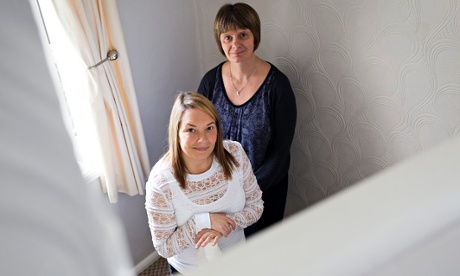
Becky, a bright 21-year-old, has just begun the second year of a science degree. She did so once before, but took time out to have her baby daughter, now seven months old. It’s hard returning to studying, Becky admits, but “when it’s done it’ll be worth it”. Although she’s not sure what she wants to do afterwards, it is, she says, “a starting point”.
Having a starting point is important to Becky because three years ago she was in a very different position – as a young person being helped at an adolescent support unit run by Blackburn with Darwen council.
The unit is part of the council’s innovative response to the challenge of meeting the residential care needs of young people; challenging because it is expensive and because going into care, including foster placement, is often not the best outcome. A statistic from a report by National Children and Adults Services bears this out: care leavers aged 19 are almost twice as likely as the general population to be designated “Neet” (not in education, employment or training).
The council, working from the principle that it is usually better for a young person to stay with their family if possible, decided to develop short breaks for those experiencing difficulties. To do so, it closed a residential home to free resources to fund the support unit. Karen Barrick, head of permanence at the council’s children’s services department, says that “one of the drivers was believing that a different way of working with families might lead to fewer people coming into care”, but nothing similar had been tried before and it was a step into the unknown. It has been a slow burn: the change was made in 2006, but the positive results from the project are only now beginning to attract more widespread interest.
“In the past 12 months we’ve had a lot of different councils coming to look around,” says Mel Coglan, short breaks manager at the support unit, which has consistently been rated “outstanding” by the Ofsted inspectorate. Barrick is giving a presentation at this week’s National Children and Adult Services conference and a similar, though smaller, unit has already been established in Bolton.
The Blackburn unit looks like an ordinary house, formed by knocking together two semi-detached properties. Inside, it is bright and airy, with pictures of young people doing various activities (canoeing, walking, cooking) lining the walls. Upstairs are four brightly coloured bedrooms for young people, as well as two for staff.
The project works as an in-between house for young people aged 11 or over who are having difficulties at home and risk being taken into care. They are referred to the unit through local children’s services to have their issues addressed. Its aim is to return the young people home and keep them there.
Short weekend breaks at the unit provide a respite for both the young person and their family. The unit operates on a “pro-social” model, where the focus is on listening and having respect for others. In the evening, young people and staff sit around a big wooden dining table for a communal supper. Staff say that making conversation over a shared meal is incredibly beneficial to young people at the unit, especially those who have never experienced such interaction.
The service offers a wide range of activities such as crafts, fishing and healthy eating, “anything that can boost their self-esteem”, says Stephen Hartley, principal adolescent support team worker. “It also concentrates on the more nitty-gritty bits that help them focus on issues relevant to them, whether it’s problems at home, conflict with parents, domestic violence or anger at what they’ve experienced.”
When the young person is back at the family home, staff at the unit are always available at the end of a phone to offer practical support or to drive to the home and help in person.
In addition, the unit has a “strengthening families” programme, which offers training for a young person and their family. “These sessions provide strategies for managing young people’s behaviour and identifying ‘positives’ within families,” explains Coglan. “Families work to develop and strengthen these positive areas.”
The young person’s progress is reviewed every 12 weeks, with new goals for improvement – such as school attendance – set each time, until the young person, support worker and family agree that it is time to leave. The unit can support up to 50 young people, with a staff of 11, plus one domestic worker.
“It’s a home from home,” says 14-year-old Matt, who used the service for about 18 months until he moved on earlier this year. “I used to get stressed out because my mum had bipolar and sometimes we’d need a break. And I couldn’t go to [my] family, so I used to come here every fortnight on a Friday.”
Gemma has had two sons who have progressed through the service. “I think it’s fantastic, for the kids and especially for the parents”, she says. The place is like home, she agrees, and importantly it’s not all fun and games for the children: they have to wash up; there are rules.
One of Gemma’s sons has schizophrenia, and was on the verge of going into care. “If it wasn’t for [the service] I was going to have a breakdown; they were fantastic,” she says. Now her son is doing “really well” and is back in school.
The unit costs some £380,000 a year to run. The council, which still runs two children’s homes of its own and pays between £2,000 and £4,000 a week for each residential placement, depending on individual needs, says that if only four young people a year are diverted from residential care, then it more than pays for itself.
In 2007, 48 young people aged 11-plus were brought into care by Blackburn with Darwen council; by 2013, this number had dropped to 18. Last year, only two young people who used the service went into care afterwards. Not only is this a big saving for the council, but a better outcome for children and their families.
Despite an increasingly limited council budget, the future of the unit seems secure. Barrick asserts that it “will be part of our strategy going forward”.
There is even talk of expanding, perhaps at the same location or on another site, to start working with younger children and reaping the benefits of early intervention. A bid has been put in for funding to develop the idea.
For the children and parents who use the support unit, it offers a precious respite – somewhere to get away from the problems of family life. “It was just the space,” reflects Becky. “When people were doing your head in, you thought, ‘oh, I’ll come here.’”
Matt agrees: “Coming here is different; you might be stressed out at home, but when you come here all the stress is taken away.”
Becky, Matt and Gemma are pseudonyms
Why not join our social care community? Becoming a member of the Guardian Social Care Network means you get sent weekly email updates on policy and best practice in the sector, as well as exclusive offers. Sign up for free.