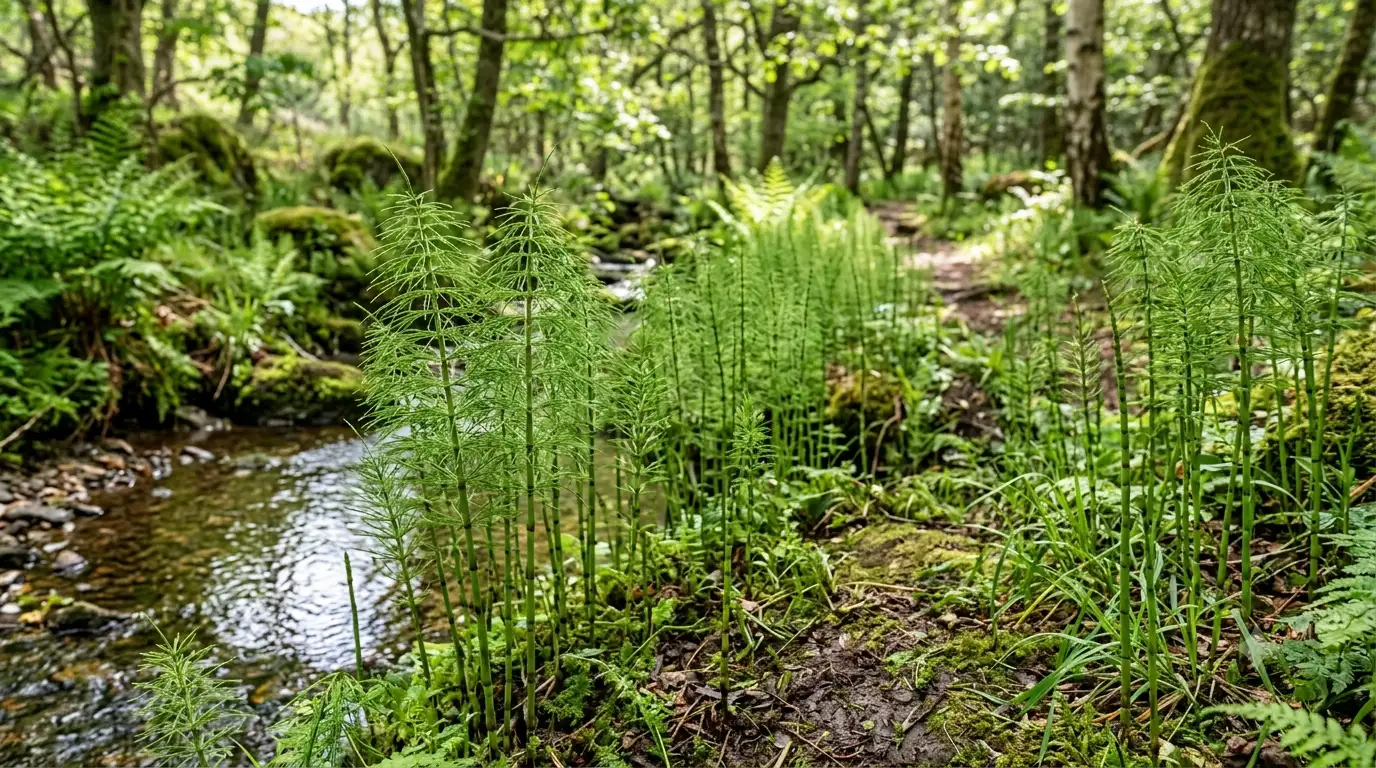
Scientists uncover hidden secret in plant : A simple riverside plant that most people would never look at twice is now leaving scientists deeply puzzled. Researchers studying smooth horsetail, a hollow-stemmed plant from one of Earth's oldest plant lineages, discovered that the water inside its stems contains the most extreme oxygen isotope values ever measured in terrestrial material, as per a report.
The finding does not mean the plant is producing anything alien. Instead, researchers found that the stem acts much like a natural distillation tower, changing the chemistry of water as it travels from the bottom of the plant to the tip, as per an Eco News report. The discovery could reshape how scientists interpret clues preserved in desert plants, fossils, and ancient climate records.
A plant older than dinosaurs is hiding a remarkable secret
Horsetails belong to the genus Equisetum, a group of plants with a fossil record stretching back more than 400 million years. Although today's smooth horsetail (Equisetum laevigatum) is far smaller than its ancient relatives, it still holds an extraordinary secret inside its green, segmented stems.
Researchers led by Zachary Sharp at the University of New Mexico collected smooth horsetails growing along the Rio Grande in New Mexico, as per the Eco News report. They wanted to understand how water changed as it moved through the plant.
From the outside, the plants appeared ordinary. Inside, something unusual was happening.
READ ALSO: World’s loneliest tree: A plant reduced to a single wild survivor is making an unexpected comeback
Water changes dramatically as it moves upward
Scientists use oxygen isotopes as fingerprints for tracking water. These isotopes are simply oxygen atoms with different weights.
The research team found that water inside the horsetail stem started with normal isotope values near the base. As the water moved upward, moisture gradually escaped through the stem walls. This evaporation left heavier oxygen isotopes behind, steadily altering the chemistry of the remaining water.
By the time the water reached the top of the stem, the isotope values had become unlike anything previously recorded in Earth-based material.
The study measured δ18O values ranging from about -8.3‰ at the base to 82.6‰ at the tip, while Δ′17O values ranged from 0 to -1,797 per meg, as per the Eco News report. According to the researchers, these measurements expanded the known terrestrial range for this type of oxygen fractionation by fivefold.
Scientists say the samples looked almost extraterrestrial
The results were so unusual that they initially seemed almost impossible.
"If I found this sample, I would say this is from a meteorite," said Zachary Sharp, professor in Earth and Planetary Sciences at the University of New Mexico, as quoted by Eco News report.
Sharp described the horsetail stem as an "engineering marvel." The plant's structure allows water to rise while tiny amounts continuously evaporate, changing the chemistry of the water segment by segment.
For a plant that many people would simply walk past, it is carrying out a surprisingly sophisticated process.
Why this discovery matters in dry environments
The findings may help explain why oxygen isotope measurements from desert plants and animals have sometimes puzzled scientists.
Dry air, heat, and wind can intensify evaporation, strongly altering the chemical signatures preserved in plants. This means that climate signals recorded in plants may not always reflect only their original water source. They may also contain the powerful effects of evaporation.
Using the horsetail measurements, researchers refined an important evaporation model that could help scientists better distinguish between biological and physical influences in climate records, as per the Eco News report.
Ancient climate clues may need another look
Horsetails produce tiny silica structures known as phytoliths. These glass-like structures can survive long after a plant dies and are often used to reconstruct ancient climates.
However, the study found that the oxygen signal preserved in phytolith silica did not always match the water moving through the stem.
As a result, fossil phytoliths could sometimes provide misleading humidity estimates if researchers average signals across an entire stem or lack sufficient context.
The finding does not make fossil records unreliable, but it does suggest that interpreting ancient climate conditions may be more complicated than previously thought.
READ ALSO: The ant discovery that stumped scientists started with one curious 8-year-old
A simple field study with big implications
The research also included a hands-on educational component. Fourteen students helped collect plant samples and measure oxygen fingerprints, connecting fieldwork directly with laboratory analysis.
Scientists now plan to investigate whether similar isotope patterns occur in other plants and environments, particularly in dry regions where evaporation can strongly influence water chemistry, as per the Eco News report.
FAQs
What plant did scientists study?Researchers studied smooth horsetail (Equisetum laevigatum).
Why are scientists puzzled by this plant?
Because water inside its stems showed the most extreme oxygen isotope values ever measured on land.