
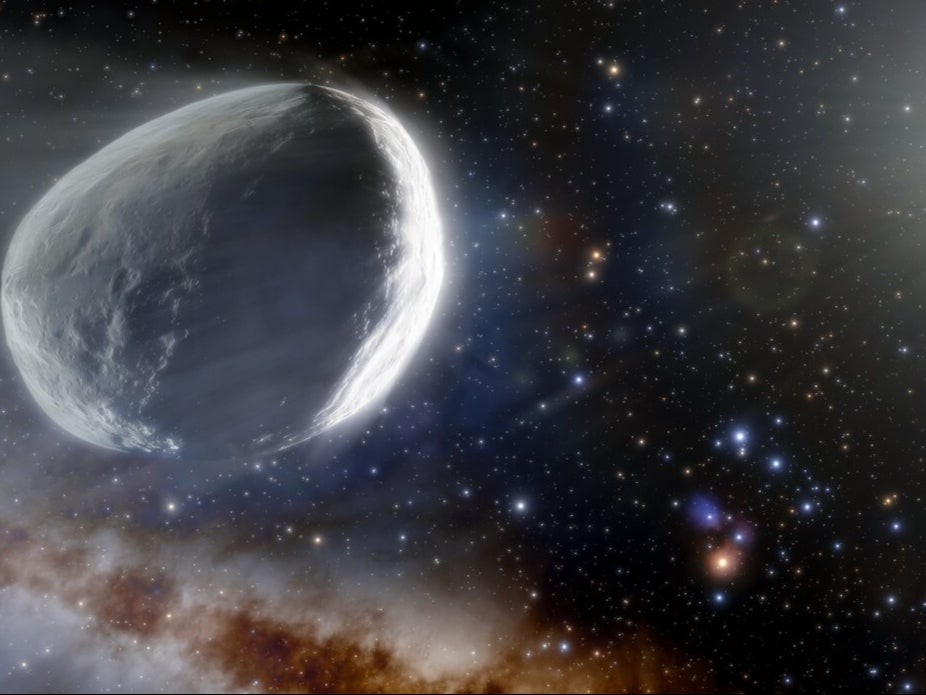
Comet Bernardinelli-Bernstein
(Picture: Photo courtesy og NOIRLab/NSF/AURA/J. da Silva (Spaceengine))A comet so massive that scientists initially believed it was a small planet is flying through space towards our solar system - and is anticipated to arrive in a decade.
The comet, called the Bernardinelli-Bernstein comet (which is named after the researchers who discovered it), is around 100–200 kilometers across and 1,000 times bigger than a standard comet, astronomers noted when it was first discovered in June.
Fortunately, the comet is not a threat to Earth. It will pass the sun at its nearest in 2031 at a distance of 10.71 astronomical units (au), just beyond Saturn’s orbit.
The enormous comet’s journey began at a distance of over 40,000 astronomical units (au) from the sun in the inexplicable Oort Cloud.
This means that it was 40,000 times farther from the sun than the Earth.
Scientists note that the comet could be the most prominent object from the Oort Cloud ever noticed. It’s also the first comet to be detected so far away on an incoming path.
Sign up to our new free Indy100 weekly newsletter
Astronomers began studying the object six years ago when no “coma” or tail common among comets was detected.
A tail was finally detected with further research over a three-year span, which confirmed that the object was indeed a comet.
Although the comet is reasonably close and extremely large, scientists said a telescope is still necessary to see it.
People aren’t believed to have seen the comet before, preceding our existence the last time it flew through space. But according to orbit analysis, the comet will be approaching the sun much closer on this voyage.
“We have the privilege of having discovered perhaps the largest comet ever seen — or at least larger than any well-studied one — and caught it early enough for people to watch it evolve as it approaches and warms up,” said Gary Bernstein, a researcher at the University of Pennsylvania. The latter discovered the comet alongside colleague Pedro Bernardinelli.
“It has not visited the Solar System in more than 3 million years.“
Read more about the findings here.