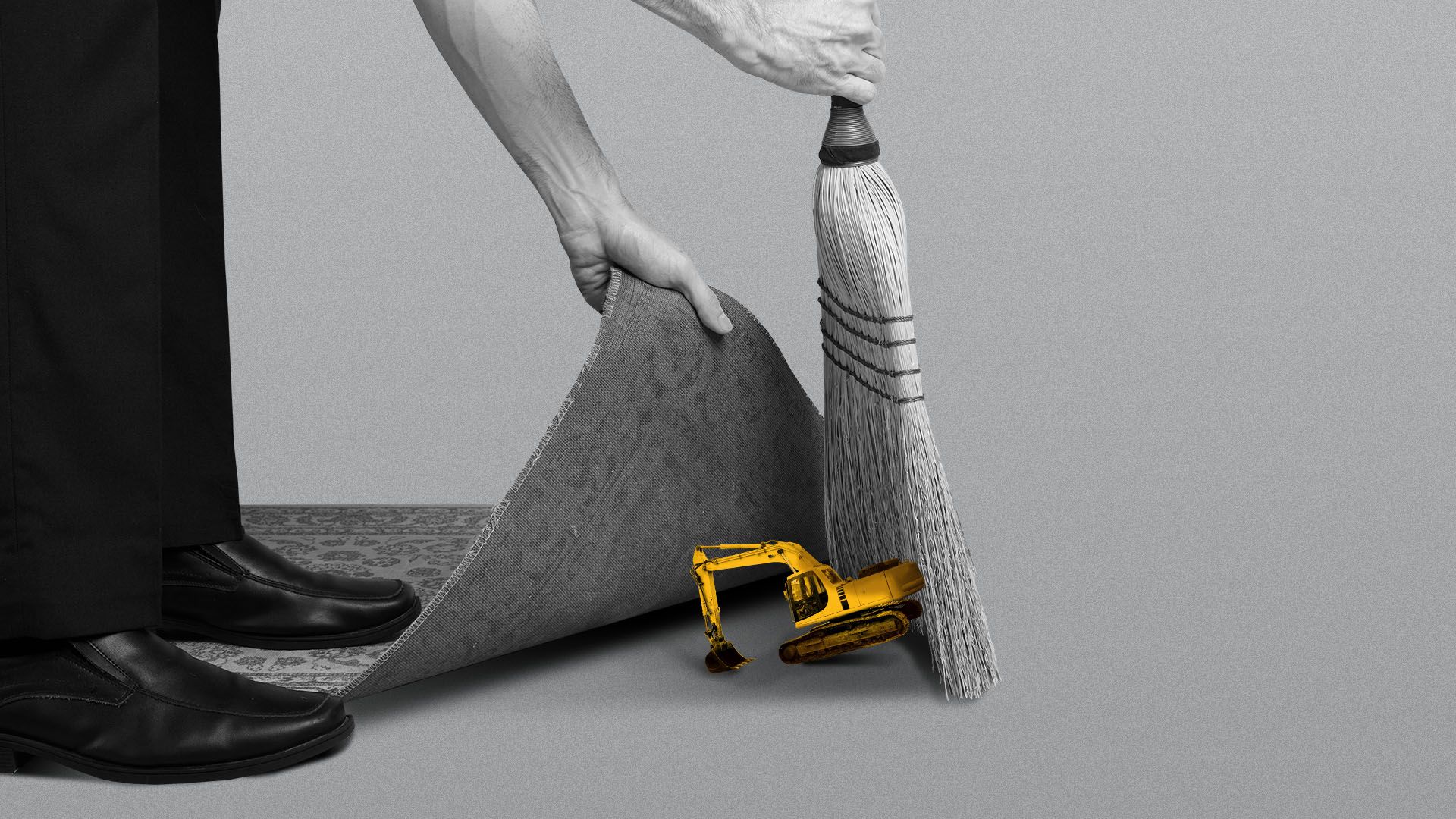
"Don't say we didn't warn you." With these words, China has signaled that its next step in the trade war might be to cut off America's access to rare earth minerals — a key component in everything from cellphones to missile systems.
The impact: China exports about 80% of the rare earths imported by the U.S., and a boycott could cripple much of American high-tech manufacturing.
- China doesn't dominate this industry because it has unusually large deposits of rare earths; it doesn't. (As every story about rare earths has to mention, they're actually very common.)
- Rather, China simply has a greater willingness than most other countries to do the filthy job of mining these minerals — a job that generally involves hundreds of nasty acid baths, a lot of pollution and even quite a bit of radioactive waste.
Flashback: In 1991, Lawrence Summers, then the World Bank's chief economist, signed his name to a notorious "pollution memo" that was leaked to the environmental community. The memo made perfect economic sense, even if it was politically rash.
- "Health impairing pollution should be done in the country with the lowest cost, which will be the country with the lowest wages," Summers wrote. "The demand for a clean environment for aesthetic and health reasons is likely to have very high income elasticity."
- Summers wasn't entirely serious. But the memo does a good job of explaining how China ended up mining most of the world's rare earths.
By the numbers: The Rare Earths Monthly Metals Index, a price gauge created in 2012 at a level of 100, stood at just 19 in May — surprisingly low after almost a year of worries that China could cut off supplies. If American businesses have been warned, they haven't shown any signs of stockpiling the precious supplies they need.
Go deeper: Why rare earth minerals matter in the U.S.-China trade war