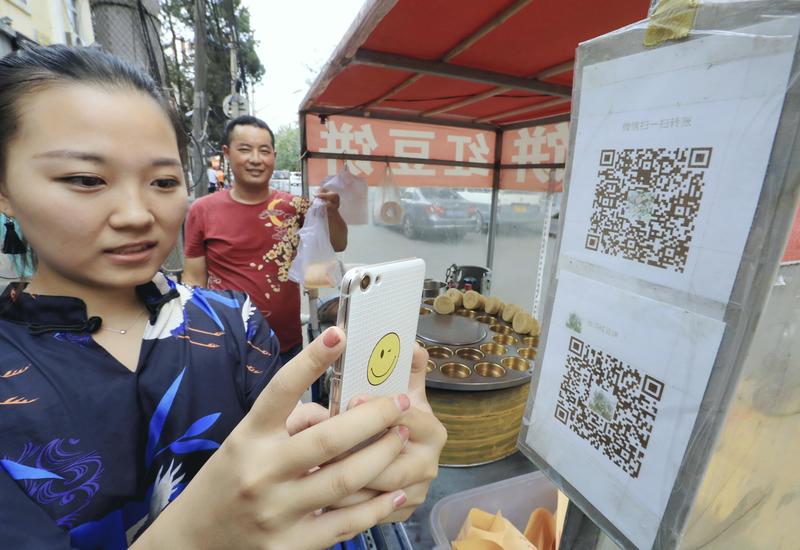
BEIJING -- People in Beijing no longer have to carry cash these days as long as they have a smartphone. Just hold your smartphone up to a QR code at a cash register, and the payment is automatically deducted from your bank account. Anything can be bought with an electronic "beep." There is nothing more convenient.
However, that is a story about people other than me.
I'm okay with friends laughing at me: "What? You still prefer cash?"
But when I pulled out a bill at a convenience store one day, the staffer at the cash register clucked their tongue at me. "I'll never come here again," I said to myself.
A staffer at another convenience store explained the shop's feelings by saying, "We appreciate customers who use smartphones because we don't have to bother with change." I accept this logic, but it's not right to cluck one's tongue at a customer.
Another day, I pulled out a 100 yuan note, the highest denomination, at a small restaurant. "Oh, cash?" a female employee said in an annoyed tone. She unlocked a drawer to get change, and handed me a bundle of five yuan notes.
Many shop staffers told me that payments by smartphone have suddenly soared since last year. An employee at a fresh juice shop targeting young customers said, "Yesterday about 100 customers came in, and not one of them paid with cash."
I finally managed to find a place where the proportion of customers who prefer cash was neck-and-neck with those who prefer smartphone payments -- a vegetable market in a residential area with many elderly customers who say they don't have smartphones. It soothed my soul.
Shared bicycles, a symbol of new businesses in China, can't be used without smartphone payment. As a person who prefers cash, I see the abandoned bicycles that block sidewalks everywhere as nothing but obstacles. I rarely take taxis now, as it's become the norm to use smartphones both to call for a cab and pay for it. Rather than waiting around to test my luck, I might as well just walk or take the subway.
I'm just going about my life normally, but my irritation is slowly growing. The space in which I exist is getting smaller. I've become a typical stubborn old man who can't get with the times.
I won't start paying by smartphone because, first of all, I'm not good with information technology. Also, the procedures are a pain. And more than anything, I'm fundamentally against letting personal information flow out into society.
If someone were to search, they could probably easily extract my personal data -- even though it's like a strand of hair in a forest of big data. My trivial information -- such as being a non-drinker who loves chocolate and a history buff who doesn't spend money on clothes -- could be discovered in seconds, with records of where I went and at what times.
Chinese authorities are bolstering surveillance of citizens through digital technology, and must be gloating at the spread of smartphone payments. However, the People's Bank of China, the nation's central bank which wants to maintain trust in currency, recently released a statement prohibiting the refusal of payment in cash, and is trying to curtail excessive moves away from cash.
As long as I can maintain my livelihood, I plan on sticking to cash.
The other day, I visited the Palace Museum, a famous sightseeing spot in Beijing. Digital payments have become the norm here, too, since last fall, and I stood in line at one of the few remaining ticket windows that accepts cash.
In a line made up of tourists from overseas and elderly Chinese, I watched the wave of people entering smoothly, holding their smartphones in one hand. I truly felt that I belonged to the minority in Chinese society.
(From The Yomiuri Shimbun, July 22, 2018)
Read more from The Japan News at https://japannews.yomiuri.co.jp/