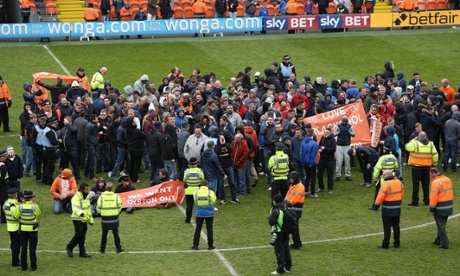
“The pitch invasion at Blackpool at the weekend featured one fan on a mobility scooter,” writes Will Hollick. “Is this the only example of a motorised incursion on to the field of play outside the game’s laws – and if not, where else can we find a transgression by man and machine?”
For those who haven’t watched the footage of the scenes at Bloomfield Road, a few hundred supporters gathered in the centre circle at the start of the second half to protest against Karl Oyston’s ownership of the club. They were followed by 60-year-old Bobby Mack, who drove his mobility scooter on to the pitch to join in the protests. “I was doing it to get back at Mr Oyston, my legs might not work but my brain certainly does,” he told the Blackpool Gazette. “The facilities at Bloomfield Road are diabolical for us disabled fans. It’s not good enough and his comments [Oyston texted a supporter calling him a ‘retard’ and telling him to enjoy his ‘special needs day out’] were very offensive to disabled people.”
Mack is not the first fan with mobility issues to turn pitch invader. Liam Davis’s injury-time equaliser for relegation-threatened Northampton Town against Rotherham in 2010-11 led to a perhaps 100 happy Cobblers dancing on to the playing surface. They were quickly ushered off but the restart was delayed by 18-year-old Derry Felton in his motorised wheelchair. “I said to my mate: “If they score I will go on the pitch”,” he told the Daily Mail. “But I didn’t believe that they would. Then they did and it was a bit of a blur really. I didn’t know what was happening and then I was in the middle of the pitch and I just thought how did I get here?”
While Felton’s charge on to the pitch and the Blackpool sit-in were both peaceful, incidents of a dangerous nature are not unheard of. There was one such incident in Swansea three-and-a-half years ago, when a match between Mumbles Rangers and Kingsbridge Colts was disrupted by a Mitsubishi performing ‘donuts’ in the centre circle. “I don’t know if he was mad or drunk but somebody could have been seriously injured or killed,” the Mumbles Rangers chairman, Chris Parkin, told the BBC. “The players and supporters were astounded. They stopped what they were doing and just looked at what was happening.”
And, back in 2010, a red card led to red mist in the eyes of an amateur footballer in Southport, Joseph Rimmer, who got straight into his vehicle upon his sending-off and attempted to mow down the referee who had expelled him. Rimmer was later jailed for six months over the incident.
Although it wasn’t in-game, the Leicester City owner Vichai Srivaddhanaprabha caused a surreal disruption after his side’s 3-1 defeat to Chelsea last Wednesday. Chelsea’s unused substitutes were warming down after the game when the Tannoy blared out the urgent message that they needed to leave the field straight away – to allow Srivaddhanaprabha’s helicopter to land and whisk him up and off.
No humans involved – not visibly anyway – in this one, but that infamous night in Belgrade last October also deserves a mention here if we’re talking about motorised visitors from the sky. It’s not every day that a drone trailing a deeply incendiary flag causes all hell to break loose on a football pitch, after all. And for a perfectly legal motorised visit that ended up going slightly awry, look no further than Gabriel Zakuani’s exacerbated injury at this year’s Africa Cup of Nations. Even better, look at the look he gives the buggy driver.
THIS IS THE KIT
“Reading the news that Arsenal will wear their yellow and blue away kit in the FA Cup final (because Villa won the toss to wear their usual kit) reminded me of the finals in 1978 (v Ipswich) and 1980 (v West Ham),” remarked Mark Goodge this time last week, “where Arsenal wore yellow and blue on both occasions, and lost both times – the latter to a headed goal by Trevor Brooking, which apparently he never scored very many of. But I digress. My real question is this: is there a statistical disadvantage – or even an advantage – to wearing your away kit at a cup final? Obviously, teams will both win and lose more often in total wearing their home kit, as in many cases there won’t be a clash so neither side has to change. But do teams do significantly worse or better when wearing a change strip?”
The history of Cup final change kits gets off to a pleasingly antsy start. Let us take you back to 1882 when Old Etonians, who had been resplendent in light green shirts in each of their four previous appearances, modelled a new green and white chequered outfit for that season’s showpiece against Blackburn Rovers. That did not sit well with the Lancashire club’s blue and white halves – a fact that appeared to escape them until they arrived in London, when they hurriedly purchased themselves a thinly-hooped set of black and white tops.
The result? A 1-0 win for Old Etonians at Kennington Oval – with Blackburn apparently claiming that the last-minute change of colours had contributed to the reverse. They would not be able to suggest the same eight years later when, incredibly, they had to play in a set of tailored white dress shirts to avoid a clash with The Wednesday’s colours and won 6-1.
The tone having been set, here come the stats. Particularly in the tournament’s earlier years, there were times when both teams changed colours – so these apply only to times on which one side took the hit, and to occasions when the colours themselves were changed rather than simply the design (for example the vogue for Cup final pinstripes that briefly reared its head in the 1950s). By our count, since the FA Cup’s inception the team in its change strip has won eight times – and lost on 15 occasions. Damningly conclusive in favour of colour-based familiarity, no? No, says David Filip, who is back for more after featuring in last week’s column and has done some similar research using a slightly different sample and significantly more brainpower. Take it away, David:
“Examining data from the last 50 League Cup and FA Cup finals, 25 of those finals were played with one team in their home kit and the other in their away kit, not counting three instances in which teams switched kits for the replay. Only eight of those 25 finals were won by the team in the away kit – a paltry 32%. But is it statistically significant?
“To test for the statistical significance of the figure, I used the binomial exact test, which is used when the outcomes of trials (cup finals in this case) are assumed to be independent (the outcome in one cup final with teams wearing opposite kits does not affect the outcome of the next, which is a pretty safe assumption here) and have the same probability of success (we are not assuming home/away kits inherently affect the likelihood of winning). As an analogy, the same test would be used if you flipped a coin 25 times, it turned up heads eight times, and you wanted to know if it was an unfair coin.
I set my a-level at the standard 0.05, meaning that the test would have to return a p-value below that in order for teams wearing opposite kits to be considered statistically significant. The p-value returned was 0.1078. So, based on these data, I cannot claim that teams do significantly worse or better in cup finals when wearing their away kit against teams wearing their home kit.”
And we thought we’d been pretty thorough there.
DON’T STOP MOVING
“While watching the FA Cup semi-final between Reading and Arsenal, I was impressed with one of their defenders, Michael Hector,” wrote Ankur Jain last week. “Not being a big Championship fan and having never heard of this player before, a quick check showed in his first five seasons as a professional (2009-10 to 2013-14), he has played for a whopping 12 different clubs. During this period, by my calculations, he has also played in the second, third, fourth, sixth, seventh and eighth tiers of English football. If that wasn’t enough, he has also played in the Irish and Scottish top flights. Has a player ever had a more nomadic start to his career than young Michael? Indeed, is there a player who has appeared in the top eight tiers of English football during his career?”
They would be hard pushed, on the latter at least. And a current club-mate of Hector’s is as realistic a contender as anyone else. The Crystal Palace striker Kwesi Appiah – on loan with the Royals – has played in the seventh tier with King’s Lynn, Thurrock, Brackley Town and Margate; the Conference with the likes of Ebbsfleet, Weymouth and Kettering; League Two with Cambridge United, AFC Wimbledon and Aldershot; League One with Yeovil and Notts County; the Championship with Crystal Palace and Reading … and has played in the final of the Africa Cup of Nations with Ghana. What price a few minutes in the Premier League next season for the club at which he signed a new contract in the spring? Regardless, the yet more impressive statistic is that Appiah is just 24 and has spent a remarkable 16 different spells with 15 clubs (he was at Cambridge twice).
Ian Burke has the definitive – ish – answer, though:
“I’ve found someone who has played in eight out of the top nine in Stefan Moore. As well as turning out in the Premier League for Villa, he was loaned out to Chesterfield in League One as well as Millwall and Leicester in the Championship. After his release from Villa in 2005, he spent his time between the Championship and League One with QPR, Walsall and Port Vale, before moving down to the Conference with Kidderminster in 2008.
“After that, he turned up at tier seven Halesowen Town, then to tier nine St Neots Town, where he helped them win promotion to the Southern League Central Division (tier eight). He stuck around a few more months until a short spell at Leamington begat a move to Conference North side Brackley (tier six) on a dual-registration deal.
“He’s currently in the Conference North with Solihull Moors, which means that League Two is the only level where Stefan Moore hasn’t played. He’s still only 31, so if any kindly gaffers fancy giving him a game to complete the set …”
Start the bidding, fourth-tier bosses – for Moore has actually just become a free agent.
KNOWLEDGE ARCHIVE
“Can someone please tell me why the Atlético Madrid club crest contains what looks like a bear trying to get jiggy with a cherry tree?” wondered Steve Guy back in 2007.
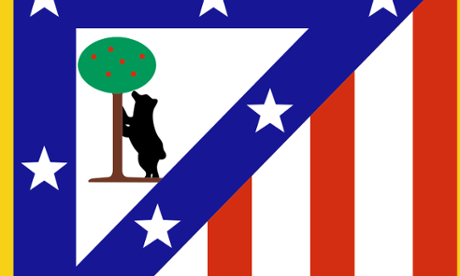
Well Steve, you have obviously never been to Puerta Del Sol square in Madrid, because you would have seen the 20-tonne statue known as El Oso y el Madroño, a life-size model of a bear doing nothing more than sniffing a Madroño tree.
The story goes that the word Madroño sounds like Madrid, so the tree was adopted as a symbol of the city. Bears used to be common around Madrid, so the two items were thrown together and they now appear on the city’s taxis, buildings and man-hole covers. Atlético added the bear and tree to their badge at some point between 1903 and 1919, and the seven stars on the club crest represent the autonomous region of Madrid (or Big Bear constellation). If you think the Madrid bear is looking lustful, have a look at the similar-looking Warwickshire coat of arms. Warwickshire County Cricket Club, meanwhile, have chosen a more-restrained version.
• For thousands more questions and answers take a trip through the Knowledge archive.
CAN YOU HELP?
“Philips announced last week that they would stop being PSV’s shirt sponsor after next season, after having spent 34 years on the front of the PSV jersey, ever since shirt sponsors were introduced in the Netherlands,” writes Kees Haasnoot. “Is this the longest run of shirt sponsoring in the world? Are there any other clubs left that have only had one name on their jersey?”
“The Commonwealth of Independent States competed at the European Championships in 1992,” notes Philip Farrell. “Apart from the four constituent parts of the United Kingdom; is this the only example of a non-nation state participating at a major tournament?”
“Belfast Celtic (1891-1949) won 14 Irish League titles and 8 Irish Cups,” notes Philip Farrell. “Are they the most successful extinct European club?”
“I’ve just looked at the bottom of the Scottish Championship table (yes I am that bored, sadly), and noticed the astounding goal difference difference between 10th placed Cowdenbeath and ninth-placed Alloa,” writes Leo Addor. “Alloa have a goal difference of -22, Cowdenbeath a goal difference of -55 –a goal difference difference of 33 for two teams placed adjacent to each other in the league table. My question is: is this the greatest goal difference difference ever among teams sitting right next to each other on a major professional league table at the end of the season?”
“Glenn Murray is likely going to be top league goalscorer for both Reading and Crystal Palace this year,” writes Paul Rumble. “Has this happened before and what are the highest totals recorded?”
“As an exiled Swindon fan (currently in China) not quite keeping up to date with all the squad news, I was initially confused when following our game earlier today to see our sent off goalie Belford replaced between the sticks by Belford,” writes Jack. “Turns out they are brothers – Tyrell and Cameron – and not one and the same. Is this the first time one brother has replaced another in goal?”
Send your questions and answers to knowledge@theguardian.com.