With the Guardian’s unstoppable rise to global dominance (NOTE: actual dominance may not be global. Or dominant) we at Guardian US thought we’d run a series of articles for newer football fans wishing to improve their knowledge of the game’s history and storylines, hopefully in a way that doesn’t patronise you to within an inch of your life. A warning: If you’re the kind of person that finds the Blizzard too populist this may not be the series for you.
Manchester United enjoy fierce local rivalries with Manchester City and Liverpool (and to a lesser extent an enmity with Everton, details of which can be found here.) They have also battled for Premier League supremacy with Jose Mourinho’s Chelsea and, especially, for the best part of a glittering decade, Arsene Wenger’s Arsenal. Plenty of reasons for simmering feuds there.
There’s no simmering feud with Southampton. No local enmity. No battles for supremacy. And yet it’s one of those fixtures which has, more than it logically should have, made a repeated impression on the Premier League era. Enough memorable matches down the years to cause supporters perusing the fixture list to suck their teeth and mutter: aye aye, United have to play Saints this weekend, could be interesting.
Hey, not everything has to be seismic.
Having said that, you could argue that a Southampton versus Manchester United fixture changed the direction of English football and shaped the entire history of the Premier League. On the face of it, not a biggie, held six seasons before the advent of the EPL, and in the Littlewoods Cup to boot. The Littlewoods Cup was the mid-to-late-80s incarnation of the League Cup, or what is now the Capital One Cup (and to think Brits criticise Americans for crass consumerism). Littlewoods, for the record, was a clothing and household goods store; a poor man’s Target. It was part of an organisation that also ran a football betting company, and bankrolled Everton and Liverpool to various degrees for decades. They took over sponsorship of the League Cup in 1986 from the exotically communist sounding Milk Marketing Board, a government body later dissolved. Kenny Bania could get a five-minute bit out of that. But we’ve gone well off piste here.
Anyway, Southampton versus Manchester United in the 1986-87 Littlewoods Cup. To give you a sense of how different the footballing world was back then, the holders of the cup were Oxford United, who had beaten Queens Park Rangers 3-0 in the 1986 final. Meanwhile, the reigning league champions of England were Liverpool. Yes, kids, calm down. Liverpool had won the title rather brilliantly the previous season, with a late run of 10 wins in the last 11 games. United had started that season with a 10-game winning burst of their own, only to somehow end up fourth in what had looked a one-horse race. Their manager Ron Atkinson was therefore under intense pressure to deliver the following season.
He failed abysmally, as United suffered a cold start. They lost to Arsenal, West Ham United, Charlton Athletic, Watford, Everton and Chelsea, and after nine games were joint bottom of the old First Division. Their only victory during that run was a 5-1 thrashing of – yes – Southampton. But the Saints paid them back handsomely in a Littlewoods Cup third-round replay on 4 November 1986. At a packed Dell – Southampton’s tiny, oddly shaped, but wonderfully atmospheric old ground – George Lawrence and future United winger Danny Wallace made it 2-0, before a young prospect called Matthew Le Tissier announced himself with a clever lob over United keeper Chris Turner, then made it four with a close-range header. Peter Davenport notched a late consolation for United, but 4-1 was a humiliation too far. Atkinson was sacked, and two days later Aberdeen boss Alex Ferguson was appointed. Manchester United owe Southampton big thanks.
So United went on to become the best team in the country – their first-ever Premier League win came at Southampton in September 1992, Dion Dublin scoring in the last minute – and by April 1996 were locked in a struggle with Newcastle United for the title. Cue one of the most famous capitulations in Premier League history, when they visited the Dell in mid-April. The tone was set within 20 seconds, as a suicidal David Beckham backpass nearly let in Southampton captain Jason Dodd. Steve Bruce conceded a needless free kick from which Le Tissier set up Ken Monkou: 1-0. Ryan Giggs gifted the ball to Jim Magilton, who started a move that led to Neil Shipperley scoring the second, Bruce and Gary Neville standing around looking upset and confused. A rare Peter Schmeichel mistake just before half time allowed Le Tissier to make it 3-0.
And so United, who had been wearing an all-grey change kit, were sent out for the second half in a blue-and-white number. “The players don’t like the grey strip,” claimed Ferguson. “They find it difficult to pick each other out. We had to change the strip.” Ah, the wrong kind of shirt. A Premier League classic. Mind you, United’s record in it had been risible: they’d lost to Aston Villa, Arsenal and Liverpool, and could only draw at Nottingham Forest. No wins. And while the costume change at the Dell didn’t affect a dramatic turnaround, Giggs did snatch a late consolation at a time when the goal difference column was as tight as the points. United still won the league. Of course they did.
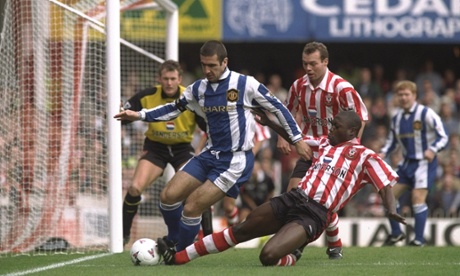
Newcastle earned a little revenge the following season, giving Fergie’s side a memorable belt in the mouth at St James’ Park. That 5-0 thrashing was viewed as a strange aberration, the sort of thing that simply didn’t happen to the champions. But then, a week later, they went down heavily again, at Southampton. Roy Keane, sporting a feral face fungus, was sent off, having picked up two yellows in the first 21 minutes. Eric Cantona should have been in the bath too, having set about giant defender Ulrich van Gobbel with a flurry of kicks and punches.
Southampton boss Graeme Souness, a conflict connoisseur, stopped just short of congratulating Cantona for his cheek. “I saw who he was involved with,” he purred. “He must be very brave.” Le Tissier scored an absurd chip, shovelling out from a thicket of players, up and over Schmeichel. Ten-man United remained in it for most of the game, 3-2 down with seven minutes to play. But then Eyal Berkovic creamed home a volley, and Egil Ostenstad scored a couple more to complete a hat-trick (though the last goal was later taken off him and credited to poor old Phil Neville). Paul Scholes’ late strike just made the scoreline look even more preposterous: 6-3.
United’s next game was a 2-1 home defeat to Chelsea. It was the first time they’d lost three games in a row during the Premier League era. They still won the league. Of course they did.
They didn’t manage it in 1998, though. Another loss at the Dell – 1-0 this time, Kevin Davies scoring early, Paul Jones making a series of splendid saves – wasn’t pivotal. Or it didn’t seem so at the time, in mid-January. United would have gone eight points clear of Blackburn and 14 clear of Arsenal had they won, albeit having used up more matches. “It’s given people hope,” sighed Fergie, who had an inkling Arsène Wenger’s side had plenty of juice left in their tank. And so it proved.
United hadn’t particularly enjoyed the 1990s at the Dell, but they started there well in the Noughties, wrapping up their canter to the 1999-2000 title with a 3-1 win. It was all done and dusted in double-quick time, David Beckham scoring a free kick, Phil Neville forcing Franny Benali to put through his own net, and Ole Gunnar Solskjaer making it three before the half hour. Marian Pahars scored the consolation. The win was a little payback for the embarrassing 3-3 draw with Saints at Old Trafford earlier in the season, during which Pahars nutmegged Jaap Stam to score, Le Tissier dribbled a goal through Massimo Taibi’s legs, and Paul Jones made the greatest and most futile double-save of all time.
United’s title win wouldn’t be the only decisive result in the fixture during that decade: Southampton, struggling under the unpopular Harry Redknapp, required a win against United on the final day of the 2004-05 season to stay in the Premier League. They gave it their all –John O’Shea deflected home a Graeme Le Saux corner to gift Saints an early lead at their new St Mary’s Stadium, but an unmarked Darren Fletcher equalised with a simple header, and Ruud van Nistelrooy sealed Southampton’s fate with another header in the second half. Keane, an unused sub, got involved with a section of the home support and a couple of stewards after pointing downwards while performing a few post-game stretches. Oh Roy. Southampton’s 27-year membership of the top flight was over. It took them seven years, a couple spent in the third tier, to get back.
But of course one particular match between the pair looms over them all. Manchester United have won 20 league titles, 11 FA Cups, four League Cups, three European Cups, a Cup Winners Cup, the Intercontinental Cup and the Fifa Club World Cup. Saints have just the one major trophy to their name: the 1976 FA Cup. Which was, needless to say, won at the expense of United.
Tommy Docherty’s United had faltered on the league run-in that year, Liverpool winning the title, their great enemy therefore in a position to begin their imperial phase in Europe. Ah well, never mind! There was always the FA Cup for consolation. They’d surely win that against second-division Saints. Ah but. United started the game strongly, but Southampton’s offside trap was working efficiently, and the favourites soon became frustrated. Sammy McIlroy hit the bar with a header, but that was the best United managed. In the first half, Saints midfielder Jim McCalliog - previously of United - sent Mick Channon free down the middle. Alex Stepney saved. But when McCalliog played a similar pass on 84 minutes to send Bobby Stokes free down the inside-left channel, Stepney was beaten. Stokes – just beating the offside trap, we’re saying, though poor camerawork has ensured the matter remains controversial to this day – threaded his shot across Stepney and into the bottom right.
One of the great FA Cup upsets. One of the many times these clubs have put on a memorable show. It’s a great fixture: one of English football’s hidden charms.