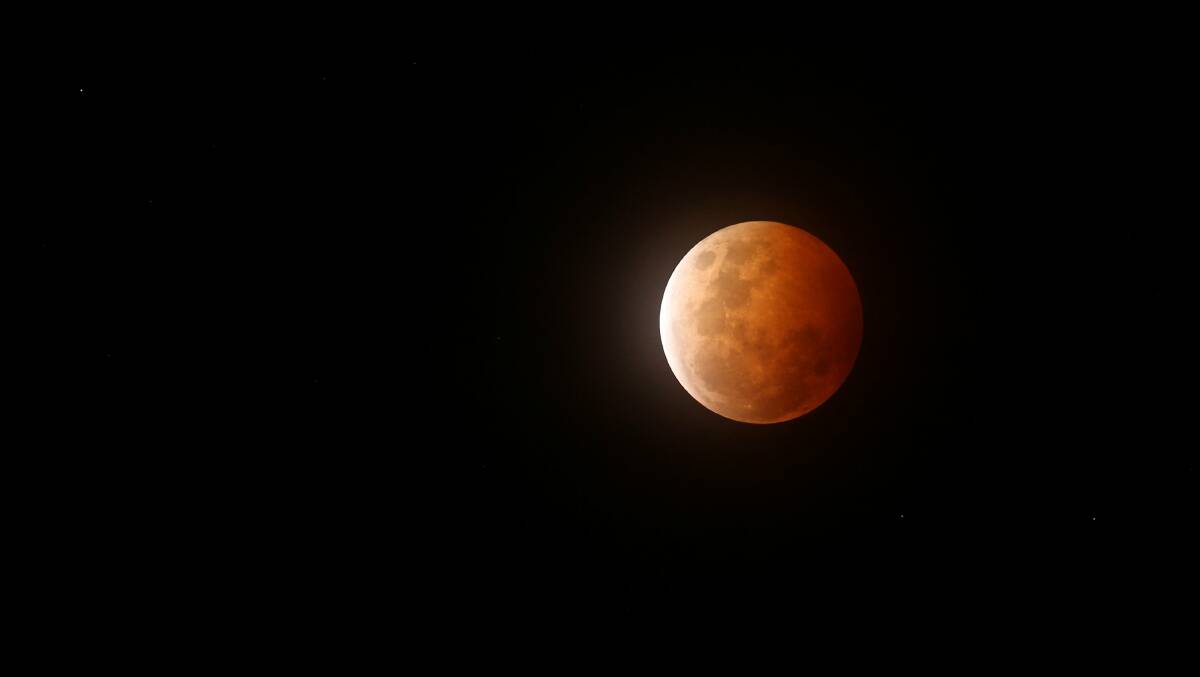
A super blood moon is happening on Wednesday night. It'll be quite a sight, if the clouds don't get in the way.
It's known as a total lunar eclipse, but gained the blood moon nickname due to its colour.
Hunter astronomy expert Col Maybury said a partial eclipse will begin in Newcastle at 6.47pm. The total eclipse is due from 9.11pm to 9.25pm.
"The moon will be just under the constellation of the scorpion. The heart of the scorpion is a red gold star called Antares, the rival of Mars. It will be beside the eclipsing moon," Col said.
"There is no need for telescopes, although binoculars heighten the visual experience. Even to the naked eye, the floating red ball is eerie to behold."
For the 250,000 years that our species, Homo sapiens, has been on this planet, the aberrations of solar and lunar eclipses have been viewed with awe and wonder.
"Eclipses were used by the religious as proof of the power of the multiple gods and goddesses that were thought to control these events," Col said.
"After the delving of Copernicus, Galileo and Newton and many ancient astronomers, it was seen they were due to the permutations and combinations of our wonderful solar system."
The eclipse will be seen by much of the world, weather permitting. "This is particularly so here on the east coast of Australia. The eclipse will begin at 6.47pm in Newcastle as a faint partial eclipse and continue through to a period of totality at 9.11pm.
It will then return to a partial eclipse at 9.25pm, concluding "as the moon travels out of the shadow altogether at 11.49pm".
"The partial eclipse is hardly discernible at the beginning, but when the moon enters the darkest shadow, the umbral, it dims considerably and takes on a distinctive red-gold hue often described as the blood moon," he said.
"This change of colour is because the only light to reach the moon is travelling through the Earth's atmosphere.
"Impurities in the air block blue light, favouring the red end of the light spectrum. The moon, being much dimmer, appears as a red golden orb with three dimensional roundness - not the bright silver flat disc we usually observe."
Funnily enough, this only happens once in a blue moon.
Science and Religion
Solar and lunar eclipses - real and fictional - have gone down in history.
Eclipses were seen as omens and signs from gods in ancient times.
In a scene from the gospels in the Bible, the sky becomes dark in daytime as Jesus is crucified. And the Koran refers to an eclipse before the birth of Mohammed.
But on May 29, 1919, science came to the fore with Einstein's eclipse. Photos showed a few stars visible during the eclipse were in the wrong place. Einstein had predicted that light from the stars would bend by the gravity of the sun, using his theory of general relativity. The darkness of the eclipse enabled the experiment to be confirmed.
This provided the first experimental evidence for general relativity. It marked Einstein's rise to prominence.
Shortly before another historic eclipse, Christopher Columbus was in Jamaica and short of food. "The natives supplied food, but his crew cheated and stole from the natives so they withdrew the food. Columbus consulted his almanac and declared that his gods were angry and would darken the light of the moon that night," Col said.
The food was soon returned.