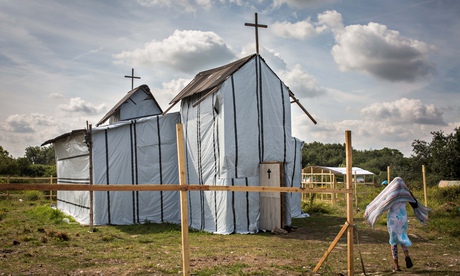
One of last Sunday’s prescribed readings for the Church of England was from the book of Exodus. Up and down the country, churchgoers will have heard how the people of Israel had escaped from political oppression in Egypt and were on their way to the promised land. In this 40 years of wandering – often vulnerable, cold and feeling unwelcome – they built a so-called “tent of meeting” for God. It was, the Bible says, located just outside of the camp. As the C of E faithful listened, I wonder how many made the imaginative link with Calais? There, Ethiopian and Eritrean Christians stuck in the port’s “jungle” camp have used the materials at hand to build a church to worship in as they await their uncertain fate.
Both the ancient and modern refugees crossed dangerous waters seeking a better life. Both migrants in a hostile and unwelcoming environment. Perhaps people called them names and thought of them as a “swarm”, in the style of David Cameron. Though the only reference to swarm in Exodus is the “swarm of flies”. Little wonder people felt insulted by that.
Christianity has existed in the Horn of Africa since the first century AD. And Judaism from long before that – with many believing that one of the lost tribes of Israel settled in Ethiopia. Which is why, in 1991, when they were under threat, the Israeli government airlifted 14,500 Ethiopian Jews to Israel in 36 hours. But there seems to be no equivalent sense of solidarity that western Christians have with their Ethiopian brothers and sisters in Christ. Back in April, a group of Ethiopian Christians, en route from Addis Ababa via Libya, were caught by Isis militants and beheaded on the beach. According to their families, some of them were hoping to come to the UK. But we don’t want them.
Cameron is happy to call this a Christian country when there is electoral advantage to be had out of it. But he is a fair-weather friend who refuses to make the connection with Christian migrants when there is not. For an expert on immigration law once stood up to ask Jesus: “And who is my neighbour?” And Cameron knows that the people of middle England did not like his reply.


.png?w=600)