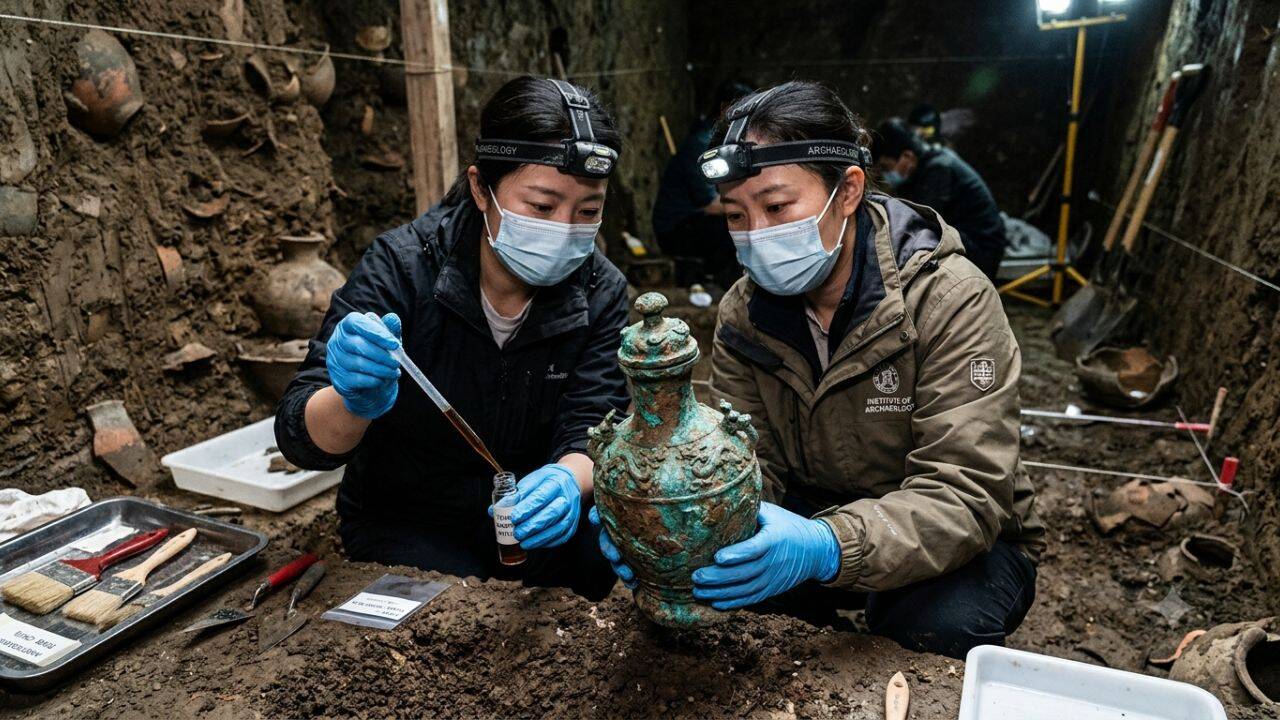
A bronze bottle buried for more than two millennia has offered an unexpectedly detailed glimpse into everyday life during one of ancient China's most influential periods. While excavating a tomb at the Shanjiabo cemetery, archaeologists came across a carefully sealed vessel that still contained liquid despite its extraordinary age. Instead of evaporating or becoming contaminated over centuries underground, the contents survived well enough for laboratory analysis, allowing specialists to investigate what people in the Qin state were producing, storing and placing alongside the dead. The discovery goes beyond the novelty of finding an ancient drink, providing rare scientific evidence of burial customs, food preservation techniques, and the sophisticated craftsmanship practiced during the Qin era.
Get breaking news anytime, anywhere. Download the TOI app now!
A forgotten Qin-era beer survived inside a sealed bronze bottle for 2,300 years
The vessel was recovered from Tomb M39 at the Shanjiabo cemetery, located close to the Qin Great Wall in present-day China. Dating places the burial between 547 and 221 BCE, a period associated with the rise of the Qin state before the unification of China.
What immediately stood out was the condition of the bronze container. It remained tightly sealed, protecting around 15 cups of pale blue-green liquid inside. The study published in the Journal of Archaeological Science, titled ‘ Decoding alcoholic beverage and brewing practices of the Qin state during the Warring States period (475-221 BC) based on archaeological evidence ’, suggests that the liquid had no noticeable smell after more than 2,300 years underground, its survival in such quantity is unusual enough to make it one of the best-preserved ancient alcoholic beverages yet examined from the region.
Its shape also offered an early clue. The vessel features a rounded neck resembling a garlic bulb, a style frequently linked with containers used for alcoholic drinks in Qin society.
More than 2,400 compounds uncovered the secrets of an ancient brew
Laboratory testing showed that the contents were far from ordinary groundwater that had seeped into the bottle over time. Chemical analysis identified more than 2,400 different compounds, indicating that the liquid originated from a deliberately prepared organic mixture.
Its composition matched a cereal-based alcoholic drink rather than fruit wine. The balance of organic acids, sugars and other compounds suggested a carefully controlled fermentation process rather than a naturally fermented liquid. Scientists also identified numerous classes of organic materials, including carbohydrates, amino acids and fatty acids, each helping to reconstruct how the beverage had been produced.
Rather than pointing to a simple recipe, the evidence reflects a drink created through several stages of preparation, using ingredients selected for both fermentation and flavour.
Scientists found evidence of a forgotten beer recipe buried
Microscopic examination uncovered thousands of preserved yeast cells inside the bottle. Their presence hints that Qin brewers relied on an effective fermentation starter capable of producing consistent results.
The drink appears to have been made from a combination of cereal grains including broomcorn millet, wheat, barley and proso millet. The addition of amino acids for flavour suggests the brewers were not simply producing alcohol but paying attention to taste and balance as well.
The grain mixture itself is unusual. Current archaeological evidence indicates this particular brewing method has not yet been identified in surviving historical texts, making the discovery valuable for understanding techniques that written records may never have captured.
A sealing method that kept the drink intact
The remarkable level of preservation was largely due to the way in which the bottle was sealed prior to its burial.
Indications show that it was initially sealed using cloth, after which a combination of mud and organic matter was used to seal the opening. The use of two layers ensured that any contamination from the outside was kept out while preventing the process of evaporation for hundreds of years.
The same process is found in other burial ceremonies within ancient China, where objects left for burial along with the deceased were effectively sealed to preserve them.
What the discovery says about Qin society
The Shanjiabo cemetery contains 183 tombs and is believed to have served both civilians and local military communities rather than only members of the elite.
Finding a substantial quantity of carefully prepared beer in what appears to be an otherwise ordinary burial suggests that sophisticated brewing was not necessarily restricted to royal households or high-ranking officials. Knowledge of fermentation, grain selection and storage seems to have been established more widely within Qin society.
The findings, published in the Journal of Archaeological Science: Reports, add fresh archaeological evidence to the long history of Chinese brewing. Beyond identifying an ancient beverage, the preserved bottle captures a practical tradition built on farming, fermentation and craftsmanship that remained hidden beneath the ground for more than 2,300 years.