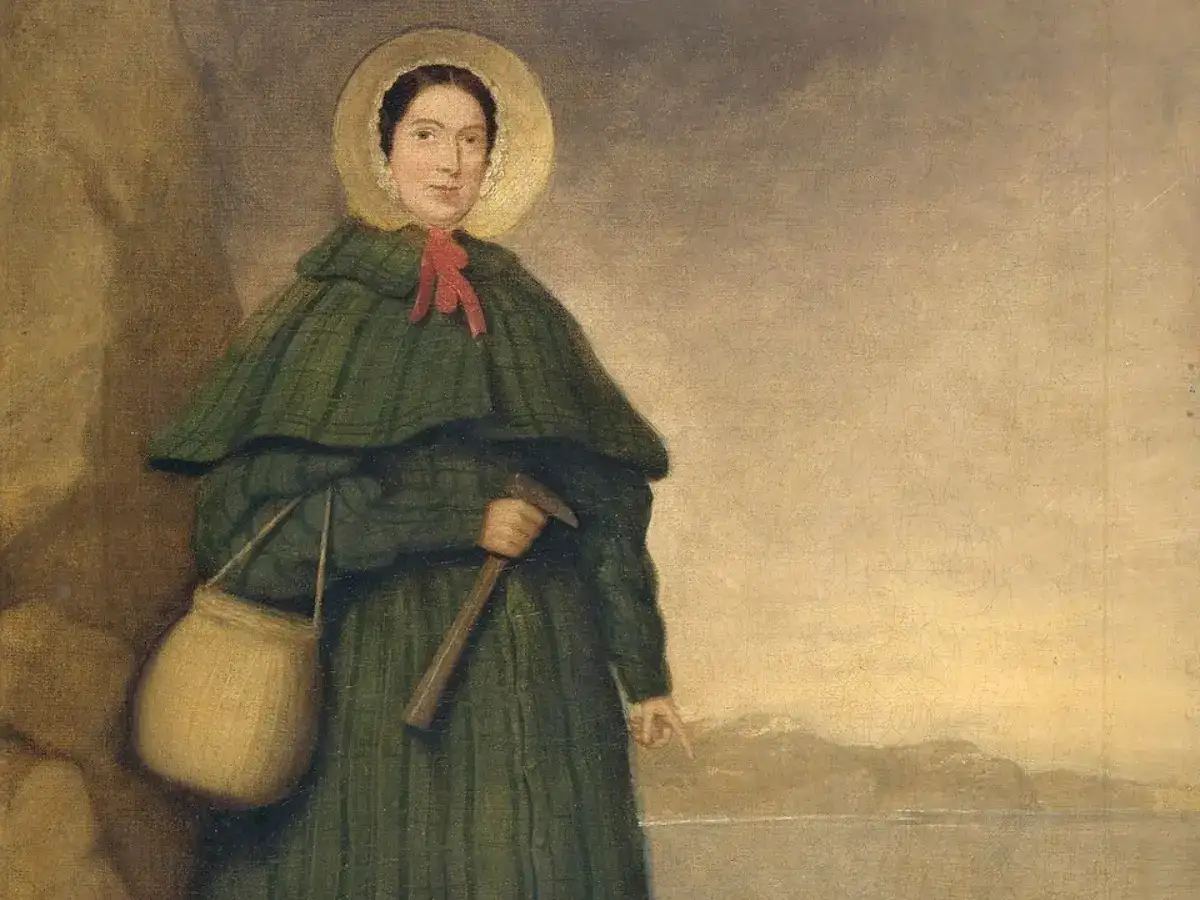
At the beginning of the nineteenth century, the cliffs of Lyme Regis in southern England were notorious for their dangerous landslides and bizarre fossils buried in them. To one local family, these cliffs offered a way to earn money by finding fossil specimens that could be sold to visitors. This practice changed the course of science.
In 1810, Joseph Anning discovered the fossilized skull of an enormous creature along the Jurassic Coast. A year later, Joseph's sister, Mary Anning, assisted in finding more bones that belonged to the same skeleton. The Natural History Museum in London reports that the fossil later became known as one of the earliest ichthyosaurs analyzed by scientists. The discovery allowed scientists to learn about the existence of large marine reptiles that lived in Earth's oceans many millions of years ago.
A family discovery on the cliffs
Mary Anning is often described as a child prodigy who stumbled upon a prehistoric monster in the rocks. Historians believe that the truth was far more complicated. According to the Natural History Museum, it was Joseph who discovered the skull first, while his sister found more remains when she returned to the same spot several times. The search for fossils was part of their daily struggle for survival.
The British Geological Survey, in an article about Mary Anning's life and achievements, noted that it was the result of years of family effort based on their knowledge of the geology of the cliffs. The Annings knew how to locate fossils that were revealed by storms in the unstable geological formation of the cliff face. They knew where to look and what kind of remains to look for among the rubble.
This was important since the study of fossils was still in its infancy, and there were many who did not know how to interpret them and their age.
Why did the ichthyosaur surprise scientists?
What shocked scientists about the fossil was its bizarre appearance. This was a creature with a tooth-filled, long snout, huge eye sockets, and a streamlined body meant for swimming. According to the Natural History Museum, ichthyosaur fossils were used as evidence for the disappearance of entire species from the face of the earth, an idea that contradicted the previously held belief that species were static and eternal.
The museum stated in its study about ichthyosaurs that the Lyme Regis fossils made extinction and deep time widely accepted by scientists. The discovery made fossil collecting more science-based because previous fossil discoveries were always wrongly interpreted or even falsely identified. Researchers now had a whole specimen to examine closely. This made it possible to make fossils prove the existence of ancient ecosystems.
Mary Anning was much more than a fossil collector
In her later years, Mary Anning established herself as one of Britain's most proficient fossil collectors. She discovered other fossils in Lyme Regis, such as plesiosaurs and pterosaurs. According to the Oxford University Museum of Natural History, Mary Anning was a self-taught fossil hunter whose discoveries formed the basis for many museums' collections and paleontology research.
Despite being knowledgeable, Mary rarely received all the recognition she deserved while she was alive. Most of the scientists interested in her fossils were academics of a higher social standing. Cambridge University Museums mentioned that the collection included the discovery of the fossils, but they failed to give due credit to Mary because of her status as a working-class tradesperson rather than a scientist. The discrepancy has turned into an important feature of Mary Anning's story.
The effect of the fossil lasted for generations
The original ichthyosaur fossil became one of the most famous samples in the history of paleontology. Scientists analyzed it for decades as they learned more about prehistoric marine life. Few studies revealed that the original fossil had been destroyed during World War II. However, the casts made from it helped scientists analyze it further.
Researchers considered the fossil important for the historical significance of its discovery. The rediscovered casts preserve the legacy of one of the earliest scientifically significant ichthyosaurs.
Why Mary Anning's story is still relevant
Mary Anning's story remains important today due to the combination of scientific discovery and overlooked talent. It is true that a working-class girl’s exploration of hazardous cliffs led to the discovery of fossil remains of long-extinct reptiles in an ancient ocean.
The story also teaches us that scientific discoveries are seldom isolated phenomena. It is true that the famous fossil discovery was not just an isolated event; it was a product of years of diligent search, family effort, and practical knowledge.
In fact, today, Mary Anning is known as one of the most prominent fossil hunters in history. In addition to revealing an extinct creature, the fossil skull found on the cliffs of Lyme Regis contributed greatly to scientists’ perception of the prehistoric world.