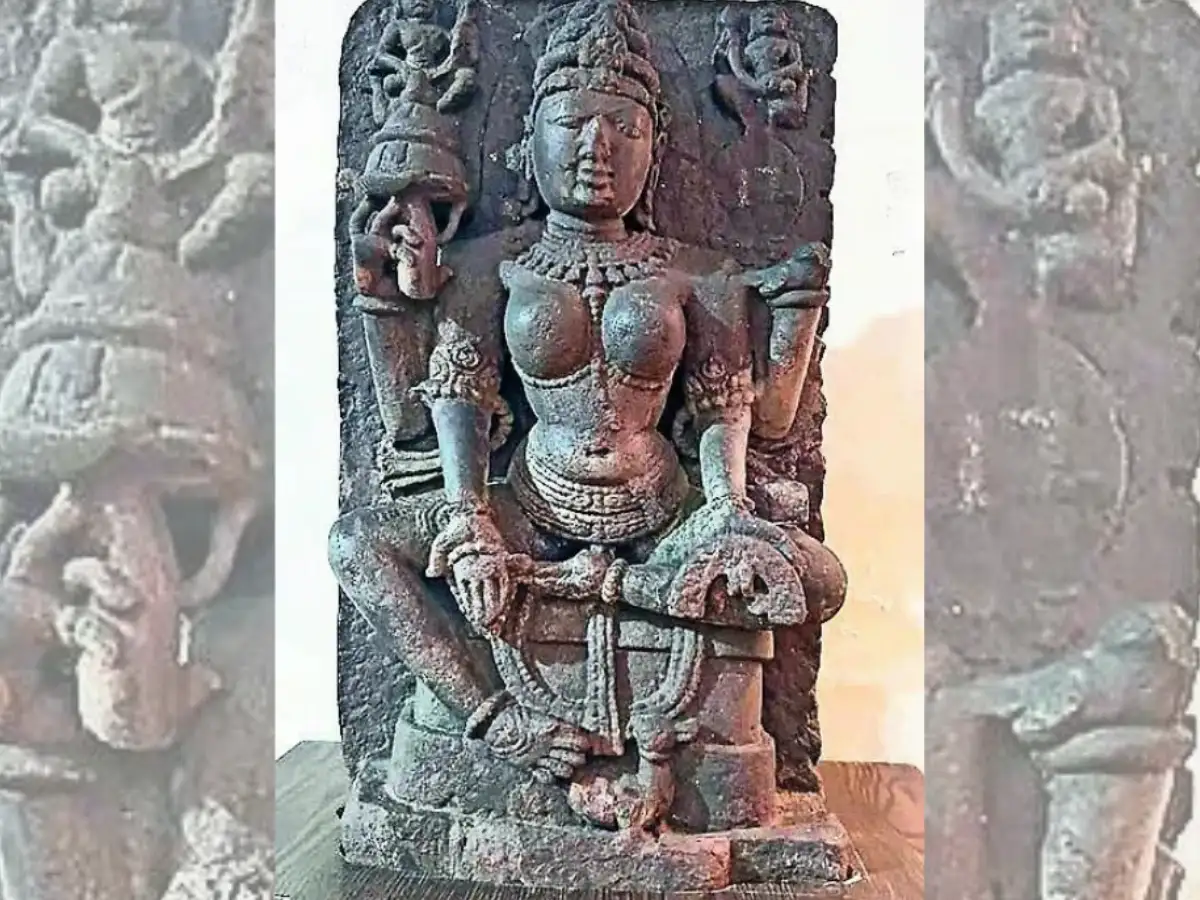
For more than 900 years, a celebrated stone sculpture carried the wrong identity. Long believed to depict Saraswati, the 12th-century idol has now been identified as goddess Gayatri after archaeologists used advanced digital documentation and 3D mapping to re-examine its iconography, according to Vinita Chaturvedi's Times of India report.
The red sandstone sculpture, housed at Bhopal's State Museum and originally unearthed in Dhar in southwestern Madhya Pradesh, has emerged as one of India's rarest known depictions of Gayatri, the personification of the Gayatri Mantra and Vedic wisdom.
The breakthrough came after fresh high-resolution 3D scans revealed iconographic details that had gone unnoticed for centuries. More than a revision of a museum catalogue, the finding restores a largely forgotten chapter of India's artistic and religious heritage.
"The image matches classical descriptions of Gayatri in the Silpasastras," said archaeologist Ramesh Yadav, associated with the directorate of archaeology, archives and museums to TOI.
Missing veena led to the breakthrough
According to Yadav, the sculpture's defining features point unmistakably to Gayatri rather than Saraswati.
“The four-armed goddess sits in lalitasana, holding a rosary, lotus and the Vedas. A finely carved hamsa (swan) beside her symbolises sacred wisdom, while celestial garland bearers affirm her divinity. Together, these attributes identify the deity as Gayatri rather than Saraswati.”
However, experts say it was the absence of one defining attribute that settled the debate.
“From the Gupta period (320–550 CE) onwards, Saraswati is almost invariably shown with a veena,” said historian and archaeologist BK Lokhande to TOI.
“This image has none. Instead, she holds the Vedas and a lotus exactly as described in Srimad Devi Bhagavata Purana and the Silpasastras. Images of Gayatri are exceptionally rare. While Gayatri, Savitri and Saraswati all embody knowledge, the iconography leaves little doubt that this is Gayatri.”
The sculpture was discovered in Dhar, the capital of the Parmar dynasty between the 9th and 14th centuries. Art historians say it reflects the graceful modelling and ornamentation of the Western Chalukyan style while closely adhering to classical textual descriptions of Gayatri. The Rigveda preserves the Gayatri Mantra, the Satapatha Brahmana venerates Gayatri as the source of sacred knowledge, while later Puranas describe her as Vedamata, Mantramata, Brahmavidya and Jaganmata.
The rediscovered sculpture is also set to play a key role in Madhya Pradesh's digital heritage initiative. Archaeology commissioner Madan Kumar Nagargoje said authenticated 3D models and digital platforms would enable researchers and the public to study one of India's rarest surviving images of goddess Gayatri.
(With TOI inputs)