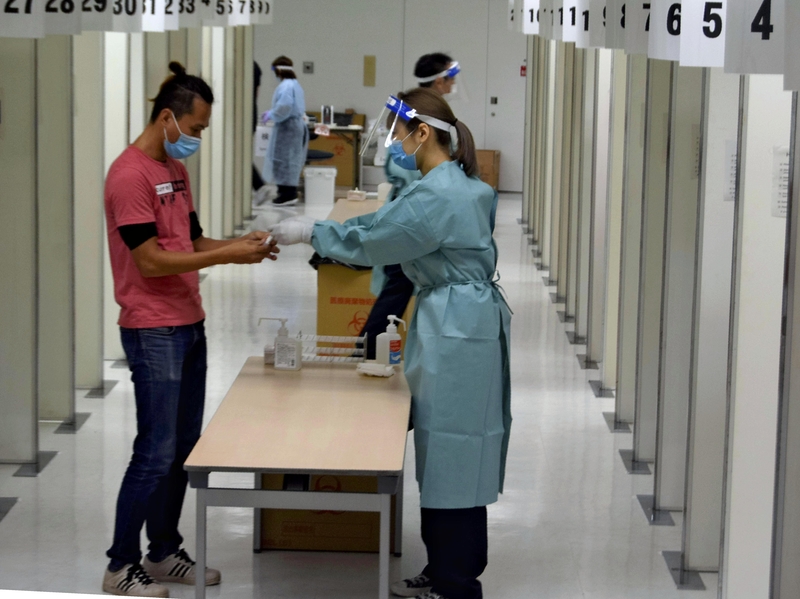
Friday marks six months since the World Health Organization declared the novel coronavirus a pandemic. So far, about 90% of infections found in airport quarantines in Japan were asymptomatic. As the coming and going of people steadily returns to normal, it will become more important for border control to effectively find those who are infected and prevent the virus from further spreading in the country.
-- European origin
According to the Health, Labor and Welfare Ministry, the first case of infection found in an airport quarantine was on March 4. By Thursday, 828 people were confirmed to have been infected at airports, of which 328 were Japanese nationals and 500 were foreigners. Of this total, at least 769, or 93%, were asymptomatic.
The government on Feb. 1 denied entry to most foreign nationals from Hubei Province in China, and required all those returning to the country, including Japanese nationals, to be tested for the virus. The government expanded the restrictions to cover 21 countries including those in Europe on March 27. Currently, the restrictions are imposed on a total of 159 countries and regions.
However, according to an analysis of the virus' genetic information conducted by the National Institute of Infectious Diseases, while the influx of the virus from Wuhan, China, was contained, the virus entered Japan from Europe and spread after mid-March. Although people from the Philippines account for the highest number of infected cases overall, people from European countries such as Italy, France and Germany accounted for the highest number of cases in March and April.
The government's expert panel in May pointed out that the outbreak in Japan was caused by an influx of returnees who had been infected in foreign countries including those in Europe when the nation had not fully implemented countermeasures. The NIID also believes the virus flowed into Japan from Europe and resulted in resurgence since June.
Many of the infected people found in airport quarantine were asymptomatic. Once entering the country, the virus has been quietly spreading unseen.
-- Antigen test
In order to contain the virus at the borders, strengthening testing systems at airports is essential.
At major airports such as Narita, Haneda and Kansai, antigen tests that use saliva have been introduced in stages since late July to replace the PCR test, which involves taking samples from the nose and throat and takes several hours before the results are known.
The risk of infection during specimen collection is reduced with saliva-based antigen testing, and results are available in about 30 minutes. While the number of tests conducted per day was 2,300 in July, it has now become possible to conduct a daily total of 4,300 tests.
Meanwhile, the government is considering easing its entry restrictions, particularly for businesspeople. With the Tokyo Olympics and Paralympics coming up next summer, a significant increase is anticipated in the number of people entering Japan. Therefore, the ministry is aiming to set up a system to conduct 10,000 tests a day by the end of this month. Outsourcing of the tests is also believed to be under consideration at Kansai Airport.
Tokyo Medical University Prof. Atsuo Hamada, an expert in travel medicine, said, "Health centers must also develop a system to follow up on those arriving in Japan."
Read more from The Japan News at https://japannews.yomiuri.co.jp/