Father’s Day is not only about celebrating human fathers but also about recognizing the remarkable parenting roles seen across the animal kingdom. From oceans to forests and skies, many animal dads show surprising dedication, sacrifice, and care when raising their young. These behaviors reveal that fatherhood in nature takes many forms, shaped by survival needs and evolutionary strategies. Some fathers protect, some feed, and others even carry their young in unusual ways, showing how powerful parental instinct can be across species.
How Animal Fathers Redefine Parenting Across Species
For Smithsonian experts, this comprehended view of fatherhood also includes animals ranging from furry to feathered, scaly to spiky. Karen McDonald, STEM program coordinator at the Smithsonian Environmental Research Center, alongside curators from the National Zoo and Conservation Biology Institute, helped compile examples of animal fathers with unique parenting approaches.
“There’s different strategies in the animal world,” McDonald states. “In some cases, it’s like ‘I’m going to have one young and I’m going to invest a lot, a lot, a lot of energy,’ versus ‘I’m going to have a whole bunch of young, not invest a ton and hope that one or two survive.’”
From protective fish to devoted bug dads, here are some of the most fascinating fathers in the animal world.
Giant Water Bug
Male giant water bugs transport eggs attached to their backs like a living load. “It’s kind of fun to think of an egg backpack,” McDonald cites. They regularly rise to the surface to oxygenate the eggs and perform underwater movements to keep water flowing around them, all while becoming more vulnerable to predators.
Red Fox
Male red foxes are primary providers during pup-rearing. “He really is feeding her and feeding them full time until they’re about four weeks old,” McDonald describes. They also teach hunting techniques by bringing live prey to the den.
Arapaima
Arapaima fathers safeguard their young by scooping them into their mouths and moving them away from danger. This behavior is significant as their offspring are really small and highly exposed to predators in early life. “Their young are quite susceptible to predation because of their small size,” states Rebecca Sturniolo, curator for Amazonia and American Trail at the National Zoo, in an email.
Common Loon
Male common loons play a leading role in choosing nesting locations, prioritizing safety and protection. Both parents remain involved in raising chicks until they mature and become independent. “They initiate and lead that selection, and I think a lot of it has to do with predators,” McDonald says.
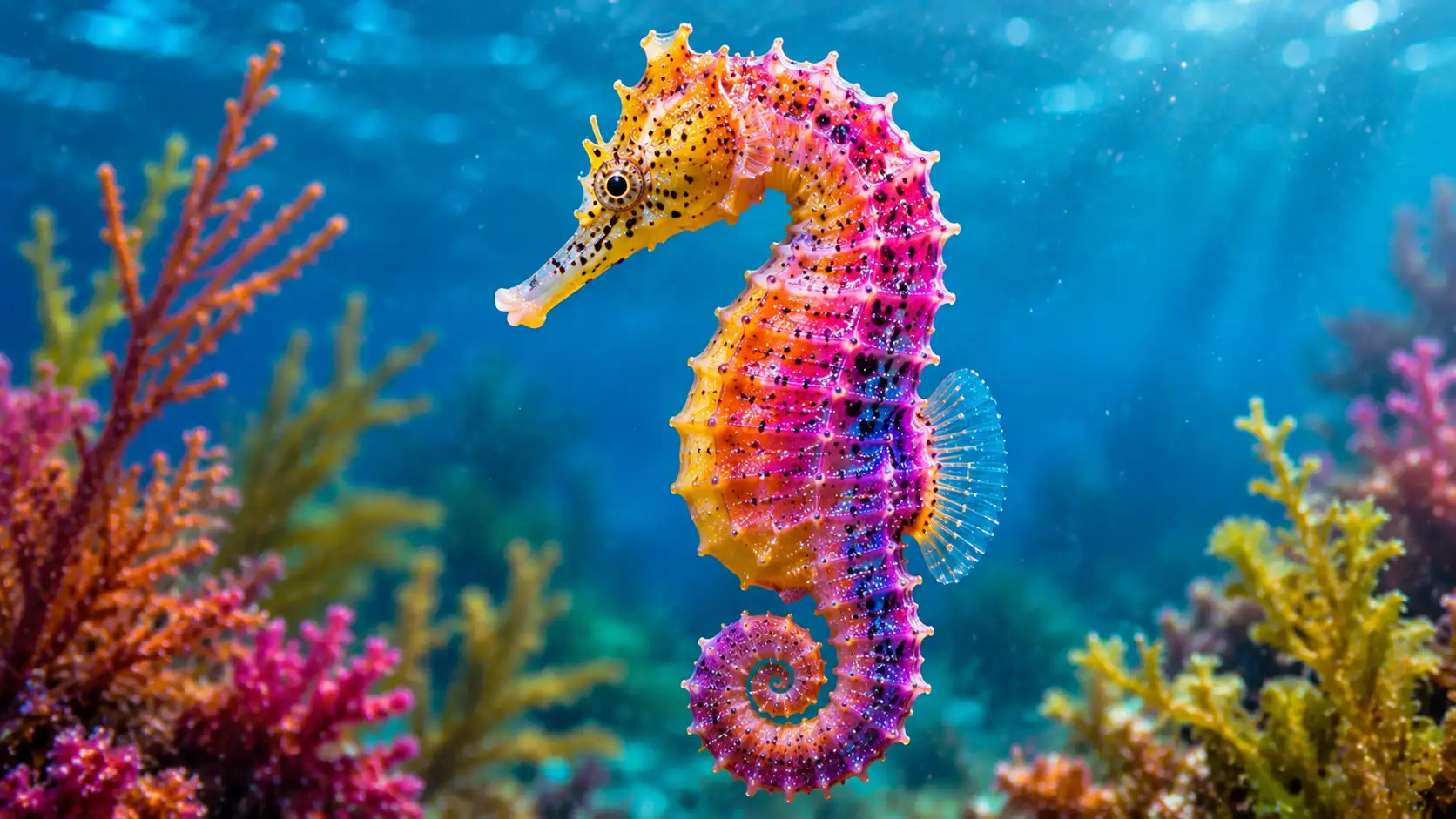
Seahorse
Male seahorses carry pregnancy in a rare reversal of parental roles. “The female transfers those unfertilized eggs into his pouch, and then he fertilizes them inside,” cites McDonald. “He literally becomes pregnant.” A single male can give birth to up to 2,000 young, though only a small number survive.
Osprey
Male ospreys are highly engaged in parenting. “They’re super involved dads,” McDonald states. They choose nest sites, help incubate eggs, feed their young, and later guide them during early flying practice.
Three-Spined Stickleback
Male sticklebacks construct nests, fertilize eggs, and guard them carefully. They fan eggs to provide oxygen, clean them, and even retrieve hatchlings that drift away. They “will court multiple females at a time, and once breeding occurs, the males build nests,” Sara Hallager, curator of birds at the National Zoo, cites in an email.
Golden Lion Tamarin
After initial nursing, baby tamarins cling to their fathers, who carry and protect them while teaching survival skills. Without the father’s care, the young are unlikely to survive. “Carrying them is a huge job, and they’re only not carrying them when mom is nursing them,” Kenton Kerns, curator of small mammals at the National Zoo, says in an email.
Greater Rhea
Greater rhea fathers take on complete accountability after mating. Males incubate eggs from multiple females and raise the chicks alone while aggressively defending them from dangers.
Source : Smithsonian Magazine (smithsonianmag.com)
FAQs:
Q1. Why do animal fathers matter in nature?
Animal fathers help improve survival rates by protecting, feeding, or teaching their young. Their care ensures stronger offspring and better chances of survival.
Q2. Do all animal species have involved fathers?
No, father involvement varies widely across species. Some are highly active, while others play little or no role.