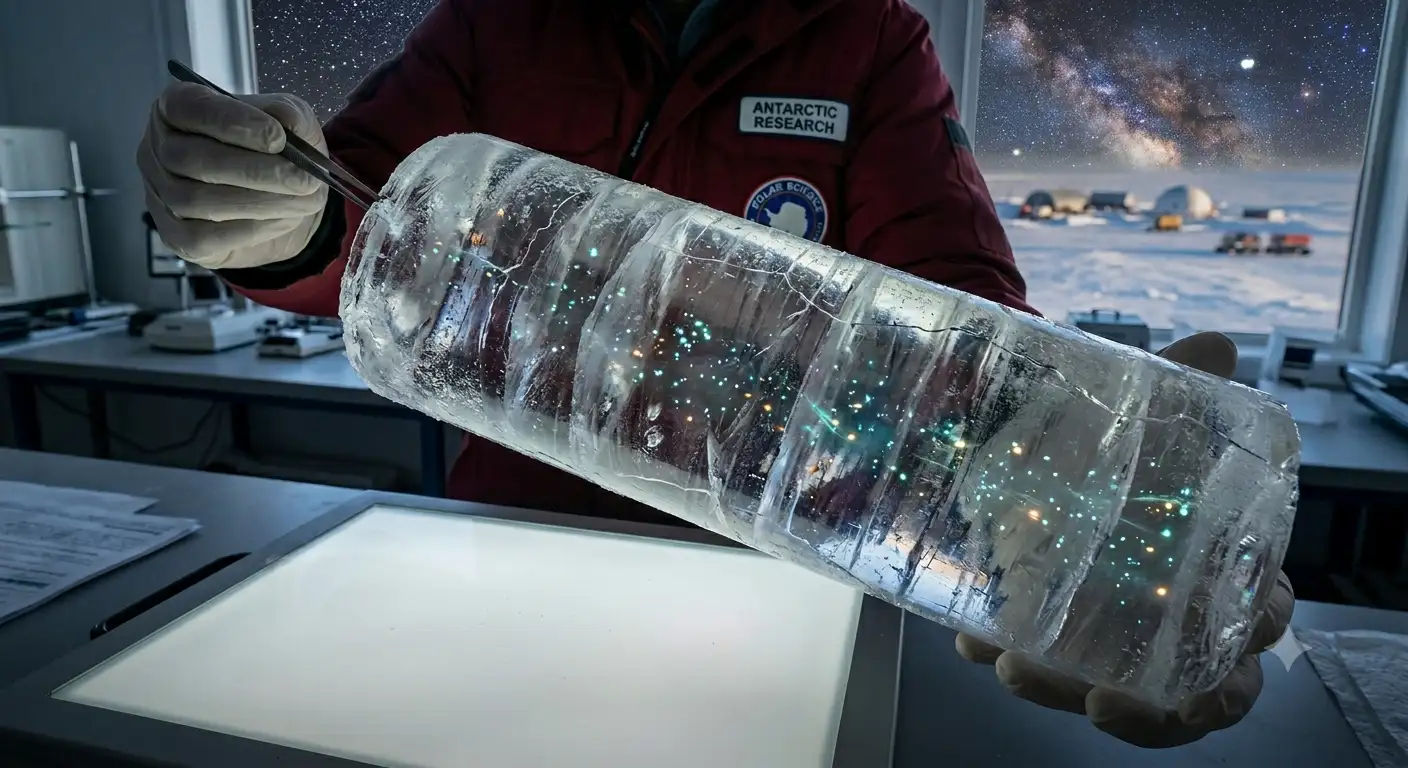
Earth is still being showered by radioactive debris from ancient exploding stars, according to a fascinating new study that uncovered traces of cosmic dust hidden inside Antarctic ice up to 80,000 years old.
ALSO READ: France vs Senegal Key Players FIFA World Cup 2026
Researchers detected iron-60, a rare radioactive isotope produced during supernova explosions, in ice samples collected from Antarctica. Because iron-60 decays over time and has a half-life of around 2.6 million years, scientists know it could not have survived since Earth formed 4.6 billion years ago. That means the material must have arrived from space relatively recently.
The discovery adds to growing evidence that our planet is currently moving through a cloud of debris left behind by ancient stellar explosions.
ALSO READ: Horrific B-52 bomber crash video
What did scientists find?
The research team analyzed ice layers dating between 40,000 and 80,000 years old and identified tiny traces of iron-60, an isotope that forms inside massive stars before being blasted into space when those stars explode.
Scientists have previously found iron-60 in deep-sea sediments, ocean crusts, lunar samples and even fresh Antarctic snow. The latest findings suggest that radioactive stardust from ancient supernovae is still reaching Earth today.
Researchers believe the material may be linked to the Local Interstellar Cloud, a vast region of gas and dust through which our solar system is currently traveling.
A clue from stars that died millions of years ago
The presence of iron-60 gives scientists a unique way to study ancient cosmic events.
Because the isotope can only be created in massive stars, it acts like a fingerprint of past supernova explosions. By tracking where it appears on Earth, researchers can learn more about the history of our galactic neighborhood and the environment surrounding the solar system.
Earlier studies found evidence of iron-60 deposits dating back millions of years, indicating that Earth has been exposed to debris from nearby stellar explosions before.
Scientists say the findings fit a larger pattern
The new discovery supports previous observations made by NASA's Advanced Composition Explorer (ACE), which detected iron-60 particles moving through space near Earth.
Physicist Martin Israel said the growing body of evidence points to the same conclusion.
"It all fits together very nicely." He added: "It's all consistent."
The study also found that iron-60 levels appear to vary over time rather than arriving at a steady rate.
According to researcher Koll: "This suggests that we were previously in a medium with lower iron-60 content, or that the cloud itself exhibits strong density variations."
Looking for a needle in 50,000 football stadiums
Detecting iron-60 is incredibly difficult because the particles are so rare. Researchers processed nearly 300 kilograms of Antarctic ice before isolating enough material for analysis. Specialized equipment was then used to identify just a handful of radioactive atoms among enormous quantities of ordinary matter.
Researcher Annabel Rolofs described the challenge with a striking comparison:
"It's like searching for a needle in 50,000 football stadiums filled to the roof with hay. The machine finds the needle in an hour."
Why the discovery matters
The radioactive dust poses no danger to Earth, but it offers a remarkable connection to events that occurred millions of years ago.
The findings suggest that tiny fragments of long-dead stars are still reaching our planet, providing scientists with a rare opportunity to study ancient supernova explosions and better understand the cosmic environment through which our solar system travels.
In short, some of the dust falling on Earth today may have begun its journey in the death of a star long before humans ever existed.